# Welcome to Book Bhagavata Online!
Dear Readers,
*We hope that the spiritual content here is relevant, inspiring and empowering to you. Our mission is to bring the ancient insights of the scriptures into the modern context - this is wisdom that breathes! As far as possible, we make this accessible to everyone, without restriction, and thus our web books are made freely available. If you feel inclined, we welcome any* [*voluntary donations*](https://keshavaswami.com/donate) *that help us keep this important work going. Thanks for considering!*
[**Click here to make a donation**](https://tally.so/r/nrA92p)
 *How do we navigate this world which sometimes feels so alien? How do we identify our purpose and satisfy our innermost yearning? How can we live joyful lives and discover the happiness and security we so much seek? How do we deal with the emotions, experiences and events of day-to-day life?* For that, Krishna lends a helping hand.
Srimad-Bhagavatam is known as **'Book Bhagavata'** - the Supreme Lord who has appeared in the form of a scripture. The saints recommend we form a deep bond with this sacred text and carry it as our constant companion. While everything else in life may change, this book, with the vision it lends us, remains a constant source of inspiration, strength and wisdom. It is enriched with spiritual insights to deal with every possible life situation we may encounter.
**By S.B. Keshava Swami**
**Based on** [**Srimad-Bhagavatam**](https://vedabase.io/en/library/sb/) **translated by His Divine Grace A.C. Bhaktivedanta Swami Prabhupada:** Founder-Acharya of the International Society for Krishna Consciousness (ISKCON)
## Using Book Bhagavata Online
*How do we navigate this world which sometimes feels so alien? How do we identify our purpose and satisfy our innermost yearning? How can we live joyful lives and discover the happiness and security we so much seek? How do we deal with the emotions, experiences and events of day-to-day life?* For that, Krishna lends a helping hand.
Srimad-Bhagavatam is known as **'Book Bhagavata'** - the Supreme Lord who has appeared in the form of a scripture. The saints recommend we form a deep bond with this sacred text and carry it as our constant companion. While everything else in life may change, this book, with the vision it lends us, remains a constant source of inspiration, strength and wisdom. It is enriched with spiritual insights to deal with every possible life situation we may encounter.
**By S.B. Keshava Swami**
**Based on** [**Srimad-Bhagavatam**](https://vedabase.io/en/library/sb/) **translated by His Divine Grace A.C. Bhaktivedanta Swami Prabhupada:** Founder-Acharya of the International Society for Krishna Consciousness (ISKCON)
## Using Book Bhagavata Online
Book Bhagavata Online © 2024 by S.B. Keshava Swami is licensed under Attribution-NonCommercial-NoDerivatives 4.0 International 


### You are free to:
1. **Share** — copy and redistribute the material in any medium or format
2. The licensor cannot revoke these freedoms as long as you follow the license terms.
### Under the following terms:
1. **Attribution** — You must give appropriate credit , provide a link to the license, and indicate if changes were made . You may do so in any reasonable manner, but not in any way that suggests the licensor endorses you or your use.
2. **NonCommercial** — You may not use the material for commercial purposes .
3. **NoDerivatives** — If you remix, transform, or build upon the material, you may not distribute the modified material.
4. **No additional restrictions** — You may not apply legal terms or technological measures that legally restrict others from doing anything the license permits.
For using **Book Bhagavata** for any purposes not covered by the license, such as commercial use, education/teaching, print distribution or creating derivative works, please get in touch with the publisher at ****.
## Buy the print edition of Book Bhagavata
* [**Amazon**](https://www.amazon.com/Book-Bhagavata-Srimad-Bhagavatam-Keshava-Swami/dp/1739468163/ref=sr_1_1?crid=190BRNULUK2V4\&dib=eyJ2IjoiMSJ9.nC6ddPuFhWQuYCt4vKCpI5O2Ucd3IeFMEPvdyQWn0gSfXkEF09IP26kHCx9y-c3cUX8GhLY4bGP7EJ8n9KRUhOX1DWxnVTrqOprqLtbajqxsGmSEUUTFZBc-dnD8B7YI1m1GfawUJRiF3bayKtKw1q_vp40sDs5FhNnVIFO8LuardN7AYZ3Jg_Np9j0uVj27ec2OOtvN60Kb7ckMfT2KBk8XazxUMJpuU62jODKlTfU.WDFL0y9XzQ9i4XNGyZ523oxNyHyAIy0siJj8vfGfQGE\&dib_tag=se\&keywords=book+bhagavata\&qid=1733679906\&sprefix=book+bhagavata%2Caps%2C211\&sr=8-1)
* **Other - contact **
## [**Visit Keshava Swami's website**](https://keshavaswami.com/)
# Copyright
Published by Wisdom That Breathes Foundation (UK Registered Charity Number 1206530)
Copyright © 2024 S.B. Keshava Swami \
S.B. Keshava Swami asserts the moral right to be identified as the author of this work.
All rights reserved. No part of this publication may be reproduced, stored in a retrieval system, or transmitted, in any form or by any means, electronic, mechanical, photocopying, recording or otherwise, without the prior written permission of the publisher.
Contact the publisher via
ISBN: 978-1-7394681-6-3
Images courtesy of The Bhaktivedanta Book Trust International, Inc.\
[www.Krishna.com](http://www.Krishna.com). Used with permission.
Efforts have been made to identify copyright holders where possible. If you believe you are the copyright holder of an image in this book and were not responsible for supplying it, please contact us.
The International Society for Krishna Consciousness Founder Acarya: His Divine Grace A.C. Bhaktivedanta Swami Prabhupada
[www.keshavaswami.com](http://www.keshavaswami.com) [www.wisdomthatbreathes.com](http://www.wisdomthatbreathes.com)
# Contents
[The Inspiration](/inspiration)
[Acknowledgements](/acknowledgements)
[Introduction](/introduction)
**01**** ** - [**S.L.A.P**](/canto-01/s.l.a.p) | SB starts with a **slap**, a wake-up call from God
**02** - [**C.U.T**](/canto-02/c.u.t) | SB can **cut** or attachment to the material world
**03** - [**S.A.V.E.S**](/canto-03/s.a.v.e.s) | SB **saves** the listener from repeated birth and death
**04** - [**S.K.I.P**](/canto-04/s.k.i.p) | SB helps you to **skip** over obstacles\
**05** - [**R.E.A.P**](/canto-05/r.e.a.p) | SB helps you **reap** the true benefit of human life
**06** - [**E.P.I.C**](/canto-06/e.p.i.c) | SB is an **epic** among all literature
**07** - [**O.P.E.N**](/canto-07/o.p.e.n) | SB can **open** the door to the spiritual world
**08** - [**G.O.L.D**](/canto-08/g.o.l.d) | SB is more valuable than **gold**
**09** - [**D.R.A.G**](/canto-09/d.r.a.g) | SB can **drag** even an unqualified person to perfection
**10** (Part 1) - [**B.A.B.Y**](/canto-10-part-1/b.a.b.y) | SB describes the pastimes of **baby** Krishna
**10** (Part 2) - [**M.A.D**](/canto-10-part-2/m.a.d) | SB will teach one to become **mad** after Krishna
**11** - [**S.U.M**](/canto-11/s.u.m) | SB contains the **sum** total of all scriptural knowledge
**12** - [**N.A.M.E**](/canto-12/n.a.m.e) | SB prescribes the holy **name** as the process for the age
[Bibliography](/appendix/bibliography)
[The Author](/appendix/the-author)
# The Inspiration
 A.C. Bhaktivedanta Swami Prabhupada was a saint like no other.
At the age of 69, homeless, penniless and alone, he arrived in the Lower East Side of New York in search of ‘better opportunities’ to share his message. This was Skid row; the lowest of the low. Here he lived, worshipped, studied and taught. Every evening, his decrepit residence, the rat-ridden 94 Bowery, would fill up with buzzing acidheads, bearded bohemians, ruined alcoholics and disillusioned dropouts. Sex, music, LSD, and consciousness expansion; that’s what made them tick. The Swami would nonchalantly step into the makeshift ‘temple’ and take his seat at the front, face-to-face with these confused souls who were looking for real love, real happiness and real spiritual experience. The Swami was unfazed; his face exuding bottomless depth and boundless compassion. In short, straight, simple philosophical discourses, he taught them eternal truths with resounding impact. When he sang in unsophisticated tunes with a bongo drum, their heads would spin, and their hearts were conquered. His tremendous devotion empowered his urgent message to penetrate the depths of their consciousness. He effortlessly smashed layers of illusion, powerfully exposing the fallacy of all materialistic ideology.
From these humble beginnings, Prabhupada went on to incorporate the International Society for Krishna Consciousness (ISKCON), and in a few short years made “Hare Krishna” a household name. No amount of social commentary, historical analysis or academic conjecture can account for his incredible achievements. Prabhupada’s life is tangible proof of a spiritual miracle.
We offer our deep gratitude to Srila Prabhupada. From morning to night, day after day, in every imaginable forum, he was teaching, writing, leading, managing, encouraging, problemsolving; using every last bit of energy to spark a spiritual revolution through the timeless wisdom of Srimad-Bhagavatam. His life is a constant challenge to delve deeper, think bigger and extend further.
# Acknowledgements
#### *“My path is very difficult. I am blind, and my feet are slipping again and again. Therefore, may the saints help me by granting me the stick of their mercy as my support.”* (Krishnadasa Kaviraja Goswami)
My spiritual master, Kadamba Kanana Swami, is the proofreader of my life. He is the sharp and saintly soul who expertly guides me at every step, revealing a vision of the future that extends way beyond my own limited conceptions. His absorption in Srimad-Bhagavatam ignited something within me, and because he told me to write, I’m trying my best.
There are some individuals who have more faith in you than yourself. For me, Srutidharma Das is one of those people; an endless fountain of encouragement and empowerment. He lives for others, and his undiminishing level of selflessness brings the teachings of these ancient scriptures to life. He has always lovingly pushed me, and for that I’ll always remain indebted.
I am a self-confessed plagiarist. I learnt so many things about Srimad- Bhagavatam from the dedicated devotees at Bhaktivedanta Manor. Further afield in the ISKCON world, we are nourished by the insights of individuals who have deeply studied and assimilated the Bhagavatam’s concepts. Many of these devotees and their works are referenced in the bibliography. Thank you to you all.
Thanks to those who reviewed the manuscript, adjusted graphics and refined the layout: Hari Vallabhi, Hardik, Gaurang, Gaurangi, Vrinda, Adi Ganga, Dimple, Manju, Hemel, Madhuri Sakhi, Veera, Reenal, Ekta, Pranesvari, Shreya, Rishiniy, Gita and Narayani. Your time and energy is deeply appreciated. Thanks to Urvi for the cover design and Saci Suta for the family tree. Thanks to Mukund who always pulls everything together. And how can I forget Yogi – my good friend, a technical whizz kid who magically transforms manuscripts into printed books.
After arriving in New York, Srila Prabhupada began publishing “Back to Godhead” magazine and insisted that every issue contain articles written by his young students. He was concerned that ancient truths be carried into the modern context in suitable language and with reference to the contemporary needs, interests and concerns of the people. His predecessor, Srila Bhaktivinoda Thakura, another prolific writer, explained how many people simply study books, collect information and then store those facts, like a magistrate imprisons a criminal in jail. He labelled it “*fruitless retention.*” Rather, he said, one should take such knowledge, sincerely apply it in one’s life, and then creatively share it according to personal ability, experience, and taste.
“Book Bhagavata” is a humble attempt to fulfil their wishes, and in some insignificant way encourage people to excavate the Srimad-Bhagavatam for their own transcendental gems. My attempt is simply to encourage the reader to approach the original source of knowledge: the profound narrations of the sages, translated and commented on by Srila Prabhupada. “Book Bhagavata” has also been produced in a spirit of self-improvement, with the sincere desire to deepen my connection with this priceless treasure-house of knowledge. It’s a grave responsibility to re-present the most profound teachings in the universe; a task which calls for genuine purity and freedom from worldly ambition. Please forgive any mistakes I have made, which are likely due to my limited knowledge and lack of spiritual depth.
S.B. Keshava Swami
# Family Tree
A.C. Bhaktivedanta Swami Prabhupada was a saint like no other.
At the age of 69, homeless, penniless and alone, he arrived in the Lower East Side of New York in search of ‘better opportunities’ to share his message. This was Skid row; the lowest of the low. Here he lived, worshipped, studied and taught. Every evening, his decrepit residence, the rat-ridden 94 Bowery, would fill up with buzzing acidheads, bearded bohemians, ruined alcoholics and disillusioned dropouts. Sex, music, LSD, and consciousness expansion; that’s what made them tick. The Swami would nonchalantly step into the makeshift ‘temple’ and take his seat at the front, face-to-face with these confused souls who were looking for real love, real happiness and real spiritual experience. The Swami was unfazed; his face exuding bottomless depth and boundless compassion. In short, straight, simple philosophical discourses, he taught them eternal truths with resounding impact. When he sang in unsophisticated tunes with a bongo drum, their heads would spin, and their hearts were conquered. His tremendous devotion empowered his urgent message to penetrate the depths of their consciousness. He effortlessly smashed layers of illusion, powerfully exposing the fallacy of all materialistic ideology.
From these humble beginnings, Prabhupada went on to incorporate the International Society for Krishna Consciousness (ISKCON), and in a few short years made “Hare Krishna” a household name. No amount of social commentary, historical analysis or academic conjecture can account for his incredible achievements. Prabhupada’s life is tangible proof of a spiritual miracle.
We offer our deep gratitude to Srila Prabhupada. From morning to night, day after day, in every imaginable forum, he was teaching, writing, leading, managing, encouraging, problemsolving; using every last bit of energy to spark a spiritual revolution through the timeless wisdom of Srimad-Bhagavatam. His life is a constant challenge to delve deeper, think bigger and extend further.
# Acknowledgements
#### *“My path is very difficult. I am blind, and my feet are slipping again and again. Therefore, may the saints help me by granting me the stick of their mercy as my support.”* (Krishnadasa Kaviraja Goswami)
My spiritual master, Kadamba Kanana Swami, is the proofreader of my life. He is the sharp and saintly soul who expertly guides me at every step, revealing a vision of the future that extends way beyond my own limited conceptions. His absorption in Srimad-Bhagavatam ignited something within me, and because he told me to write, I’m trying my best.
There are some individuals who have more faith in you than yourself. For me, Srutidharma Das is one of those people; an endless fountain of encouragement and empowerment. He lives for others, and his undiminishing level of selflessness brings the teachings of these ancient scriptures to life. He has always lovingly pushed me, and for that I’ll always remain indebted.
I am a self-confessed plagiarist. I learnt so many things about Srimad- Bhagavatam from the dedicated devotees at Bhaktivedanta Manor. Further afield in the ISKCON world, we are nourished by the insights of individuals who have deeply studied and assimilated the Bhagavatam’s concepts. Many of these devotees and their works are referenced in the bibliography. Thank you to you all.
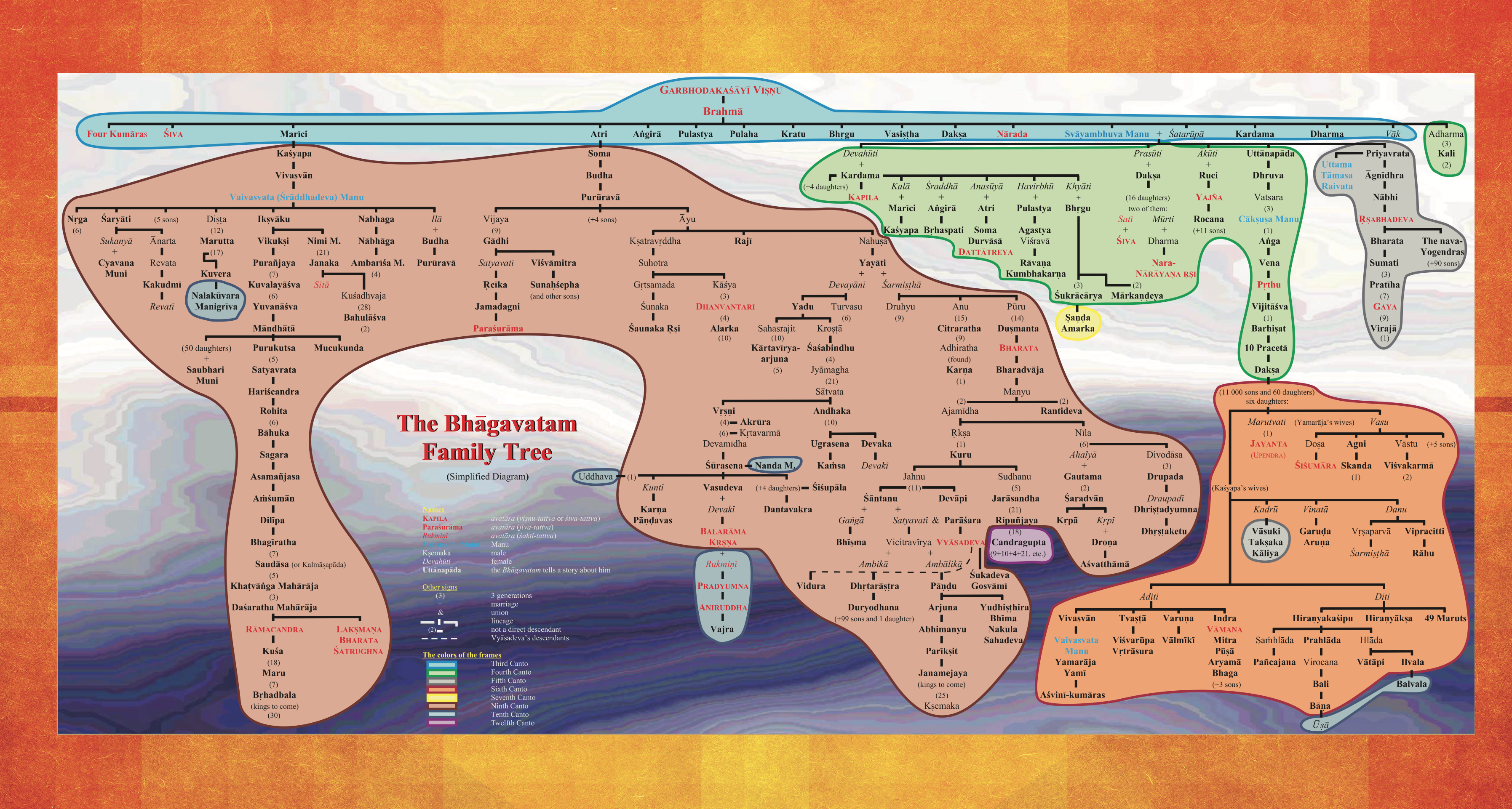
Thanks to those who reviewed the manuscript, adjusted graphics and refined the layout: Hari Vallabhi, Hardik, Gaurang, Gaurangi, Vrinda, Adi Ganga, Dimple, Manju, Hemel, Madhuri Sakhi, Veera, Reenal, Ekta, Pranesvari, Shreya, Rishiniy, Gita and Narayani. Your time and energy is deeply appreciated. Thanks to Urvi for the cover design and Saci Suta for the family tree. Thanks to Mukund who always pulls everything together. And how can I forget Yogi – my good friend, a technical whizz kid who magically transforms manuscripts into printed books.
After arriving in New York, Srila Prabhupada began publishing “Back to Godhead” magazine and insisted that every issue contain articles written by his young students. He was concerned that ancient truths be carried into the modern context in suitable language and with reference to the contemporary needs, interests and concerns of the people. His predecessor, Srila Bhaktivinoda Thakura, another prolific writer, explained how many people simply study books, collect information and then store those facts, like a magistrate imprisons a criminal in jail. He labelled it “*fruitless retention.*” Rather, he said, one should take such knowledge, sincerely apply it in one’s life, and then creatively share it according to personal ability, experience, and taste.
“Book Bhagavata” is a humble attempt to fulfil their wishes, and in some insignificant way encourage people to excavate the Srimad-Bhagavatam for their own transcendental gems. My attempt is simply to encourage the reader to approach the original source of knowledge: the profound narrations of the sages, translated and commented on by Srila Prabhupada. “Book Bhagavata” has also been produced in a spirit of self-improvement, with the sincere desire to deepen my connection with this priceless treasure-house of knowledge. It’s a grave responsibility to re-present the most profound teachings in the universe; a task which calls for genuine purity and freedom from worldly ambition. Please forgive any mistakes I have made, which are likely due to my limited knowledge and lack of spiritual depth.
S.B. Keshava Swami
# Family Tree
 # Introduction
> *“There are two types of Bhagavatas, namely the book Bhagavata and the devotee Bhagavata. Both the Bhagavatas are competent remedies, and both of them or either of them can be good enough to eliminate the obstacles. A devotee Bhagavata is as good as the book Bhagavata because the devotee Bhagavata leads his life in terms of the book Bhagavata and the book Bhagavata is full of information about the Personality of Godhead and His pure devotees, who are also Bhagavatas. Bhagavata book and person are identical.”* [*(Srimad Bhagavatam 1.1.18)*](https://vedabase.io/en/library/sb/1/1/18)
# Life's Constant Companion
Time ticks by, and everything in our life changes – the place where we live, the people who surround us, the responsibilities we shoulder and the condition of the body we possess. In the Bhagavad-gita, Krishna rubberstamps the material world as *asasvatam*, a place where everything invariably fades away. That transitory nature triggers feelings of discomfort and insecurity within us. Thus, Krishna further describes the material world as *dukhalayam*, a place of inevitable misery and suffering. Nobody is exempt. By nature, however, we are eternal, pleasure-seeking, spiritual beings. That quality is so inherent that it’s undeniable.
*How do we navigate this world, which sometimes seems so alien? How do we find our purpose and satisfy our innermost yearning? How can we live joyful lives and discover the happiness and security we so much seek? How do we deal with the emotions, experiences and events of day-to-day life?*
For that, Krishna lends a helping hand. Srimad-Bhagavatam is known as ‘Book Bhagavata’ – the Supreme Lord who has appeared in the form of a scripture. The saints recommend that we form a deep bond with this sacred text and carry it as our constant companion. While everything else in life may change, this book, and the vision it lends us, remains a constant source of inspiration, strength and wisdom. It is enriched with spiritual insights to deal with every possible life situation we may encounter. The celebrated saint, Sanatana Goswami, beautifully captures this relationship: *“O Srimad-Bhagavatam, O my only friend, O my companion, O my teacher, O my great wealth, O my deliverer, O my good fortune, O my bliss, I offer respectful obeisances unto you.”* (Krishna Lila-Stava)
The Srimad-Bhagavatam is indeed a life companion. As we browse through the pages, we’ll find a relevant story, an inspiring personality, a striking situation, a philosophical exchange or a powerful life lesson which illuminates our heart. Every word brings life back into perspective, reminding us of the greater journey we are on, and filling us with clarity, hope and inspiration. The words of the saints and sages give us the broadest vision of reality, and as we immerse ourselves in those teachings, we’re elevated to the most powerful vantage point in life.
But it doesn’t end there. The Srimad-Bhagavatam transports us to Krishna’s abode of unlimited possibility. It’s a spiritual world that most people may never have conceived of - a world in which God is not just revered as the controller, creator or judge, but is adored for His incredible charm, sweetness and delightful personality. In that world, God seeks His devotees as much as they seek Him, He loves them as much as they love Him, and He needs them as much as they need Him. That transcendent world is our true home, and Srimad-Bhagavatam is the guidebook that will take us there.
# Srimad-Bhagavatam Travels West
In September 1959, Srila Prabhupada entered the *sannyasa* (renounced) order of life. Renunciation for him, however, didn’t mean retirement. Having taken this step, Srila Prabhupada was free to pursue his missionary dreams on the order of his guru, Srila Bhaktisiddhanta Saraswati Thakura. That year, he took up residence in a tiny stone room in Radha Damodara temple, Vrindavana, where his saintly predecessors had resided centuries ago. He focused on writing, knowing that this would be his greatest gift to the world.
Srila Prabhupada began meticulously translating Srimad-Bhagavatam into English, verse-by-verse. It was a painstaking effort, but an incredibly blissful one too. On one particular day he encountered his spiritual master in a dream. Srila Prabhupada recalled: *“He encouraged me, saying I should write. I have received my guru’s mercy. He blessed me and gave me the power. I was too much anxious for the Bhagavatam commentary!”* Reassured and inspired, Srila Prabhupada continued writing, and then went on to produce, proofread and publish his type-written manuscript. It was a victory: one-thousand volumes of the Srimad-Bhagavatam, Canto One, Volume One, were printed.
Srila Prabhupada’s next venture was to take the Srimad-Bhagavatam further than it had ever gone before. To assist, Sumati Morarji, the wealthy director of Scindia Steamship Lines, reluctantly offered him free passage on a cargo ship bound for America. Apprehensive about his health, well-being and safety, she much preferred he stay in India and complete his translation of Srimad- Bhagavatam. She had already financed the printing of the initial volumes, and relished the saintly *sannyasi’s* lectures on the timeless words of the sages. Srila Prabhupada, however, had a bigger vision in mind. One day, early in 1965, he excitedly arrived at the Scindia offices and showed everyone the ‘hot-off-the-press’ third (and final) volume of Srimad-Bhagavatam, Canto One. *“Now I am ready to go!”* Srila Prabhupada announced, feeling the full conviction to embark on his mission to the western world.
Srila Prabhupada was utterly convinced of the relevance of Srimad-Bhagavatam. He knew these teachings were the timeless, perennial science of God consciousness. A well-intentioned person questioned him: *“Why present this work, which has a very small audience? Why not something else, easier and more popular?”* Srila Prabhupada had a different opinion. He called the Srimad- Bhagavatam *“India’s message of peace and goodwill,”* and carried five trunks of those transcendental volumes with him to America. These were the secret weapons in his adventure to activate a worldwide revolution of consciousness.
# The Greatest Gift
Srila Prabhupada considered his translation of the Srimad-Bhagavatam his magnum opus and greatest gift to the world. He didn’t simply translate the Sanskrit text, but expertly revealed truths beyond this world in a clear and easy-to-understand way. We don’t have the time to read as many books as our spiritual preceptors did. Even if we did, we probably wouldn’t have the patience to carefully study them with concentration. And even if we possessed such patience, due to lack of spiritual realisation and insight, we’d struggle to extract the essence of the teachings in an authentic and applicable way. Thankfully, Srila Prabhupada offered that service to the world, and brought the beautiful Srimad- Bhagavatam to the masses.
When, due to ill health, he returned to Vrindavana in May 1977, he confidently said, *“So there is nothing to be said new. Whatever I have to speak, I have spoken in my books. Now you try to understand it and continue your endeavour.”* A few months later he left the mortal world.
Srila Prabhupada considered the Srimad-Bhagavatam, along with the Bhagavad-gita and Chaitanya-Charitamrita, the substantial foundation of his International Society for Krishna Consciousness (ISKCON). He created ISKCON for the purpose of propagating Vaisnava theology (devotion to Lord Krishna), and he directed his disciples to publish and copiously distribute these scriptures in as many languages as possible. Srila Prabhupada’s multi-volume rendition of the Srimad- Bhagavatam was unfortunately left incomplete when he passed away in 1977; it was finished ten years later, by the collaborative effort of his disciples.
# Hidden Gems
In ancient times, sacred scriptures were few and far between, hand-copied, and in the possession of only the most fortunate. One saint’s manuscript of Srimad- Bhagavatam was blotted, smudged and rendered practically unreadable due to the tears of love which were shed during his reading. Today, such priceless books are readily available at our fingertips and we can read them anywhere and at any time on our smartphones, tablets, e-readers and laptops. Our shelves are lined with the published copies – big books, small books, deluxe collectors’ items and ‘all-in-one’ versions – a veritable library of wisdom! But how much quality time have we devoted to reading them? And when we do, are we in the right headspace to draw the unlimited inspiration that is available? With improved access we must simultaneously intensify our deep absorption and contemplation of the subject matter. After all, a few short sentences, properly digested, can change one’s entire life.
*“I am requesting all of my students to read my books very seriously every day without fail. In this way, if your mind becomes absorbed at least one or two hours daily in the transcendental subject matter of Srimad-Bhagavatam, Bhagavad-gita, and other books then very easily you will make your advancement in Krishna consciousness.”* [(Srila Prabhupada, Letter, June 13, 1972)](https://vedabase.io/en/library/letters/letter-to-bhargava/)
# Book Bhagavata
This small contribution does not fully describe each episode of the Srimad- Bhagavatam, since Srila Prabhupada’s translation does that perfectly. The key objectives are as follows:
* To present an easy-to-follow overview of the entire text
* To extract key philosophical concepts, historical facts and life lessons from the various episodes
* To provide a roadmap and framework for anyone who desires to explore the Srimad-Bhagavatam in greater detail.
The format for this summary study is as follows:
* Standard text - a summary of the verses
* Superscripted numbers - the chapters being summarised
* Boxed text – various lessons and reflections on the narration
* There are also specific references which are footnoted.
*Note: ‘Book Bhagavata’ is not a commentary on the Srimad-Bhagavatam. The primary objective is to provide a succinct overview of the text. For authentic and in-depth analysis one can refer to the following commentaries which were used by Srila Prabhupada himself:*
* Bala-prabodhini, by Goswami Sri Giridharalala
* Bhagavata-bhavartha-prakasika, by Sri Madhusudana Saraswati
* Bhagavata-candrika, by Viraraghava Acarya
* Bhavartha-dipika, by Sridhara Swami
* Bhavartha-dipika-prakasa, by Sri Vamsidhara
* Krama-sandarbha and Brhad Vaisnava Tosani, by Jiva Goswami
* Pada-ratnavali, by Vijayadhvaja Tirtha
* Sarartha Darsini, by Srimad Visvanatha Chakravarti
* Siddhanta-pradipa, by Srimad Sukadeva
* Subodhini, by Srimad Vallabhacarya
* Subodhini Prakasa, by Srimad Goswami Sri Purusottama carana
* Tattvasara, by Sri Radha Mohana Tarka Vacaspati Goswami Bhattacarya
# S.L.A.P
Lord Krishna, who is expert and unpredictable, crafts inconceivable plans which awaken us to the existence of a higher reality. Often, this is done through unexpected challenges and reversals; a divine ‘slap’ which acts as a wake-up call to kickstart our journey back to Him. In Maharaja Pariksit’s case, the Lord arranged for him to be cursed to die in seven days. The illustrious King wholeheartedly embraced the unexpected news, severed all material attachments, and received the wisdom of Srimad- Bhagavatam from Sukadeva Goswami. Canto One describes the purpose of Srimad-Bhagavatam – to depict, inspire and awaken pure, unmotivated love of God. Through the various narrations, we witness this pure love being exhibited by different devotees, who all ultimately attain the absolute perfection of life.
> *Prabhupada: When there is suffering given by Krishna... Therefore a devotee does not take seriously suffering. Tat te ‘nukampam susumiksamanah* [*\[SB 10.14.8\]*](https://vedabase.io/en/library/sb/10/14/8)*. A devotee thinks, “It is the favour of Krishna that He has put me into suffering.” They never see suffering as suffering. It is favour of Krishna. That is devotee’s vision. It is exactly like a son who knows his father well. If the father **slaps**, the son never protests. He knows that “It is good for me.” Similarly, a devotee never is disturbed when there is suffering given by Krishna.*
>
> *Giriraja: A karmi \[materialistic person] is suffering just the laws of...*
>
> *Prabhupada: The karmi is different. The karmi is suffering... He is suffering just like criminal is suffering. A criminal is given **slap** by the police. That **slap** and the father is giving **slap**, that **slap** is different. Although it looks the same thing, but there is great difference.*
>
> \~ [Morning Walk, 1st May 1974, Mumbai](https://prabhupadavani.org/transcriptions/740501mwbom/)
{% hint style="info" %}
[S - **Srimad-Bhagavatam (1-6)**](/canto-01/s.l.a.p/s-srimad-bhagavatam-1-6)
[L - **Love (7-11)**](/canto-01/s.l.a.p/l-love-7-11)
[A - **Attaining the Absolute (12-15)**](/canto-01/s.l.a.p/a-attaining-the-absolute-12-15)
[P - **Pariksit Punished (16-19)**](/canto-01/s.l.a.p/p-pariksit-punished-16-19)
{% endhint %}
# S - Srimad-Bhagavatam (1-6)
*The opening chapters of Srimad-Bhagavatam describe its uniqueness, background, primary contents and ultimate purpose. Before diving into this ocean of spiritual wisdom, we’re made aware of our great fortune in contacting this priceless scripture. Srimad-Bhagavatam invites us into Krishna’s world of unlimited possibility. It teaches us how to nourish the spirit, a transcendental endeavour which is founded upon the process of attentive hearing. By such aural reception, the heart is cleansed, our original consciousness is reawakened and we find what we have always been looking for.*
# Glorious Bhagavatam
Chapter 1
We want happiness, but first we must know who we are. To understand ourselves, we must identify our origin. When the sun rises, we automatically see ourselves – similarly, when we find God, we discover our true self. That’s why this book is so exceptional.
Srila Vyasadeva, the great sage and author of Srimad-Bhagavatam, first brings our attention to Lord Krishna. He is the source of everything, the director of the material cosmos and the superlative enjoyer in His own abode.
Through the teachings of Srimad-Bhagavatam, one can capture Krishna within the heart. The purity of this book is unparalleled since it sidelines all materialistic ideas, uproots all miseries and clearly distinguishes reality from illusion. Srila Vyasadeva, a literary giant, compiled it at the summit of his spiritual maturity, and it’s so comprehensive that nothing else is needed to achieve perfection. It is the mature fruit of the tree of Vedic knowledge, crystallising the essence of all wisdom. The author invites the reader to relish this masterpiece, which will surely trigger a revolution of consciousness within the individual, and indeed society at large.
# Essential Truths of Bhagavatam (Six Questions)
Chapter 1, 2, 3
At the sacred forest of Naimisaranya, located in present-day northern India, 88,000 sages had gathered. Headed by Saunaka Rishi, their noble purpose was to perform a one-thousand-year sacrifice for the spiritual well-being of mankind. Seeing the divine calibre and spotless character of Suta Goswami, the sages place six crucial enquiries before him. This exchange of questions and answers unveils essential spiritual truths for the benefit of countless generations to come \[1[^1]].
1. ***“What is the ultimate good for humanity?”*** When living beings free themselves from selfish material desires, engage in unmotivated and uninterrupted service to Krishna, and thus develop pure love for Him, they truly satisfy their innermost yearning.
2. ***“What is the essence of all scriptural knowledge?”*** The understanding that Krishna is the Supreme Personality of Godhead, and that we should reestablish our lost relationship with Him through devotional service (*bhakti*).
3. ***“Why did Krishna appear in this world?”*** To protect and uplift those of saintly disposition, and to attract all other living entities to re-enter the spiritual world.
4. ***“What were the activities of the Lord in relation to creation?”*** After generating the entire material substance, the Lord facilitated the creative process by expanding as the various Vishnu incarnations, thus providing a stage for living entities to live separately from God.
5. ***“What were the activities of each incarnation of the Lord?”*** The various forms of the Lord descend from the spiritual world to the material world for different purposes, and Krishna is the original source of them all (twenty-two such incarnations are described).
6. ***“When Krishna departs from the world, where will religious principles be found?”*** Though religiosity (*dharma*) and knowledge (*jnana*) depart with Krishna when He leaves the material world, those living in the subsequent age of darkness can illuminate their lives by reading Srimad-Bhagavatam.
Suta Goswami thus highlights the compelling power of hearing Srimad- Bhagavatam. One who receives it with open ears and an open heart, is gifted with a profound understanding of *Bhagavan* (the Supreme Lord) and the process of *bhakti* (devotional service to Him), and simultaneously experiences a purification of heart that raises one to the platform of pure devotion.
# Introduction
> *“There are two types of Bhagavatas, namely the book Bhagavata and the devotee Bhagavata. Both the Bhagavatas are competent remedies, and both of them or either of them can be good enough to eliminate the obstacles. A devotee Bhagavata is as good as the book Bhagavata because the devotee Bhagavata leads his life in terms of the book Bhagavata and the book Bhagavata is full of information about the Personality of Godhead and His pure devotees, who are also Bhagavatas. Bhagavata book and person are identical.”* [*(Srimad Bhagavatam 1.1.18)*](https://vedabase.io/en/library/sb/1/1/18)
# Life's Constant Companion
Time ticks by, and everything in our life changes – the place where we live, the people who surround us, the responsibilities we shoulder and the condition of the body we possess. In the Bhagavad-gita, Krishna rubberstamps the material world as *asasvatam*, a place where everything invariably fades away. That transitory nature triggers feelings of discomfort and insecurity within us. Thus, Krishna further describes the material world as *dukhalayam*, a place of inevitable misery and suffering. Nobody is exempt. By nature, however, we are eternal, pleasure-seeking, spiritual beings. That quality is so inherent that it’s undeniable.
*How do we navigate this world, which sometimes seems so alien? How do we find our purpose and satisfy our innermost yearning? How can we live joyful lives and discover the happiness and security we so much seek? How do we deal with the emotions, experiences and events of day-to-day life?*
For that, Krishna lends a helping hand. Srimad-Bhagavatam is known as ‘Book Bhagavata’ – the Supreme Lord who has appeared in the form of a scripture. The saints recommend that we form a deep bond with this sacred text and carry it as our constant companion. While everything else in life may change, this book, and the vision it lends us, remains a constant source of inspiration, strength and wisdom. It is enriched with spiritual insights to deal with every possible life situation we may encounter. The celebrated saint, Sanatana Goswami, beautifully captures this relationship: *“O Srimad-Bhagavatam, O my only friend, O my companion, O my teacher, O my great wealth, O my deliverer, O my good fortune, O my bliss, I offer respectful obeisances unto you.”* (Krishna Lila-Stava)
The Srimad-Bhagavatam is indeed a life companion. As we browse through the pages, we’ll find a relevant story, an inspiring personality, a striking situation, a philosophical exchange or a powerful life lesson which illuminates our heart. Every word brings life back into perspective, reminding us of the greater journey we are on, and filling us with clarity, hope and inspiration. The words of the saints and sages give us the broadest vision of reality, and as we immerse ourselves in those teachings, we’re elevated to the most powerful vantage point in life.
But it doesn’t end there. The Srimad-Bhagavatam transports us to Krishna’s abode of unlimited possibility. It’s a spiritual world that most people may never have conceived of - a world in which God is not just revered as the controller, creator or judge, but is adored for His incredible charm, sweetness and delightful personality. In that world, God seeks His devotees as much as they seek Him, He loves them as much as they love Him, and He needs them as much as they need Him. That transcendent world is our true home, and Srimad-Bhagavatam is the guidebook that will take us there.
# Srimad-Bhagavatam Travels West
In September 1959, Srila Prabhupada entered the *sannyasa* (renounced) order of life. Renunciation for him, however, didn’t mean retirement. Having taken this step, Srila Prabhupada was free to pursue his missionary dreams on the order of his guru, Srila Bhaktisiddhanta Saraswati Thakura. That year, he took up residence in a tiny stone room in Radha Damodara temple, Vrindavana, where his saintly predecessors had resided centuries ago. He focused on writing, knowing that this would be his greatest gift to the world.
Srila Prabhupada began meticulously translating Srimad-Bhagavatam into English, verse-by-verse. It was a painstaking effort, but an incredibly blissful one too. On one particular day he encountered his spiritual master in a dream. Srila Prabhupada recalled: *“He encouraged me, saying I should write. I have received my guru’s mercy. He blessed me and gave me the power. I was too much anxious for the Bhagavatam commentary!”* Reassured and inspired, Srila Prabhupada continued writing, and then went on to produce, proofread and publish his type-written manuscript. It was a victory: one-thousand volumes of the Srimad-Bhagavatam, Canto One, Volume One, were printed.
Srila Prabhupada’s next venture was to take the Srimad-Bhagavatam further than it had ever gone before. To assist, Sumati Morarji, the wealthy director of Scindia Steamship Lines, reluctantly offered him free passage on a cargo ship bound for America. Apprehensive about his health, well-being and safety, she much preferred he stay in India and complete his translation of Srimad- Bhagavatam. She had already financed the printing of the initial volumes, and relished the saintly *sannyasi’s* lectures on the timeless words of the sages. Srila Prabhupada, however, had a bigger vision in mind. One day, early in 1965, he excitedly arrived at the Scindia offices and showed everyone the ‘hot-off-the-press’ third (and final) volume of Srimad-Bhagavatam, Canto One. *“Now I am ready to go!”* Srila Prabhupada announced, feeling the full conviction to embark on his mission to the western world.
Srila Prabhupada was utterly convinced of the relevance of Srimad-Bhagavatam. He knew these teachings were the timeless, perennial science of God consciousness. A well-intentioned person questioned him: *“Why present this work, which has a very small audience? Why not something else, easier and more popular?”* Srila Prabhupada had a different opinion. He called the Srimad- Bhagavatam *“India’s message of peace and goodwill,”* and carried five trunks of those transcendental volumes with him to America. These were the secret weapons in his adventure to activate a worldwide revolution of consciousness.
# The Greatest Gift
Srila Prabhupada considered his translation of the Srimad-Bhagavatam his magnum opus and greatest gift to the world. He didn’t simply translate the Sanskrit text, but expertly revealed truths beyond this world in a clear and easy-to-understand way. We don’t have the time to read as many books as our spiritual preceptors did. Even if we did, we probably wouldn’t have the patience to carefully study them with concentration. And even if we possessed such patience, due to lack of spiritual realisation and insight, we’d struggle to extract the essence of the teachings in an authentic and applicable way. Thankfully, Srila Prabhupada offered that service to the world, and brought the beautiful Srimad- Bhagavatam to the masses.
When, due to ill health, he returned to Vrindavana in May 1977, he confidently said, *“So there is nothing to be said new. Whatever I have to speak, I have spoken in my books. Now you try to understand it and continue your endeavour.”* A few months later he left the mortal world.
Srila Prabhupada considered the Srimad-Bhagavatam, along with the Bhagavad-gita and Chaitanya-Charitamrita, the substantial foundation of his International Society for Krishna Consciousness (ISKCON). He created ISKCON for the purpose of propagating Vaisnava theology (devotion to Lord Krishna), and he directed his disciples to publish and copiously distribute these scriptures in as many languages as possible. Srila Prabhupada’s multi-volume rendition of the Srimad- Bhagavatam was unfortunately left incomplete when he passed away in 1977; it was finished ten years later, by the collaborative effort of his disciples.
# Hidden Gems
In ancient times, sacred scriptures were few and far between, hand-copied, and in the possession of only the most fortunate. One saint’s manuscript of Srimad- Bhagavatam was blotted, smudged and rendered practically unreadable due to the tears of love which were shed during his reading. Today, such priceless books are readily available at our fingertips and we can read them anywhere and at any time on our smartphones, tablets, e-readers and laptops. Our shelves are lined with the published copies – big books, small books, deluxe collectors’ items and ‘all-in-one’ versions – a veritable library of wisdom! But how much quality time have we devoted to reading them? And when we do, are we in the right headspace to draw the unlimited inspiration that is available? With improved access we must simultaneously intensify our deep absorption and contemplation of the subject matter. After all, a few short sentences, properly digested, can change one’s entire life.
*“I am requesting all of my students to read my books very seriously every day without fail. In this way, if your mind becomes absorbed at least one or two hours daily in the transcendental subject matter of Srimad-Bhagavatam, Bhagavad-gita, and other books then very easily you will make your advancement in Krishna consciousness.”* [(Srila Prabhupada, Letter, June 13, 1972)](https://vedabase.io/en/library/letters/letter-to-bhargava/)
# Book Bhagavata
This small contribution does not fully describe each episode of the Srimad- Bhagavatam, since Srila Prabhupada’s translation does that perfectly. The key objectives are as follows:
* To present an easy-to-follow overview of the entire text
* To extract key philosophical concepts, historical facts and life lessons from the various episodes
* To provide a roadmap and framework for anyone who desires to explore the Srimad-Bhagavatam in greater detail.
The format for this summary study is as follows:
* Standard text - a summary of the verses
* Superscripted numbers - the chapters being summarised
* Boxed text – various lessons and reflections on the narration
* There are also specific references which are footnoted.
*Note: ‘Book Bhagavata’ is not a commentary on the Srimad-Bhagavatam. The primary objective is to provide a succinct overview of the text. For authentic and in-depth analysis one can refer to the following commentaries which were used by Srila Prabhupada himself:*
* Bala-prabodhini, by Goswami Sri Giridharalala
* Bhagavata-bhavartha-prakasika, by Sri Madhusudana Saraswati
* Bhagavata-candrika, by Viraraghava Acarya
* Bhavartha-dipika, by Sridhara Swami
* Bhavartha-dipika-prakasa, by Sri Vamsidhara
* Krama-sandarbha and Brhad Vaisnava Tosani, by Jiva Goswami
* Pada-ratnavali, by Vijayadhvaja Tirtha
* Sarartha Darsini, by Srimad Visvanatha Chakravarti
* Siddhanta-pradipa, by Srimad Sukadeva
* Subodhini, by Srimad Vallabhacarya
* Subodhini Prakasa, by Srimad Goswami Sri Purusottama carana
* Tattvasara, by Sri Radha Mohana Tarka Vacaspati Goswami Bhattacarya
# S.L.A.P
Lord Krishna, who is expert and unpredictable, crafts inconceivable plans which awaken us to the existence of a higher reality. Often, this is done through unexpected challenges and reversals; a divine ‘slap’ which acts as a wake-up call to kickstart our journey back to Him. In Maharaja Pariksit’s case, the Lord arranged for him to be cursed to die in seven days. The illustrious King wholeheartedly embraced the unexpected news, severed all material attachments, and received the wisdom of Srimad- Bhagavatam from Sukadeva Goswami. Canto One describes the purpose of Srimad-Bhagavatam – to depict, inspire and awaken pure, unmotivated love of God. Through the various narrations, we witness this pure love being exhibited by different devotees, who all ultimately attain the absolute perfection of life.
> *Prabhupada: When there is suffering given by Krishna... Therefore a devotee does not take seriously suffering. Tat te ‘nukampam susumiksamanah* [*\[SB 10.14.8\]*](https://vedabase.io/en/library/sb/10/14/8)*. A devotee thinks, “It is the favour of Krishna that He has put me into suffering.” They never see suffering as suffering. It is favour of Krishna. That is devotee’s vision. It is exactly like a son who knows his father well. If the father **slaps**, the son never protests. He knows that “It is good for me.” Similarly, a devotee never is disturbed when there is suffering given by Krishna.*
>
> *Giriraja: A karmi \[materialistic person] is suffering just the laws of...*
>
> *Prabhupada: The karmi is different. The karmi is suffering... He is suffering just like criminal is suffering. A criminal is given **slap** by the police. That **slap** and the father is giving **slap**, that **slap** is different. Although it looks the same thing, but there is great difference.*
>
> \~ [Morning Walk, 1st May 1974, Mumbai](https://prabhupadavani.org/transcriptions/740501mwbom/)
{% hint style="info" %}
[S - **Srimad-Bhagavatam (1-6)**](/canto-01/s.l.a.p/s-srimad-bhagavatam-1-6)
[L - **Love (7-11)**](/canto-01/s.l.a.p/l-love-7-11)
[A - **Attaining the Absolute (12-15)**](/canto-01/s.l.a.p/a-attaining-the-absolute-12-15)
[P - **Pariksit Punished (16-19)**](/canto-01/s.l.a.p/p-pariksit-punished-16-19)
{% endhint %}
# S - Srimad-Bhagavatam (1-6)
*The opening chapters of Srimad-Bhagavatam describe its uniqueness, background, primary contents and ultimate purpose. Before diving into this ocean of spiritual wisdom, we’re made aware of our great fortune in contacting this priceless scripture. Srimad-Bhagavatam invites us into Krishna’s world of unlimited possibility. It teaches us how to nourish the spirit, a transcendental endeavour which is founded upon the process of attentive hearing. By such aural reception, the heart is cleansed, our original consciousness is reawakened and we find what we have always been looking for.*
# Glorious Bhagavatam
Chapter 1
We want happiness, but first we must know who we are. To understand ourselves, we must identify our origin. When the sun rises, we automatically see ourselves – similarly, when we find God, we discover our true self. That’s why this book is so exceptional.
Srila Vyasadeva, the great sage and author of Srimad-Bhagavatam, first brings our attention to Lord Krishna. He is the source of everything, the director of the material cosmos and the superlative enjoyer in His own abode.
Through the teachings of Srimad-Bhagavatam, one can capture Krishna within the heart. The purity of this book is unparalleled since it sidelines all materialistic ideas, uproots all miseries and clearly distinguishes reality from illusion. Srila Vyasadeva, a literary giant, compiled it at the summit of his spiritual maturity, and it’s so comprehensive that nothing else is needed to achieve perfection. It is the mature fruit of the tree of Vedic knowledge, crystallising the essence of all wisdom. The author invites the reader to relish this masterpiece, which will surely trigger a revolution of consciousness within the individual, and indeed society at large.
# Essential Truths of Bhagavatam (Six Questions)
Chapter 1, 2, 3
At the sacred forest of Naimisaranya, located in present-day northern India, 88,000 sages had gathered. Headed by Saunaka Rishi, their noble purpose was to perform a one-thousand-year sacrifice for the spiritual well-being of mankind. Seeing the divine calibre and spotless character of Suta Goswami, the sages place six crucial enquiries before him. This exchange of questions and answers unveils essential spiritual truths for the benefit of countless generations to come \[1[^1]].
1. ***“What is the ultimate good for humanity?”*** When living beings free themselves from selfish material desires, engage in unmotivated and uninterrupted service to Krishna, and thus develop pure love for Him, they truly satisfy their innermost yearning.
2. ***“What is the essence of all scriptural knowledge?”*** The understanding that Krishna is the Supreme Personality of Godhead, and that we should reestablish our lost relationship with Him through devotional service (*bhakti*).
3. ***“Why did Krishna appear in this world?”*** To protect and uplift those of saintly disposition, and to attract all other living entities to re-enter the spiritual world.
4. ***“What were the activities of the Lord in relation to creation?”*** After generating the entire material substance, the Lord facilitated the creative process by expanding as the various Vishnu incarnations, thus providing a stage for living entities to live separately from God.
5. ***“What were the activities of each incarnation of the Lord?”*** The various forms of the Lord descend from the spiritual world to the material world for different purposes, and Krishna is the original source of them all (twenty-two such incarnations are described).
6. ***“When Krishna departs from the world, where will religious principles be found?”*** Though religiosity (*dharma*) and knowledge (*jnana*) depart with Krishna when He leaves the material world, those living in the subsequent age of darkness can illuminate their lives by reading Srimad-Bhagavatam.
Suta Goswami thus highlights the compelling power of hearing Srimad- Bhagavatam. One who receives it with open ears and an open heart, is gifted with a profound understanding of *Bhagavan* (the Supreme Lord) and the process of *bhakti* (devotional service to Him), and simultaneously experiences a purification of heart that raises one to the platform of pure devotion.
 [^1]: Questions are in [Chapter 1](https://vedabase.io/en/library/sb/1/1/) and answers are in [Chapters 2](https://vedabase.io/en/library/sb/1/2/) and [3](https://vedabase.io/en/library/sb/1/3/). The conversation between Suta Goswami and Saunaka Rishi continues until the end of the Canto Twelve, and in between, many other conversations are recounted by them
# The Goal of Bhagavatam (Sri Krishna)
Chapter 3
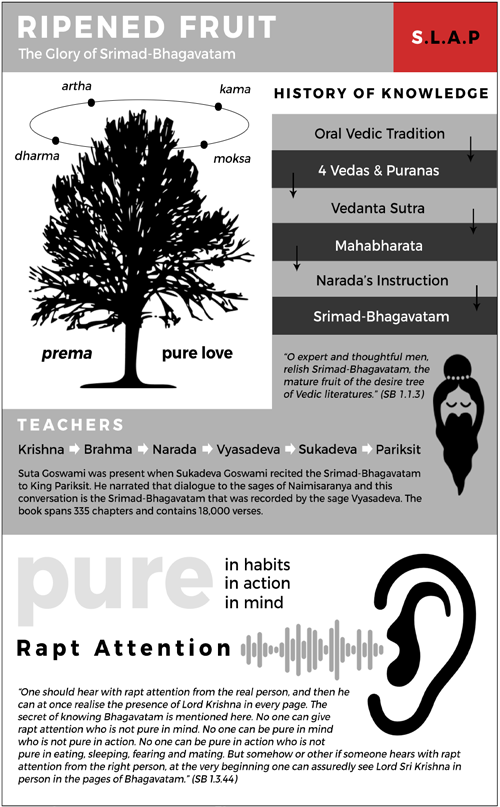
Srimad-Bhagavatam is the ripened fruit on the tree of all Vedic knowledge, and the twenty-eighth verse of Chapter Three is said to be the emperor of all its verses. After describing twenty-two of the Lord’s unlimited incarnations, Suta Goswami establishes, in no uncertain terms, that Krishna is the original source of them all: *“All of the above-mentioned incarnations are either plenary portions or portions of the plenary portions of the Lord, but Lord Sri Krishna is the original Personality of Godhead. All of them appear on planets whenever there is a disturbance created by the atheists. The Lord incarnates to protect the theists.”* ([SB 1.3.28](https://vedabase.io/en/library/sb/1/3/28/))
This verse, also known as the *paribhasa-sutra* (a verse which governs the entire book), reveals the purpose and essence of the entire Srimad-Bhagavatam – that Krishna is the Supreme Personality of Godhead, and the all-attractive goal of life.
# History of Bhagavatam (Four Questions)
Chapter 3, 4
Suta Goswami goes on to describe how he received the teachings of Srimad- Bhagavatam. Srila Vyasadeva had previously instructed Sukadeva Goswami, his son, in this spiritual science. Then, in a historic conversation, Sukadeva Goswami spoke it to Maharaja Pariksit, the saintly king who was cursed to die in seven days. Suta Goswami heard that recital and was now imparting the very same knowledge to the sages of Naimisaranya.
Having received enlightening answers to their first six questions, the sages posed a further four questions surrounding the history of Srimad-Bhagavatam. The answers to those four questions extend to the end of Canto One \[2][^1]:
1. Why, when and where was Srimad-Bhagavatam compiled?
2. How was Sukadeva Goswami viewed by others and how did his meeting with Maharaja Pariksit transpire?
3. How was Maharaja Pariksit born and what were his activities?
4. Why did Maharaja Pariksit renounce everything and travel to the bank of the Ganges?
[^1]: Question 1 is answered in [Chapters 4](https://vedabase.io/en/library/sb/1/4/)-[6 ](https://vedabase.io/en/library/sb/1/6/)/ Questions 2-4 are answered in [Chapters 7](https://vedabase.io/en/library/sb/1/7/)-[19](https://vedabase.io/en/library/sb/1/19/)
# Compilation of Bhagavatam
Chapter 4, 5, 6
Suta Goswami begins by addressing the first question regarding the compilation of Srimad-Bhagavatam.
Once, whilst Srila Vyasadeva was deep in meditation, he envisioned the bleak future of civilisation. Moved by compassion, he resolved to make the spiritual truths more accessible for the mass of people. He divided the original Veda into four, compiled the fifth Veda consisting of ancient histories, and entrusted each division of literature to various sages for preservation, development and further dissemination.
Despite producing so many volumes of books, Vyasadeva remained dissatisfied. When Narada Muni arrived at his hermitage in Badarikasrama, he immediately diagnosed the problem and instructed Vyasadeva to compile a literature which would beautifully highlight the identity and activities of Lord Krishna, the Supreme Personality of Godhead. Narada informed him that his previous works had obscured this most essential revelation; so much was discussed, but the essence was overlooked.
To highlight the power of hearing about Krishna, Narada Muni described how, through the association of great saints, he progressed in devotional service. The transformation took place by serving and hearing from spiritually evolved souls with the proper eagerness and humility. Being further questioned by Vyasadeva, Narada Muni explained his previous life as the son of a maidservant, how his mother died, his subsequent meeting with the Supersoul, and his current birth as a wandering sage. Narada clearly possessed the depth of realisation required to guide his disciple towards spiritual perfection.
Having received these jewel-like instructions, Vyasadeva went into a divine trance and perfectly grasped all the spiritual conclusions. He subsequently compiled the Srimad-Bhagavatam and taught it to his son, Sukadeva Goswami.
# Ripened fruit
> *“The Personality of Godhead Sri Krishna appeared before us just a little prior to the beginning of Kali-yuga, and He returned to His eternal home practically at the commencement of Kali-yuga. While He was present, He exhibited everything by His different activities. He spoke the Bhagavad-gita specifically and eradicated all pretentious principles of religiosity. And prior to His departure from this material world, He empowered Sri Vyasadeva through Narada to compile the messages of the Srimad-Bhagavatam, and thus both the Bhagavad-gita and the Srimad-Bhagavatam are like torchbearers for the blind people of this age. In other words, if men in this age of Kali want to see the real light of life, they must take to these two books only, and their aim of life will be fulfilled. Bhagavad-gita is the preliminary study of the Bhagavatam. And Srimad-Bhagavatam is the summum bonum of life, Lord Sri Krishna personified. We must therefore accept Srimad-Bhagavatam as the direct representation of Lord Krishna. One who can see Srimad-Bhagavatam can see also Lord Sri Krishna in person. They are identical.”* ([SB 1.3.43](https://vedabase.io/en/library/sb/1/3/43/)).
Vyasadeva appeared in this world with the sole mission of educating the masses in transcendental knowledge. Seeing that the Vedic mantras had become unclear and confusing, he divided the one Veda into four separate works, and also compiled the fifth Veda (historical stories) to give further insight and information. These divisions were given to various sages who, under Vyasadeva’s guidance, elaborated upon them and produced voluminous texts, still very difficult for the layman to understand and apply. The various viewpoints expressed were also difficult to reconcile. Thus, Vyasadeva decided to harmonise the diversity by shrinking the thousands of millions of Vedic verses into a single book of concise codes known as the Vedanta-Sutra.
After completing this work, he still felt it too ambiguous and complex for most people to understand, and thus attempted to communicate the same teachings in story-format through the epic history of India known as the Mahabharata. Despite these mammoth endeavours Vyasadeva remained dissatisfied, concerned that the essence had not yet come to the forefront.
Enter Narada Muni, who expertly diagnosed the root cause of the author’s disenchantment. Srila Vyasadeva’s writings had stressed the preliminary (and often materialistic) goals of religion – *dharma* (piety), *artha* (economic development), *kama* (sense gratification) and *moksa* (release from suffering). The travelling mendicant explained how Vyasadeva had inadvertently misled people, failing to glorify the Supreme Lord and highlight His name, fame, pastimes and glories. Having received this wise counsel, Vyasadeva went on to compose the Srimad-Bhagavatam, which magnified and zeroed in on the essence of the Vedas: *pure, untainted, loving devotion to Lord Krishna.* At last, Vyasadeva felt satisfied in his endeavour to provide the light of knowledge to the lost souls of Kali-yuga, the current cosmic age of degradation. Srimad- Bhagavatam, the spotless (*amala*) Purana, would indeed be the saving grace in the impending dark times, clearly establishing the goal of life and the true source of unlimited happiness in no uncertain terms.
Having compiled Srimad-Bhagavatam, Vyasadeva taught the contents to his son, Sukadeva Goswami. When he was born, Sukadeva Goswami immediately left home, fearful of potential material influences. Vyasadeva arranged to lure him back by having beautiful verses of the Srimad-Bhagavatam recited within his earshot. Sukadeva Goswami was indeed attracted to return, and subsequently heard the entire Srimad-Bhagavatam from his father. Later, Sukadeva Goswami met Maharaja Pariksit and narrated the entire Srimad-Bhagavatam to him in seven days. During that discourse, Vyasadeva and Suta Goswami were both present. Having grasped the entire narration, Suta Goswami later recited it to the sages of Naimisaranya, headed by Saunaka Rishi.
# The Narrations of Srimad-Bhagavatam
In bygone ages, all Vedic knowledge was passed down orally. People would hear the knowledge, remember it, assimilate it, and perfectly communicate it to the next person without any adulteration. The power of comprehension was so great that no written books were required. Foreseeing the degradation of Kali-yuga, however, Vyasadeva was eager to have the knowledge documented for posterity.
Technically speaking, each narration of Srimad-Bhagavatam is slightly different. For example, the Srimad-Bhagavatam spoken by Sukadeva Goswami to Maharaja Pariksit is obviously not identical to that which was spoken by Suta Goswami to Saunaka Rishi. That said, the substance, emphasis and conclusion remains eternally unchanged. What to speak of these slight variations, in the various planetary systems we find different versions of the Srimad-Bhagavatam for different gradations of living entity. The Srimad-Bhagavatam existing in heavenly planets, for example, is far more voluminous.
For the earthly humans, Vyasadeva chose to record the recital between Suta Goswami and Saunaka Rishi as the written form of Srimad-Bhagavatam. At the time of writing, numerous narrations of Srimad-Bhagavatam were being conducted amongst the sages. Once this dialogue was put into written form, however, it became the standard. Spontaneous recitals of Srimad-Bhagavatam gradually disappeared, and as people lost their recollective powers they took shelter of this documented form of the epic conversation.
[^1]: Questions are in [Chapter 1](https://vedabase.io/en/library/sb/1/1/) and answers are in [Chapters 2](https://vedabase.io/en/library/sb/1/2/) and [3](https://vedabase.io/en/library/sb/1/3/). The conversation between Suta Goswami and Saunaka Rishi continues until the end of the Canto Twelve, and in between, many other conversations are recounted by them
# The Goal of Bhagavatam (Sri Krishna)
Chapter 3
Srimad-Bhagavatam is the ripened fruit on the tree of all Vedic knowledge, and the twenty-eighth verse of Chapter Three is said to be the emperor of all its verses. After describing twenty-two of the Lord’s unlimited incarnations, Suta Goswami establishes, in no uncertain terms, that Krishna is the original source of them all: *“All of the above-mentioned incarnations are either plenary portions or portions of the plenary portions of the Lord, but Lord Sri Krishna is the original Personality of Godhead. All of them appear on planets whenever there is a disturbance created by the atheists. The Lord incarnates to protect the theists.”* ([SB 1.3.28](https://vedabase.io/en/library/sb/1/3/28/))
This verse, also known as the *paribhasa-sutra* (a verse which governs the entire book), reveals the purpose and essence of the entire Srimad-Bhagavatam – that Krishna is the Supreme Personality of Godhead, and the all-attractive goal of life.
# History of Bhagavatam (Four Questions)
Chapter 3, 4
Suta Goswami goes on to describe how he received the teachings of Srimad- Bhagavatam. Srila Vyasadeva had previously instructed Sukadeva Goswami, his son, in this spiritual science. Then, in a historic conversation, Sukadeva Goswami spoke it to Maharaja Pariksit, the saintly king who was cursed to die in seven days. Suta Goswami heard that recital and was now imparting the very same knowledge to the sages of Naimisaranya.
Having received enlightening answers to their first six questions, the sages posed a further four questions surrounding the history of Srimad-Bhagavatam. The answers to those four questions extend to the end of Canto One \[2][^1]:
1. Why, when and where was Srimad-Bhagavatam compiled?
2. How was Sukadeva Goswami viewed by others and how did his meeting with Maharaja Pariksit transpire?
3. How was Maharaja Pariksit born and what were his activities?
4. Why did Maharaja Pariksit renounce everything and travel to the bank of the Ganges?
[^1]: Question 1 is answered in [Chapters 4](https://vedabase.io/en/library/sb/1/4/)-[6 ](https://vedabase.io/en/library/sb/1/6/)/ Questions 2-4 are answered in [Chapters 7](https://vedabase.io/en/library/sb/1/7/)-[19](https://vedabase.io/en/library/sb/1/19/)
# Compilation of Bhagavatam
Chapter 4, 5, 6
Suta Goswami begins by addressing the first question regarding the compilation of Srimad-Bhagavatam.
Once, whilst Srila Vyasadeva was deep in meditation, he envisioned the bleak future of civilisation. Moved by compassion, he resolved to make the spiritual truths more accessible for the mass of people. He divided the original Veda into four, compiled the fifth Veda consisting of ancient histories, and entrusted each division of literature to various sages for preservation, development and further dissemination.
Despite producing so many volumes of books, Vyasadeva remained dissatisfied. When Narada Muni arrived at his hermitage in Badarikasrama, he immediately diagnosed the problem and instructed Vyasadeva to compile a literature which would beautifully highlight the identity and activities of Lord Krishna, the Supreme Personality of Godhead. Narada informed him that his previous works had obscured this most essential revelation; so much was discussed, but the essence was overlooked.
To highlight the power of hearing about Krishna, Narada Muni described how, through the association of great saints, he progressed in devotional service. The transformation took place by serving and hearing from spiritually evolved souls with the proper eagerness and humility. Being further questioned by Vyasadeva, Narada Muni explained his previous life as the son of a maidservant, how his mother died, his subsequent meeting with the Supersoul, and his current birth as a wandering sage. Narada clearly possessed the depth of realisation required to guide his disciple towards spiritual perfection.
Having received these jewel-like instructions, Vyasadeva went into a divine trance and perfectly grasped all the spiritual conclusions. He subsequently compiled the Srimad-Bhagavatam and taught it to his son, Sukadeva Goswami.
# Ripened fruit
> *“The Personality of Godhead Sri Krishna appeared before us just a little prior to the beginning of Kali-yuga, and He returned to His eternal home practically at the commencement of Kali-yuga. While He was present, He exhibited everything by His different activities. He spoke the Bhagavad-gita specifically and eradicated all pretentious principles of religiosity. And prior to His departure from this material world, He empowered Sri Vyasadeva through Narada to compile the messages of the Srimad-Bhagavatam, and thus both the Bhagavad-gita and the Srimad-Bhagavatam are like torchbearers for the blind people of this age. In other words, if men in this age of Kali want to see the real light of life, they must take to these two books only, and their aim of life will be fulfilled. Bhagavad-gita is the preliminary study of the Bhagavatam. And Srimad-Bhagavatam is the summum bonum of life, Lord Sri Krishna personified. We must therefore accept Srimad-Bhagavatam as the direct representation of Lord Krishna. One who can see Srimad-Bhagavatam can see also Lord Sri Krishna in person. They are identical.”* ([SB 1.3.43](https://vedabase.io/en/library/sb/1/3/43/)).
Vyasadeva appeared in this world with the sole mission of educating the masses in transcendental knowledge. Seeing that the Vedic mantras had become unclear and confusing, he divided the one Veda into four separate works, and also compiled the fifth Veda (historical stories) to give further insight and information. These divisions were given to various sages who, under Vyasadeva’s guidance, elaborated upon them and produced voluminous texts, still very difficult for the layman to understand and apply. The various viewpoints expressed were also difficult to reconcile. Thus, Vyasadeva decided to harmonise the diversity by shrinking the thousands of millions of Vedic verses into a single book of concise codes known as the Vedanta-Sutra.
After completing this work, he still felt it too ambiguous and complex for most people to understand, and thus attempted to communicate the same teachings in story-format through the epic history of India known as the Mahabharata. Despite these mammoth endeavours Vyasadeva remained dissatisfied, concerned that the essence had not yet come to the forefront.
Enter Narada Muni, who expertly diagnosed the root cause of the author’s disenchantment. Srila Vyasadeva’s writings had stressed the preliminary (and often materialistic) goals of religion – *dharma* (piety), *artha* (economic development), *kama* (sense gratification) and *moksa* (release from suffering). The travelling mendicant explained how Vyasadeva had inadvertently misled people, failing to glorify the Supreme Lord and highlight His name, fame, pastimes and glories. Having received this wise counsel, Vyasadeva went on to compose the Srimad-Bhagavatam, which magnified and zeroed in on the essence of the Vedas: *pure, untainted, loving devotion to Lord Krishna.* At last, Vyasadeva felt satisfied in his endeavour to provide the light of knowledge to the lost souls of Kali-yuga, the current cosmic age of degradation. Srimad- Bhagavatam, the spotless (*amala*) Purana, would indeed be the saving grace in the impending dark times, clearly establishing the goal of life and the true source of unlimited happiness in no uncertain terms.
Having compiled Srimad-Bhagavatam, Vyasadeva taught the contents to his son, Sukadeva Goswami. When he was born, Sukadeva Goswami immediately left home, fearful of potential material influences. Vyasadeva arranged to lure him back by having beautiful verses of the Srimad-Bhagavatam recited within his earshot. Sukadeva Goswami was indeed attracted to return, and subsequently heard the entire Srimad-Bhagavatam from his father. Later, Sukadeva Goswami met Maharaja Pariksit and narrated the entire Srimad-Bhagavatam to him in seven days. During that discourse, Vyasadeva and Suta Goswami were both present. Having grasped the entire narration, Suta Goswami later recited it to the sages of Naimisaranya, headed by Saunaka Rishi.
# The Narrations of Srimad-Bhagavatam
In bygone ages, all Vedic knowledge was passed down orally. People would hear the knowledge, remember it, assimilate it, and perfectly communicate it to the next person without any adulteration. The power of comprehension was so great that no written books were required. Foreseeing the degradation of Kali-yuga, however, Vyasadeva was eager to have the knowledge documented for posterity.
Technically speaking, each narration of Srimad-Bhagavatam is slightly different. For example, the Srimad-Bhagavatam spoken by Sukadeva Goswami to Maharaja Pariksit is obviously not identical to that which was spoken by Suta Goswami to Saunaka Rishi. That said, the substance, emphasis and conclusion remains eternally unchanged. What to speak of these slight variations, in the various planetary systems we find different versions of the Srimad-Bhagavatam for different gradations of living entity. The Srimad-Bhagavatam existing in heavenly planets, for example, is far more voluminous.
For the earthly humans, Vyasadeva chose to record the recital between Suta Goswami and Saunaka Rishi as the written form of Srimad-Bhagavatam. At the time of writing, numerous narrations of Srimad-Bhagavatam were being conducted amongst the sages. Once this dialogue was put into written form, however, it became the standard. Spontaneous recitals of Srimad-Bhagavatam gradually disappeared, and as people lost their recollective powers they took shelter of this documented form of the epic conversation.
 # L - Love (7-11)
*Srimad-Bhagavatam’s purpose is to assist the reader in reawakening pure love of Krishna, which is lying dormant within everyone’s heart. Suta Goswami described the remarkable devotees who preceded Maharaja Pariksit, and the spotless devotion they exuded. The examples of Uttara, the Pandavas, Kunti and Bhismadeva highlight the loving surrender that Krishna’s devotees embody, and the intimate reciprocation that He graciously extends. In their exchanges with Krishna, many beautiful prayers are recited (*stuti*), which attract the mercy of the Lord (*kripa*) and help the devotee reawaken pure love (*rati*).*
# The Love of Arjuna
Chapter 7
Having answered the first query, Suta Goswami turns his attention to the second question of the sages: *“How was Sukadeva Goswami viewed by others, and how did his meeting with Maharaja Pariksit transpire?”* Before directly addressing this, Suta Goswami narrated the events which transpired at the conclusion of the Kuruksetra battle, which is when Maharaja Pariksit was born.
When Asvatthama was being chased by Arjuna due to his heinous act of killing the sleeping sons of Draupadi, he released a deadly brahmastra weapon in a frenzy of panic. Arjuna was startled and confused, unsure of what his next move should be. Since surrendered devotees see the Lord as their only protector, Arjuna instinctively approached Krishna in his time of need and sought counsel. Though in the most intense of situations, Arjuna lovingly glorified Krishna and expressed his full dependence upon Him.
Taking Krishna’s advice, Arjuna counteracted Asvatthama’s weapon with his own *brahmastra* and thus captured the ruthless warrior. There were conflicting proposals as to what Asvatthama’s fate should be – some called for his death while others wanted to spare him. Arjuna ingeniously cut the jewel and hair from Asvatthama’s head. The warrior was utterly humiliated but still alive, and Arjuna successfully reconciled all the different opinions by simultaneously ‘killing’ him and sparing his life.
# The Love of Uttara
Chapter 8
Following this incident, Krishna performed the funeral rites for the countless soldiers who died in the battle of Kuruksetra. The Lord then prepared to leave for Dwaraka. Just then, Asvatthama directed another deadly *brahmastra* toward the pregnant Uttara (wife of Abhimanyu, Arjuna’s son) in a last-gasp attempt to terminate the final heir in the Pandava dynasty. Another shocking reversal!
Though personally detached from the impending danger, Uttara desperately begged Krishna to save the child in her womb. Just like Arjuna, she knew only Krishna as the Supreme controller and the Supreme friend. Always ready to serve His unalloyed devotees, Krishna, as *Paramatma* (Supersoul in the heart), covered and protected the embryo with His personal energy, and simultaneously foiled the *brahmastra* weapon.
# The Love of Kunti
Chapter 8
Having witnessed yet another exhibition of Krishna’s love, compassion and unrelenting protection, Queen Kunti offered a garland of celebrated prayers. She glorified the wonderful guardianship that Krishna offers His devotees, but simultaneously prayed for further calamities, which help the sincere devotee to remember Him. The exalted Queen expressed how true devotion is born in the hearts of those who are materially exhausted, praying that her affectionate family ties would not hinder her spiritual progress. She praised the Lord’s divine appearance, which creates a spiritual resurgence, but lamented the impending separation from Krishna.
That Queen Kunti never lost faith in Krishna, despite so many catastrophic reversals, indicates the incomparable degree of love and devotion that she exuded.
# L - Love (7-11)
*Srimad-Bhagavatam’s purpose is to assist the reader in reawakening pure love of Krishna, which is lying dormant within everyone’s heart. Suta Goswami described the remarkable devotees who preceded Maharaja Pariksit, and the spotless devotion they exuded. The examples of Uttara, the Pandavas, Kunti and Bhismadeva highlight the loving surrender that Krishna’s devotees embody, and the intimate reciprocation that He graciously extends. In their exchanges with Krishna, many beautiful prayers are recited (*stuti*), which attract the mercy of the Lord (*kripa*) and help the devotee reawaken pure love (*rati*).*
# The Love of Arjuna
Chapter 7
Having answered the first query, Suta Goswami turns his attention to the second question of the sages: *“How was Sukadeva Goswami viewed by others, and how did his meeting with Maharaja Pariksit transpire?”* Before directly addressing this, Suta Goswami narrated the events which transpired at the conclusion of the Kuruksetra battle, which is when Maharaja Pariksit was born.
When Asvatthama was being chased by Arjuna due to his heinous act of killing the sleeping sons of Draupadi, he released a deadly brahmastra weapon in a frenzy of panic. Arjuna was startled and confused, unsure of what his next move should be. Since surrendered devotees see the Lord as their only protector, Arjuna instinctively approached Krishna in his time of need and sought counsel. Though in the most intense of situations, Arjuna lovingly glorified Krishna and expressed his full dependence upon Him.
Taking Krishna’s advice, Arjuna counteracted Asvatthama’s weapon with his own *brahmastra* and thus captured the ruthless warrior. There were conflicting proposals as to what Asvatthama’s fate should be – some called for his death while others wanted to spare him. Arjuna ingeniously cut the jewel and hair from Asvatthama’s head. The warrior was utterly humiliated but still alive, and Arjuna successfully reconciled all the different opinions by simultaneously ‘killing’ him and sparing his life.
# The Love of Uttara
Chapter 8
Following this incident, Krishna performed the funeral rites for the countless soldiers who died in the battle of Kuruksetra. The Lord then prepared to leave for Dwaraka. Just then, Asvatthama directed another deadly *brahmastra* toward the pregnant Uttara (wife of Abhimanyu, Arjuna’s son) in a last-gasp attempt to terminate the final heir in the Pandava dynasty. Another shocking reversal!
Though personally detached from the impending danger, Uttara desperately begged Krishna to save the child in her womb. Just like Arjuna, she knew only Krishna as the Supreme controller and the Supreme friend. Always ready to serve His unalloyed devotees, Krishna, as *Paramatma* (Supersoul in the heart), covered and protected the embryo with His personal energy, and simultaneously foiled the *brahmastra* weapon.
# The Love of Kunti
Chapter 8
Having witnessed yet another exhibition of Krishna’s love, compassion and unrelenting protection, Queen Kunti offered a garland of celebrated prayers. She glorified the wonderful guardianship that Krishna offers His devotees, but simultaneously prayed for further calamities, which help the sincere devotee to remember Him. The exalted Queen expressed how true devotion is born in the hearts of those who are materially exhausted, praying that her affectionate family ties would not hinder her spiritual progress. She praised the Lord’s divine appearance, which creates a spiritual resurgence, but lamented the impending separation from Krishna.
That Queen Kunti never lost faith in Krishna, despite so many catastrophic reversals, indicates the incomparable degree of love and devotion that she exuded.
 # The Love of Bhismadeva
Chapter 9
Overwhelmed and traumatised by the massacre that had occurred at Kuruksetra, Maharaja Yuddhistira went to visit Bhismadeva, accompanied by Krishna and the Pandavas. Lying on the bed of arrows, Bhismadeva praised the Pandavas for patiently tolerating so many devious intrigues and grievous injustices. Despite their piety, knowledge, strength, righteousness, and having Krishna as their constant companion, the Pandavas were not exempt from difficulties. The divine plans of the Lord, Bhismadeva said, are practically impossible to decode.
With deep gratitude and appreciation, Bhismadeva beautifully glorified Krishna and expressed his incomparable fortune at having the Supreme Lord present during his final hours. The legendary grandsire imparted his concluding words of wisdom to Maharaja Yuddhistira, offering a variety of profound insights on the duties of human beings (*dharma*) in various contexts of life. Immersing his consciousness in Krishna, he offered his deep appreciation to the Lord and prayed for the ability to remember Him at death. Bhismadeva thus departed this mortal world in perfect consciousness. His spiritual purity transported him to the Lord’s abode.
With the historic departure of Bhismadeva, Maharaja Yuddhistira was duly enthroned as the next leader.
# The Love of Hastinapura’s Residents (Separation)
Chapter 10
Having remained in Hastinapura for a few months, Krishna decided it was time to leave. As He departed, the ladies began crying profusely, while other residents of Hastinapura nearly fainted from the feelings of impending separation. Their hearts were melting in the pot of attraction for Krishna. Such are the intense emotions of Krishna’s pure devotees. Maharaja Yuddhistira provided Krishna with martial protection and the Pandavas followed along as far as they could to see Him off.
It was an agonising departure. In separation, lovers feel one moment to be like millions of years. This unique type of emotion, known as *vipralambha-bhava*, paradoxically generates the most intense connection with Krishna.
# The Love of Dwaraka’s Residents (Union)
Chapter 11
The separation in Hastinapura was contrasted with a jubilant meeting in Dwaraka. In that city of immeasurable opulence, all the inhabitants excitedly welcomed Krishna and offered Him an abundance of gifts in great love. Krishna was reunited with His parents, Vasudeva and Devaki, and bowed down to them with great affection. When Krishna entered the palaces of His 16,108 queens, they were completely overwhelmed at the sight of their Lord and husband, and a variety of loving sentiments arose within them. They embraced Krishna in their hearts, with their eyes, and through their sons. Even prostitutes and outcastes lovingly greeted Krishna, who, being equally affectionate to all, unhesitatingly reciprocated with each and everyone’s devotion.
# Pure Love
> *“The ultimate result of devotional service is to develop genuine love for the Supreme Personality. Love is a word which is often used in relation with man and woman. And love is the only word that can be properly used to indicate the relation between Lord Krishna and the living entities. The living entities are mentioned as* prakrti *in the Bhagavad-gita, and in Sanskrit* prakrti *is a feminine object. The Lord is always described as the* parama-purusa*, or the supreme male personality. Thus the affection between the Lord and the living entities is something like that between the male and the female. Therefore the term love of Godhead is quite appropriate.”* [(SB 1.7.7)](https://vedabase.io/en/library/sb/1/7/7/)
Industries thrive on it, popstars sing about it, teenagers dream about it, and people are willing to do practically anything for it. To love and be loved - the everlasting, universal dream. Though we wholeheartedly endeavour for that perfect connection in our material sojourn, for the most part it’s a letdown, and the story of life is more a case of frustrated love. Srimad-Bhagavatam introduces us to a world of pure and selfless loving relationships. Because the accounts of loving exchange are so rich, Srimad-Bhagavatam is described as *rasamalayam*, ‘the abode of loving relish.’ The narrations described in this section give us an insight into these divine exchanges. In Gopala Champu, Jiva Goswami states that hearing of the love exchanged between Krishna and His devotees helps awaken a similar love within the heart of the sincere hearer.
When the innate desire for loving connection is reposed in Krishna, everything makes perfect sense, we reconnect with our true purpose and life becomes full of joy and happiness. Some think of God as a strict and unforgiving judge; the old man who sits on a grand throne and hurls down thunderbolts every time someone deviates. Others consider Him a crutch for the weak; an imaginary being who brings peace, hope and comfort, but has little to do with objective reality. Some think of God as a mythological tool of the power-hungry elite, used to keep the masses in line and maintain the status quo. For many, God is simply the cosmic order supplier; a convenient port of call in times of need and want.
The Vedic writings paint a radically different picture. Their extraordinary revelation is not simply that God exists, but that He is bursting with colour, character and bliss. According to the Taittiriya Upanisad (2.7.1), God is ‘*raso vai sah*’ – the perfect embodiment of affectionate relationships, loving relish and transcendental sweetness.
# Rasa Theology
Rupa Goswami, the leading disciple of Sri Chaitanya Mahaprabhu, dissected the vast theology of *rasa* (loving relish) and systematically presented it in his masterpiece known as the Bhakti-rasamrita Sindhu, literally translated as the ‘Nectarean ocean of devotional sentiments.’ Drawing from the Sanskrit dramaturgy of Bharata Muni, Rupa Goswami analyses the subtle loving feelings that souls experience in a variety of relationships with Krishna. Just as a full meal contains salty, spicy, pungent and sweet preparations, all combining to give a complete experience, so the various tastes of *rasa* create a unique spiritual experience. Rupa Goswami poetically compares the devotees of the Lord to sharks (*makara*) who swim deep in this ocean of love, oblivious to the small rivers of spiritual side benefits (like liberation from suffering). Whilst swimming in the oceanic relationship with Krishna, they find the most valuable of jewels in the depths of the seabed.
The love experienced between the living entity and God can take many forms, each with unique intensities. To enter such exchanges, one must first become entirely averse to the allure of material pleasures, which block one’s ability to enter the arena of pure spiritual love. In the early stages of spirituality, one may gravitate towards an impersonal conception of the Supreme. God is seen as an energy, consciousness or all-pervading influence. True love, however, is experienced between persons, where there is opportunity for interaction, exchange and an active reciprocation. Though the Lord is the complete whole, both personal and impersonal, His Supreme personal feature invites a more intimate relationship where deeper emotions can be experienced.
The Personality of Godhead manifests Himself in a variety of forms. Vishnu is God at work – the personality who creates and maintains the entire cosmos. Krishna, on the other hand, is God at home – the personality who is more concerned with intimate relationships and loving interactions. Thus, according to *rasa* theology, a more intimate connection can be established with Krishna. Amongst devotees of Krishna, there are also variations. Some focus on His majestic qualities and awe-inspiring opulence and power (*aisvarya*). Their understanding gives rise to a mood of respect and reverence, which invariably creates a distance too. Those who focus on Krishna’s sweetness (*madhurya*), captured by His irresistible beauty and charm, transcend such barriers and enter into closer exchanges.
Of such confidential devotees, there are those who are in union with Krishna and experience the ecstasy of meeting Him face-to-face (*sambhoga*). Other devotees, however, are subjected to separation from Krishna (*vipralambha*). Their desperation and anticipation to meet Him creates a heightened emotional churning and unrelenting yearning. The gopis of Vrindavana are the prime example of this. Their feelings of transcendental separation are considered the epitome of divine love for God \[3[^1]].
[^1]: This analysis was inspired by Chaitanya Charan Das, [www.thespiritualscientist.com](https://bhagavata.keshavaswami.com/canto-01/s.l.a.p/l-love-7-11/pure-love/www.thespiritualscientist.com)
# Our Relationship with Krishna
The narrations of Srimad-Bhagavatam are an inspiration to revive our own connection with Krishna, who is ever-awaiting the opportunity to engage in relationships of pure love with His devotees. Though Krishna receives the love of unlimited associates, He still considers our love for him so invaluable and indispensable that He yearns for the living entity to reconnect with Him, and personally descends to the world to make all arrangements to that end. Srila Prabhupada explains:
> *“In the spiritual world there are five kinds of relationships with the Supreme Lord - s*anta, dasya, sakhya, vatsalya *and* madhurya*. The perverted reflections of these rasas are found in the material world. Land, home, furniture and other inert material objects are related in* santa*, or the neutral and silent sense, whereas servants work in the* dasya *relationship. The reciprocation between friends is called* sakhya*, the affection of a parent for a child is known as* vatsalya*, and the affairs of conjugal love constitute* madhurya*. These five relationships in the material world are distorted reflections of the original, pure sentiments, which should be understood and perfected in relationship with the Supreme Personality of Godhead under the guidance of a bona fide spiritual master. In the material world the perverted rasas bring frustration. If these rasas are re- established with Lord Krishna, the result is eternal, blissful life.” (*[*CC Adi 1.56*](https://vedabase.io/en/library/cc/adi/1/56/)*)*
By diligently chanting the holy names of Krishna, as outlined by Sri Chaitanya Mahaprabhu, anyone can purify their heart and reawaken their original spiritual form (*svarupa*) and relationship with the Lord. We hold back in the relationships of this world because we are uncertain of how others will reciprocate with our love. Furthermore, we are reticent about investing too much in an individual, since it may damage other relationships. When we direct our love towards Krishna, however, we can rest assured that He’ll generously and unfailingly reciprocate with every single endeavour we make. In addition, by nurturing our love for Krishna we automatically develop our love for everyone else, since all living entities are eternally and intimately connected with Him.
# The Love of Bhismadeva
Chapter 9
Overwhelmed and traumatised by the massacre that had occurred at Kuruksetra, Maharaja Yuddhistira went to visit Bhismadeva, accompanied by Krishna and the Pandavas. Lying on the bed of arrows, Bhismadeva praised the Pandavas for patiently tolerating so many devious intrigues and grievous injustices. Despite their piety, knowledge, strength, righteousness, and having Krishna as their constant companion, the Pandavas were not exempt from difficulties. The divine plans of the Lord, Bhismadeva said, are practically impossible to decode.
With deep gratitude and appreciation, Bhismadeva beautifully glorified Krishna and expressed his incomparable fortune at having the Supreme Lord present during his final hours. The legendary grandsire imparted his concluding words of wisdom to Maharaja Yuddhistira, offering a variety of profound insights on the duties of human beings (*dharma*) in various contexts of life. Immersing his consciousness in Krishna, he offered his deep appreciation to the Lord and prayed for the ability to remember Him at death. Bhismadeva thus departed this mortal world in perfect consciousness. His spiritual purity transported him to the Lord’s abode.
With the historic departure of Bhismadeva, Maharaja Yuddhistira was duly enthroned as the next leader.
# The Love of Hastinapura’s Residents (Separation)
Chapter 10
Having remained in Hastinapura for a few months, Krishna decided it was time to leave. As He departed, the ladies began crying profusely, while other residents of Hastinapura nearly fainted from the feelings of impending separation. Their hearts were melting in the pot of attraction for Krishna. Such are the intense emotions of Krishna’s pure devotees. Maharaja Yuddhistira provided Krishna with martial protection and the Pandavas followed along as far as they could to see Him off.
It was an agonising departure. In separation, lovers feel one moment to be like millions of years. This unique type of emotion, known as *vipralambha-bhava*, paradoxically generates the most intense connection with Krishna.
# The Love of Dwaraka’s Residents (Union)
Chapter 11
The separation in Hastinapura was contrasted with a jubilant meeting in Dwaraka. In that city of immeasurable opulence, all the inhabitants excitedly welcomed Krishna and offered Him an abundance of gifts in great love. Krishna was reunited with His parents, Vasudeva and Devaki, and bowed down to them with great affection. When Krishna entered the palaces of His 16,108 queens, they were completely overwhelmed at the sight of their Lord and husband, and a variety of loving sentiments arose within them. They embraced Krishna in their hearts, with their eyes, and through their sons. Even prostitutes and outcastes lovingly greeted Krishna, who, being equally affectionate to all, unhesitatingly reciprocated with each and everyone’s devotion.
# Pure Love
> *“The ultimate result of devotional service is to develop genuine love for the Supreme Personality. Love is a word which is often used in relation with man and woman. And love is the only word that can be properly used to indicate the relation between Lord Krishna and the living entities. The living entities are mentioned as* prakrti *in the Bhagavad-gita, and in Sanskrit* prakrti *is a feminine object. The Lord is always described as the* parama-purusa*, or the supreme male personality. Thus the affection between the Lord and the living entities is something like that between the male and the female. Therefore the term love of Godhead is quite appropriate.”* [(SB 1.7.7)](https://vedabase.io/en/library/sb/1/7/7/)
Industries thrive on it, popstars sing about it, teenagers dream about it, and people are willing to do practically anything for it. To love and be loved - the everlasting, universal dream. Though we wholeheartedly endeavour for that perfect connection in our material sojourn, for the most part it’s a letdown, and the story of life is more a case of frustrated love. Srimad-Bhagavatam introduces us to a world of pure and selfless loving relationships. Because the accounts of loving exchange are so rich, Srimad-Bhagavatam is described as *rasamalayam*, ‘the abode of loving relish.’ The narrations described in this section give us an insight into these divine exchanges. In Gopala Champu, Jiva Goswami states that hearing of the love exchanged between Krishna and His devotees helps awaken a similar love within the heart of the sincere hearer.
When the innate desire for loving connection is reposed in Krishna, everything makes perfect sense, we reconnect with our true purpose and life becomes full of joy and happiness. Some think of God as a strict and unforgiving judge; the old man who sits on a grand throne and hurls down thunderbolts every time someone deviates. Others consider Him a crutch for the weak; an imaginary being who brings peace, hope and comfort, but has little to do with objective reality. Some think of God as a mythological tool of the power-hungry elite, used to keep the masses in line and maintain the status quo. For many, God is simply the cosmic order supplier; a convenient port of call in times of need and want.
The Vedic writings paint a radically different picture. Their extraordinary revelation is not simply that God exists, but that He is bursting with colour, character and bliss. According to the Taittiriya Upanisad (2.7.1), God is ‘*raso vai sah*’ – the perfect embodiment of affectionate relationships, loving relish and transcendental sweetness.
# Rasa Theology
Rupa Goswami, the leading disciple of Sri Chaitanya Mahaprabhu, dissected the vast theology of *rasa* (loving relish) and systematically presented it in his masterpiece known as the Bhakti-rasamrita Sindhu, literally translated as the ‘Nectarean ocean of devotional sentiments.’ Drawing from the Sanskrit dramaturgy of Bharata Muni, Rupa Goswami analyses the subtle loving feelings that souls experience in a variety of relationships with Krishna. Just as a full meal contains salty, spicy, pungent and sweet preparations, all combining to give a complete experience, so the various tastes of *rasa* create a unique spiritual experience. Rupa Goswami poetically compares the devotees of the Lord to sharks (*makara*) who swim deep in this ocean of love, oblivious to the small rivers of spiritual side benefits (like liberation from suffering). Whilst swimming in the oceanic relationship with Krishna, they find the most valuable of jewels in the depths of the seabed.
The love experienced between the living entity and God can take many forms, each with unique intensities. To enter such exchanges, one must first become entirely averse to the allure of material pleasures, which block one’s ability to enter the arena of pure spiritual love. In the early stages of spirituality, one may gravitate towards an impersonal conception of the Supreme. God is seen as an energy, consciousness or all-pervading influence. True love, however, is experienced between persons, where there is opportunity for interaction, exchange and an active reciprocation. Though the Lord is the complete whole, both personal and impersonal, His Supreme personal feature invites a more intimate relationship where deeper emotions can be experienced.
The Personality of Godhead manifests Himself in a variety of forms. Vishnu is God at work – the personality who creates and maintains the entire cosmos. Krishna, on the other hand, is God at home – the personality who is more concerned with intimate relationships and loving interactions. Thus, according to *rasa* theology, a more intimate connection can be established with Krishna. Amongst devotees of Krishna, there are also variations. Some focus on His majestic qualities and awe-inspiring opulence and power (*aisvarya*). Their understanding gives rise to a mood of respect and reverence, which invariably creates a distance too. Those who focus on Krishna’s sweetness (*madhurya*), captured by His irresistible beauty and charm, transcend such barriers and enter into closer exchanges.
Of such confidential devotees, there are those who are in union with Krishna and experience the ecstasy of meeting Him face-to-face (*sambhoga*). Other devotees, however, are subjected to separation from Krishna (*vipralambha*). Their desperation and anticipation to meet Him creates a heightened emotional churning and unrelenting yearning. The gopis of Vrindavana are the prime example of this. Their feelings of transcendental separation are considered the epitome of divine love for God \[3[^1]].
[^1]: This analysis was inspired by Chaitanya Charan Das, [www.thespiritualscientist.com](https://bhagavata.keshavaswami.com/canto-01/s.l.a.p/l-love-7-11/pure-love/www.thespiritualscientist.com)
# Our Relationship with Krishna
The narrations of Srimad-Bhagavatam are an inspiration to revive our own connection with Krishna, who is ever-awaiting the opportunity to engage in relationships of pure love with His devotees. Though Krishna receives the love of unlimited associates, He still considers our love for him so invaluable and indispensable that He yearns for the living entity to reconnect with Him, and personally descends to the world to make all arrangements to that end. Srila Prabhupada explains:
> *“In the spiritual world there are five kinds of relationships with the Supreme Lord - s*anta, dasya, sakhya, vatsalya *and* madhurya*. The perverted reflections of these rasas are found in the material world. Land, home, furniture and other inert material objects are related in* santa*, or the neutral and silent sense, whereas servants work in the* dasya *relationship. The reciprocation between friends is called* sakhya*, the affection of a parent for a child is known as* vatsalya*, and the affairs of conjugal love constitute* madhurya*. These five relationships in the material world are distorted reflections of the original, pure sentiments, which should be understood and perfected in relationship with the Supreme Personality of Godhead under the guidance of a bona fide spiritual master. In the material world the perverted rasas bring frustration. If these rasas are re- established with Lord Krishna, the result is eternal, blissful life.” (*[*CC Adi 1.56*](https://vedabase.io/en/library/cc/adi/1/56/)*)*
By diligently chanting the holy names of Krishna, as outlined by Sri Chaitanya Mahaprabhu, anyone can purify their heart and reawaken their original spiritual form (*svarupa*) and relationship with the Lord. We hold back in the relationships of this world because we are uncertain of how others will reciprocate with our love. Furthermore, we are reticent about investing too much in an individual, since it may damage other relationships. When we direct our love towards Krishna, however, we can rest assured that He’ll generously and unfailingly reciprocate with every single endeavour we make. In addition, by nurturing our love for Krishna we automatically develop our love for everyone else, since all living entities are eternally and intimately connected with Him.
 # A - Attaining the Absolute (12-15)
*After performing beautiful pastimes on earth, Krishna Himself returned to the Absolute abode where He is eternally engaged in loving relationships with all His devotees. The devotee who loves Krishna, and is always thinking of Krishna, ultimately attains Krishna’s abode. Suta Goswami described a series of personalities who lived in perfection, and thus left in perfection: Queen Kunti, the Pandavas, Vidura, Draupadi and Subhadra all went back to Godhead. Maharaja Pariksit, a great devotee Himself, would also perfect his life and attain the Absolute.*
# Pariksit’s Birth (and Eventual Departure)
Chapter 12
Suta Goswami next addresses the third question of the sages, regarding the birth and activities of Maharaja Pariksit. He thus continues his narration from Chapter 8, where Maharaja Pariksit’s life had been saved by Krishna.
When Asvatthama released the *brahmastra* weapon, Krishna personally protected Maharaja Pariksit, who was in the womb of his mother, Uttara. After his birth, the *brahmanas* predicted that he would become an exalted devotee of the Lord, comparing his rulership and qualities to great kings like Maharaja Iksvaku and Lord Rama.
Those *brahmanas* also predicted his death; after being cursed to die in seven days, he would sever all material attachments, offer himself in full surrender to the Lord and hear Srimad-Bhagavatam from Sukadeva Goswami. After being bitten by the snake-bird, Maharaja Pariksit would eventually attain the Absolute abode and return back to Godhead. Thus, Maharaja Pariksit grew up in the royal family, Maharaja Yuddhistira performed multiple sacrifices and Krishna left for Dwaraka. \[4[^1]].
[^1]: Described in [Canto One, Chapter 10](https://vedabase.io/en/library/sb/1/10/)
# Dhritarastra Departs
Chapter 13
Suta Goswami continues narrating the incidents leading to Maharaja Pariksit’s coronation.
Previously, being insulted by Dhritarastra, Vidura had left the palace and embarked on a pilgrimage. After completing his travels, Vidura still felt a deep compassion for his misguided brother and thus decided to try and help him one more time. After being joyfully received in the palace, Vidura swiftly turned to Dhritarastra and warned him about the dangers of remaining attached to family life. After reminding the blind King of his ailing health and shameless dependence on others, the inspiration of renunciation awakened within Dhritarastra. Vidura’s cutting words had done the trick! The saintly advisor encouraged him to renounce his royal opulence and seize the opportunity to immerse himself in spiritual practice.
Having experienced a change of heart, Dhritarastra, accompanied by his wife, immediately severed his family connections and journeyed toward the Himalayas in the pursuit of spiritual perfection. Maharaja Yuddhistira and Sanjaya were completely shocked when they realised that Dhritarastra, Gandhari and Vidura had all left. Narada Muni arrived at the palace and brought everything into perspective. He highlighted the temporal nature of material existence and reminded them that Krishna is the only real protector. Narada predicted the auspicious passing away of Dhritarastra in five days and explained how his chaste wife, Gandhari, would follow suit. This indeed came to pass. Because of spiritual immersion, Dhritarastra attained the Absolute (liberation).
# A - Attaining the Absolute (12-15)
*After performing beautiful pastimes on earth, Krishna Himself returned to the Absolute abode where He is eternally engaged in loving relationships with all His devotees. The devotee who loves Krishna, and is always thinking of Krishna, ultimately attains Krishna’s abode. Suta Goswami described a series of personalities who lived in perfection, and thus left in perfection: Queen Kunti, the Pandavas, Vidura, Draupadi and Subhadra all went back to Godhead. Maharaja Pariksit, a great devotee Himself, would also perfect his life and attain the Absolute.*
# Pariksit’s Birth (and Eventual Departure)
Chapter 12
Suta Goswami next addresses the third question of the sages, regarding the birth and activities of Maharaja Pariksit. He thus continues his narration from Chapter 8, where Maharaja Pariksit’s life had been saved by Krishna.
When Asvatthama released the *brahmastra* weapon, Krishna personally protected Maharaja Pariksit, who was in the womb of his mother, Uttara. After his birth, the *brahmanas* predicted that he would become an exalted devotee of the Lord, comparing his rulership and qualities to great kings like Maharaja Iksvaku and Lord Rama.
Those *brahmanas* also predicted his death; after being cursed to die in seven days, he would sever all material attachments, offer himself in full surrender to the Lord and hear Srimad-Bhagavatam from Sukadeva Goswami. After being bitten by the snake-bird, Maharaja Pariksit would eventually attain the Absolute abode and return back to Godhead. Thus, Maharaja Pariksit grew up in the royal family, Maharaja Yuddhistira performed multiple sacrifices and Krishna left for Dwaraka. \[4[^1]].
[^1]: Described in [Canto One, Chapter 10](https://vedabase.io/en/library/sb/1/10/)
# Dhritarastra Departs
Chapter 13
Suta Goswami continues narrating the incidents leading to Maharaja Pariksit’s coronation.
Previously, being insulted by Dhritarastra, Vidura had left the palace and embarked on a pilgrimage. After completing his travels, Vidura still felt a deep compassion for his misguided brother and thus decided to try and help him one more time. After being joyfully received in the palace, Vidura swiftly turned to Dhritarastra and warned him about the dangers of remaining attached to family life. After reminding the blind King of his ailing health and shameless dependence on others, the inspiration of renunciation awakened within Dhritarastra. Vidura’s cutting words had done the trick! The saintly advisor encouraged him to renounce his royal opulence and seize the opportunity to immerse himself in spiritual practice.
Having experienced a change of heart, Dhritarastra, accompanied by his wife, immediately severed his family connections and journeyed toward the Himalayas in the pursuit of spiritual perfection. Maharaja Yuddhistira and Sanjaya were completely shocked when they realised that Dhritarastra, Gandhari and Vidura had all left. Narada Muni arrived at the palace and brought everything into perspective. He highlighted the temporal nature of material existence and reminded them that Krishna is the only real protector. Narada predicted the auspicious passing away of Dhritarastra in five days and explained how his chaste wife, Gandhari, would follow suit. This indeed came to pass. Because of spiritual immersion, Dhritarastra attained the Absolute (liberation).
 # Krishna Departs
Chapter 14, 15
While Arjuna was away visiting Krishna in Dwaraka, Maharaja Yuddhistira observed a series of inauspicious omens in Hastinapura. Something was amiss. When Arjuna eventually returned, his facial expression and deflated demeanour said it all. Maharaja Yuddhistira naturally questioned whether all the family and friends in Dwaraka were well. Through a variety of enquiries, Maharaja Yuddhistira tried to ascertain what had gone wrong.
Dejected and unconsolable, Arjuna reluctantly delivered the heartbreaking news: Krishna had left this mortal world and the Yadu dynasty had simultaneously been practically obliterated! \[5[^1]] Arjuna remembered the incredible love, friendship, wisdom and mercy that Krishna had showered upon him. The Lord had come to this world to display His wonderful pastimes, and had now returned to the Absolute world to continue those loving exchanges with His pure devotees. This was all part of His transcendental drama.
[^1]: Described in [Canto Eleven, Chapter 30](https://vedabase.io/en/library/sb/11/30/)
# Kunti, Pandavas, Vidura, Draupadi and Subhadra Depart
Chapter 15
When Kunti overheard that Krishna had left, she fully immersed herself in devotional service and attained the Absolute world. After Krishna’s departure, the influence of Kali, which was already somewhat present, unfolded to a greater degree. Observing the inauspicious conditions in the world, Maharaja Yuddhistira prepared to leave home, but first enthroned Maharaja Pariksit in Hastinapura, and Vajranabha in Mathura. Maharaja Yuddhistira subsequently relinquished his royal duties, adopted the life of a simple mendicant and travelled towards the North and attained perfection. His younger brothers decided to follow in his footsteps and, by their devotion and dedication, also attained the Absolute world.
Vidura returned to his post as a demigod administrator, while Draupadi and Subhadra, who were also absorbed in thoughts of Krishna, also went back to the Absolute world.
# The Final Lesson
*“Because the living being is eternal, he can be happy only in the eternal abode of the kingdom of God (*paravyoma*), from which no one returns to this region of repeated birth and death, disease and old age. Therefore, any comfort of life or any material happiness which does not warrant an eternal life is but illusion for the eternal living being. One who understands this factually is learned, and such a learned person can sacrifice any amount of material happiness to achieve the desired goal known as* brahma-sukham*, or absolute happiness.”* [(SB 1.13.17)](https://vedabase.io/en/library/sb/1/13/17/)
At the conclusion of Canto One, Maharaja Pariksit posed a question to Sukadeva Goswami, upon which the entire Srimad-Bhagavatam is based: *“What is the duty of a person in life in all circumstances? And that of a person who is about to die?”* In essence, the thoughtful King asked the great sage how one should *live* in this world and how one should leave this world. Thus, in practically every Canto of the Srimad-Bhagavatam we find detailed accounts of how great personalities depart from this world. The final lesson of their life edifies us in how to face the inevitability of death with grace, detachment and immaculate spiritual consciousness. While leaving the world, these great personalities leave behind profound teachings and an inspiring example to follow.
In the Bhagavad-gita, Krishna explains how a person’s thoughts at the time of death sum up their consciousness and aspirations cultivated throughout life. Thus, one’s state of mind at the critical moment of departure determines the next life situation. Those who remember God at death reach the kingdom of God. Think about someone who spends decades at school, but because of laziness, inattention and apathy, fails the final exam. They must start all over again. In the same way, the success of our life is measured by how well we perform in the final exam known as death. How we perform in the final exam is dependent on how we diligently prepare ourselves during the course of life.
Though some may consider it morbid to contemplate death, it remains an inconvenient reality that *nobody* wants to experience but that everyone will encounter. As a young monk, I remember enthusiastically volunteering to attend funeral programmes whenever the opportunity arose. For me, they were a reality check, a confirmation and an impetus to dig deeper. Even today, sages cover themselves in ashes and meditate in front of flower-decked funeral pyres to bolster their spiritual urgency. Steve Jobs, the founder of Apple, described death as *“life’s most effective change-agent,”* and while addressing thousands of Stanford Unversity graduates, he famously commented: *“Remembering that you are going to die is the best way I know to avoid the trap of thinking you have something to lose. You are already naked. There is no reason not to follow your heart.”*
# An Inconvenient Truth?
Try as we may to avoid it, death is constantly knocking at our doorstep. Fastforwarding a few years, we can anticipate that we’ll grieve for loved ones, endure the devastation and emptiness of loss, and become personally weakened by the assault of old age and infirmity. All such experiences prepare us for the inevitable end. Nevertheless, we live in a society where death is sterilised, sanitised and carefully sealed off from public view. The latest statistics indicate that 72% of people die without writing a will. Maybe they thought it would never happen to them. Maybe they just didn’t want to think about it. Despite our denial and defiance, time and tide wait for no man.
Death, however, need not be seen as an inconvenient truth, but rather the ultimate meditation to reinstate clarity and perspective into every aspect of our life.
**Priority** - death reminds us of our priorities; those critical things we must pursue before time runs out. The harsh reality of having to leave behind our possessions, positions and profiles, helps promote our spiritual practices on the ‘to-do’ list, knowing such practices to be our eternal wealth *(sad-dhana iti sadhana)*.
**Urgency** - the chronic tendency to ‘put things off till later’ confronts us all, and the reminder of unpredictable temporality can heighten one’s urgency. Death not only reminds us of what is important, but urges us to pursue it now. There’s no point in killing time once you realise that time is actually killing you.
**Humility** – death fosters a deep sense of humility. When a young man explained his unease with the ancient ritual of bowing down before God, Srila Prabhupada told him that he would inevitably be forced to bow down when death appeared at his door. The utter powerlessness to counteract it helps us realise we are not in control and higher powers are at work. That level of acceptance brings great freedom and peace of mind. The annihilation of pride opens doors to higher spiritual realisation.
**Clarity** - through the lens of temporality, we perceive everything and everyone we complain about in a new light. We all have the experience of failing to appreciate things until they have gone. In presence we tend to focus on faults, but in absence we see significant value. Death lends us clarity of vision.
**Immunity** - in the face of permanent expiry, our worries and anxieties pale into insignificance. We build an inner immunity to apprehension. Life is full of many fears - of getting sick, of growing old, of being unsuccessful - but our greatest fear is of death, before which all others pale in comparison. Being fearless of death means that one is liberated from fear altogether.
**Opportunity** – a realised devotee undergoing terminal illness had a striking epiphany in his acute predicament: *“When you get this close to death, you see that it is not what you thought. Throughout life we fear it, but when you are this close you see that it is not the end; it is a portal to opportunities beckoning us, a portal beyond which we are able to see our true existence and nature. It is not something negative or destructive; it is the opposite of that - hugely life affirming.”*
For most of us, however, death hasn’t quite registered. That stubborn obliviousness to the inevitability of death is the inconvenient reality. Once the certainty of death sinks in, only then can we truly break free and live life unbound.
# Back to Godhead
As we learn of all the great devotees who attained the Absolute, we may wonder whether that should be the aspiration for us. Should we actively desire to reenter the spiritual world, or is that another type of selfishness that compromises the purity of our devotion?
Once, when a disciple expressed his desire to perpetually serve Srila Prabhupada life after life, his spiritual master’s reply came as a shock -*“Don’t make me come back here lifetime after lifetime to accept your service!”* Knowing the devotee’s level of advancement, Srila Prabhupada pointed out that in the beginning of our spiritual journey, the meditation to escape the misery of the material world and attain liberation was a valid one that would inspire our spiritual practice. Repeating the words of his spiritual master, Srila Prabhupada would remind devotees: *“This world is like a toilet – you do your business and get out!”* At the formulative stages of *bhakti*, we cultivate desires which are favourable to deepening our spiritual practice.
On a higher level, one realises that the spiritual world is not just a geographical location, but actually a state of consciousness. When one is fully absorbed in remembering, serving and pleasing Krishna, then they are already living in the spiritual world. Rupa Goswami labels such a person as a *jivan mukta* – ‘liberated while living.’ Such persons are indifferent to where they go after death and more concerned with having the opportunity to serve Krishna life after life.
On an even higher level, however, one may well desire to return to the spiritual world if it facilitates their service to Krishna. At this stage, the desire to re-enter the spiritual world is not driven by personal consideration but rather spiritual desire. We observe that many great teachers, in their infinite depth, pray for a particular spiritual perfection in the transcendent world, knowing it will facilitate pleasurable service to the Lord.
# Krishna Departs
Chapter 14, 15
While Arjuna was away visiting Krishna in Dwaraka, Maharaja Yuddhistira observed a series of inauspicious omens in Hastinapura. Something was amiss. When Arjuna eventually returned, his facial expression and deflated demeanour said it all. Maharaja Yuddhistira naturally questioned whether all the family and friends in Dwaraka were well. Through a variety of enquiries, Maharaja Yuddhistira tried to ascertain what had gone wrong.
Dejected and unconsolable, Arjuna reluctantly delivered the heartbreaking news: Krishna had left this mortal world and the Yadu dynasty had simultaneously been practically obliterated! \[5[^1]] Arjuna remembered the incredible love, friendship, wisdom and mercy that Krishna had showered upon him. The Lord had come to this world to display His wonderful pastimes, and had now returned to the Absolute world to continue those loving exchanges with His pure devotees. This was all part of His transcendental drama.
[^1]: Described in [Canto Eleven, Chapter 30](https://vedabase.io/en/library/sb/11/30/)
# Kunti, Pandavas, Vidura, Draupadi and Subhadra Depart
Chapter 15
When Kunti overheard that Krishna had left, she fully immersed herself in devotional service and attained the Absolute world. After Krishna’s departure, the influence of Kali, which was already somewhat present, unfolded to a greater degree. Observing the inauspicious conditions in the world, Maharaja Yuddhistira prepared to leave home, but first enthroned Maharaja Pariksit in Hastinapura, and Vajranabha in Mathura. Maharaja Yuddhistira subsequently relinquished his royal duties, adopted the life of a simple mendicant and travelled towards the North and attained perfection. His younger brothers decided to follow in his footsteps and, by their devotion and dedication, also attained the Absolute world.
Vidura returned to his post as a demigod administrator, while Draupadi and Subhadra, who were also absorbed in thoughts of Krishna, also went back to the Absolute world.
# The Final Lesson
*“Because the living being is eternal, he can be happy only in the eternal abode of the kingdom of God (*paravyoma*), from which no one returns to this region of repeated birth and death, disease and old age. Therefore, any comfort of life or any material happiness which does not warrant an eternal life is but illusion for the eternal living being. One who understands this factually is learned, and such a learned person can sacrifice any amount of material happiness to achieve the desired goal known as* brahma-sukham*, or absolute happiness.”* [(SB 1.13.17)](https://vedabase.io/en/library/sb/1/13/17/)
At the conclusion of Canto One, Maharaja Pariksit posed a question to Sukadeva Goswami, upon which the entire Srimad-Bhagavatam is based: *“What is the duty of a person in life in all circumstances? And that of a person who is about to die?”* In essence, the thoughtful King asked the great sage how one should *live* in this world and how one should leave this world. Thus, in practically every Canto of the Srimad-Bhagavatam we find detailed accounts of how great personalities depart from this world. The final lesson of their life edifies us in how to face the inevitability of death with grace, detachment and immaculate spiritual consciousness. While leaving the world, these great personalities leave behind profound teachings and an inspiring example to follow.
In the Bhagavad-gita, Krishna explains how a person’s thoughts at the time of death sum up their consciousness and aspirations cultivated throughout life. Thus, one’s state of mind at the critical moment of departure determines the next life situation. Those who remember God at death reach the kingdom of God. Think about someone who spends decades at school, but because of laziness, inattention and apathy, fails the final exam. They must start all over again. In the same way, the success of our life is measured by how well we perform in the final exam known as death. How we perform in the final exam is dependent on how we diligently prepare ourselves during the course of life.
Though some may consider it morbid to contemplate death, it remains an inconvenient reality that *nobody* wants to experience but that everyone will encounter. As a young monk, I remember enthusiastically volunteering to attend funeral programmes whenever the opportunity arose. For me, they were a reality check, a confirmation and an impetus to dig deeper. Even today, sages cover themselves in ashes and meditate in front of flower-decked funeral pyres to bolster their spiritual urgency. Steve Jobs, the founder of Apple, described death as *“life’s most effective change-agent,”* and while addressing thousands of Stanford Unversity graduates, he famously commented: *“Remembering that you are going to die is the best way I know to avoid the trap of thinking you have something to lose. You are already naked. There is no reason not to follow your heart.”*
# An Inconvenient Truth?
Try as we may to avoid it, death is constantly knocking at our doorstep. Fastforwarding a few years, we can anticipate that we’ll grieve for loved ones, endure the devastation and emptiness of loss, and become personally weakened by the assault of old age and infirmity. All such experiences prepare us for the inevitable end. Nevertheless, we live in a society where death is sterilised, sanitised and carefully sealed off from public view. The latest statistics indicate that 72% of people die without writing a will. Maybe they thought it would never happen to them. Maybe they just didn’t want to think about it. Despite our denial and defiance, time and tide wait for no man.
Death, however, need not be seen as an inconvenient truth, but rather the ultimate meditation to reinstate clarity and perspective into every aspect of our life.
**Priority** - death reminds us of our priorities; those critical things we must pursue before time runs out. The harsh reality of having to leave behind our possessions, positions and profiles, helps promote our spiritual practices on the ‘to-do’ list, knowing such practices to be our eternal wealth *(sad-dhana iti sadhana)*.
**Urgency** - the chronic tendency to ‘put things off till later’ confronts us all, and the reminder of unpredictable temporality can heighten one’s urgency. Death not only reminds us of what is important, but urges us to pursue it now. There’s no point in killing time once you realise that time is actually killing you.
**Humility** – death fosters a deep sense of humility. When a young man explained his unease with the ancient ritual of bowing down before God, Srila Prabhupada told him that he would inevitably be forced to bow down when death appeared at his door. The utter powerlessness to counteract it helps us realise we are not in control and higher powers are at work. That level of acceptance brings great freedom and peace of mind. The annihilation of pride opens doors to higher spiritual realisation.
**Clarity** - through the lens of temporality, we perceive everything and everyone we complain about in a new light. We all have the experience of failing to appreciate things until they have gone. In presence we tend to focus on faults, but in absence we see significant value. Death lends us clarity of vision.
**Immunity** - in the face of permanent expiry, our worries and anxieties pale into insignificance. We build an inner immunity to apprehension. Life is full of many fears - of getting sick, of growing old, of being unsuccessful - but our greatest fear is of death, before which all others pale in comparison. Being fearless of death means that one is liberated from fear altogether.
**Opportunity** – a realised devotee undergoing terminal illness had a striking epiphany in his acute predicament: *“When you get this close to death, you see that it is not what you thought. Throughout life we fear it, but when you are this close you see that it is not the end; it is a portal to opportunities beckoning us, a portal beyond which we are able to see our true existence and nature. It is not something negative or destructive; it is the opposite of that - hugely life affirming.”*
For most of us, however, death hasn’t quite registered. That stubborn obliviousness to the inevitability of death is the inconvenient reality. Once the certainty of death sinks in, only then can we truly break free and live life unbound.
# Back to Godhead
As we learn of all the great devotees who attained the Absolute, we may wonder whether that should be the aspiration for us. Should we actively desire to reenter the spiritual world, or is that another type of selfishness that compromises the purity of our devotion?
Once, when a disciple expressed his desire to perpetually serve Srila Prabhupada life after life, his spiritual master’s reply came as a shock -*“Don’t make me come back here lifetime after lifetime to accept your service!”* Knowing the devotee’s level of advancement, Srila Prabhupada pointed out that in the beginning of our spiritual journey, the meditation to escape the misery of the material world and attain liberation was a valid one that would inspire our spiritual practice. Repeating the words of his spiritual master, Srila Prabhupada would remind devotees: *“This world is like a toilet – you do your business and get out!”* At the formulative stages of *bhakti*, we cultivate desires which are favourable to deepening our spiritual practice.
On a higher level, one realises that the spiritual world is not just a geographical location, but actually a state of consciousness. When one is fully absorbed in remembering, serving and pleasing Krishna, then they are already living in the spiritual world. Rupa Goswami labels such a person as a *jivan mukta* – ‘liberated while living.’ Such persons are indifferent to where they go after death and more concerned with having the opportunity to serve Krishna life after life.
On an even higher level, however, one may well desire to return to the spiritual world if it facilitates their service to Krishna. At this stage, the desire to re-enter the spiritual world is not driven by personal consideration but rather spiritual desire. We observe that many great teachers, in their infinite depth, pray for a particular spiritual perfection in the transcendent world, knowing it will facilitate pleasurable service to the Lord.
 # P - Pariksit Punished (16-19)
*When Maharaja Pariksit was cursed by the brahmana boy, Srngi, it was a transcendental ‘slap’ orchestrated by the will of providence. Though a pure devotee, Maharaja Pariksit was nevertheless placed in a situation where his surrender and devotion became shiningly evident to all. Following in the footsteps of the great King, every individual should learn the art of unhesitatingly embracing the inconceivable plans of Krishna, which sometimes come as quite a shock. Maharaja Pariksit was handed the notice of seven days to live, but our time may be even shorter.*
# Pariksit’s Rule
Chapter 16
Having narrated the events leading to Maharaja Pariksit’s coronation, Suta Goswami next described the intriguing story of the King’s life.
Maharaja Pariksit governed the land as an ideal King, married Iravati (the daughter of King Uttara), begot four children, and performed auspicious sacrifices under the guidance of the family *brahmana*, Kripacarya. When the King observed the inauspicious effects of Kali entering his kingdom, he fearlessly seized his weapons and set out to counteract the evil influence.
# Pariksit and Kali
Chapter 16, 17
On his travels, Maharaja Pariksit encountered a terrified bull (the personification of *dharma*), who was bereft of three legs. The bull was speaking to a cow (the personification of *bhumi*, Mother Earth), who was grieving after Krishna’s departure and lamenting the subsequent degradation in the kingdom. They had been mercilessly attacked by Kali, the agent of darkness. Seeing their pitiable condition, Maharaja Pariksit pacified them and vowed to address the injustice that had occurred.
When the King furiously approached Kali and prepared to slay him, the agent of darkness displayed repentance and surrender. Bound by kingly principles, the righteous Maharaja Pariksit refrained from annihilating Kali, and instead awarded him four specific places to reside – where there is meat-eating, intoxication, gambling and illicit sex (and in addition, any place where gold is hoarded). The King then re-established the lost legs of religion and revived the sanctity of the kingdom.
# Pariksit Cursed
Chapter 18
Suta Goswami next addresses the fourth question, regarding the renunciation of Maharaja Pariksit and his travelling to the Ganges.
Once, while on a hunting expedition, Maharaja Pariksit felt fatigued, hungry and thirsty. He arrived at the hermitage of Samika Rishi, and when he entered, observed the sage sitting with closed eyes. When Maharaja Pariksit requested some water, the sage, completely absorbed in spiritual trance, failed to respond. Feeling insulted, Maharaja Pariksit picked up a lifeless snake with his bow and angrily placed it on the shoulder of the sage. Since Maharaja Pariksit was an advanced devotee who had control over his mind and senses, his uncharacteristically harsh reaction was clearly the arrangement of the Lord.
When Srngi, the sage’s son, heard of this, he condemned the King as an upstart and impulsively cursed him: *“On the seventh day from today a snake-bird will bite the most wretched one of that dynasty \[Maharaja Pariksit].”* When he found out, Samika Rishi deeply regretted the impetuous reaction of his proud son and prayed to the Lord for forgiveness.
# Pariksit Retires and Sukadeva Enters
Chapter 19
Upon hearing of the curse, Maharaja Pariksit, who remained unfazed and equipoised, graciously embraced the news of his imminent death and detached himself from the world. He humbly accepted his mistake and proceeded to the bank of the Ganges, where he sat in meditation with a vow to fast until death.
Sages gathered there under the pretence of pilgrimage, though in actuality they could foresee that a historic spiritual dialogue would ensue. They sat in anticipation and vowed to exclusively discuss spiritual topics until Maharaja Pariksit’s last breath. At that time, Sukadeva Goswami, the powerful son of Vyasadeva, appeared. Though only sixteen years old, he was completely disinterested in material life and commanded the respect of a spiritual giant. He accepted the exalted seat of honour, ready to answer any question posed. Maharaja Pariksit stepped forward, expressed his great fortune and offered heartfelt prayers to Sukadeva Goswami. Acutely aware of his impending death, the King begged for guidance at this most crucial time, confronted with the final exam of life.
*“I have only seven days to live”* the King said. *“What should I do?”*
# P - Pariksit Punished (16-19)
*When Maharaja Pariksit was cursed by the brahmana boy, Srngi, it was a transcendental ‘slap’ orchestrated by the will of providence. Though a pure devotee, Maharaja Pariksit was nevertheless placed in a situation where his surrender and devotion became shiningly evident to all. Following in the footsteps of the great King, every individual should learn the art of unhesitatingly embracing the inconceivable plans of Krishna, which sometimes come as quite a shock. Maharaja Pariksit was handed the notice of seven days to live, but our time may be even shorter.*
# Pariksit’s Rule
Chapter 16
Having narrated the events leading to Maharaja Pariksit’s coronation, Suta Goswami next described the intriguing story of the King’s life.
Maharaja Pariksit governed the land as an ideal King, married Iravati (the daughter of King Uttara), begot four children, and performed auspicious sacrifices under the guidance of the family *brahmana*, Kripacarya. When the King observed the inauspicious effects of Kali entering his kingdom, he fearlessly seized his weapons and set out to counteract the evil influence.
# Pariksit and Kali
Chapter 16, 17
On his travels, Maharaja Pariksit encountered a terrified bull (the personification of *dharma*), who was bereft of three legs. The bull was speaking to a cow (the personification of *bhumi*, Mother Earth), who was grieving after Krishna’s departure and lamenting the subsequent degradation in the kingdom. They had been mercilessly attacked by Kali, the agent of darkness. Seeing their pitiable condition, Maharaja Pariksit pacified them and vowed to address the injustice that had occurred.
When the King furiously approached Kali and prepared to slay him, the agent of darkness displayed repentance and surrender. Bound by kingly principles, the righteous Maharaja Pariksit refrained from annihilating Kali, and instead awarded him four specific places to reside – where there is meat-eating, intoxication, gambling and illicit sex (and in addition, any place where gold is hoarded). The King then re-established the lost legs of religion and revived the sanctity of the kingdom.
# Pariksit Cursed
Chapter 18
Suta Goswami next addresses the fourth question, regarding the renunciation of Maharaja Pariksit and his travelling to the Ganges.
Once, while on a hunting expedition, Maharaja Pariksit felt fatigued, hungry and thirsty. He arrived at the hermitage of Samika Rishi, and when he entered, observed the sage sitting with closed eyes. When Maharaja Pariksit requested some water, the sage, completely absorbed in spiritual trance, failed to respond. Feeling insulted, Maharaja Pariksit picked up a lifeless snake with his bow and angrily placed it on the shoulder of the sage. Since Maharaja Pariksit was an advanced devotee who had control over his mind and senses, his uncharacteristically harsh reaction was clearly the arrangement of the Lord.
When Srngi, the sage’s son, heard of this, he condemned the King as an upstart and impulsively cursed him: *“On the seventh day from today a snake-bird will bite the most wretched one of that dynasty \[Maharaja Pariksit].”* When he found out, Samika Rishi deeply regretted the impetuous reaction of his proud son and prayed to the Lord for forgiveness.
# Pariksit Retires and Sukadeva Enters
Chapter 19
Upon hearing of the curse, Maharaja Pariksit, who remained unfazed and equipoised, graciously embraced the news of his imminent death and detached himself from the world. He humbly accepted his mistake and proceeded to the bank of the Ganges, where he sat in meditation with a vow to fast until death.
Sages gathered there under the pretence of pilgrimage, though in actuality they could foresee that a historic spiritual dialogue would ensue. They sat in anticipation and vowed to exclusively discuss spiritual topics until Maharaja Pariksit’s last breath. At that time, Sukadeva Goswami, the powerful son of Vyasadeva, appeared. Though only sixteen years old, he was completely disinterested in material life and commanded the respect of a spiritual giant. He accepted the exalted seat of honour, ready to answer any question posed. Maharaja Pariksit stepped forward, expressed his great fortune and offered heartfelt prayers to Sukadeva Goswami. Acutely aware of his impending death, the King begged for guidance at this most crucial time, confronted with the final exam of life.
*“I have only seven days to live”* the King said. *“What should I do?”*
 # Navigating Life
> *“But by the will of the Lord, the circumstances were so created that they became ways to the King’s becoming unattached to family connection and governmental activities and thus becoming a completely surrendered soul unto the lotus feet of Lord Krishna. The merciful Lord sometimes creates such awkward positions for his pure devotees in order to drag them towards Himself from the mire of material existence. But outwardly the situations appear to be frustrating to the devotees. The devotees of the Lord are always under the protection of the Lord, and in any condition, frustration or success, the Lord is the supreme guide for the devotees. The pure devotees, therefore, accept all conditions of frustration as blessings from the Lord.”* [(SB 1.18.28)](https://vedabase.io/en/library/sb/1/18/28/)
From the moment he was saved by Krishna in the womb of his mother, Maharaja Pariksit’s inner longing was to find his Lord again. His life was wonderful in its birth, wonderful in its duration and wonderful in its completion. Perhaps the most wonderful aspect of his life, however, was his response to the unexpected news of his own death.
Once, when asked how we should react to life’s challenges, a teacher told his student to bring a cup of boiling water, a potato, some cotton wool and a bottle of herbs. The teacher first placed the potato into the cup. A few moments later the hard potato crumbled: *“Some people become emotional wrecks and fall apart in difficult times – don’t be like this”*he said. Next, the cotton wool was dipped into the boiling water. After a few minutes, the soft substance became shrunken, solid and impenetrable: *“Other people become hard-hearted and emotionally disconnected – don’t be like this”* he said. The herbs were then thrown in. Almost instantaneously, a wonderful aroma emanated from the cup: *“Unique individuals use life’s challenges to bring out their best – be like this!”* he concluded. It was a graphic teaching.
Srila Prabhupada regularly quoted a famous prayer of Lord Brahma, reminding his students of how they should navigate the rocky road of the material world: *“My dear Lord, one who earnestly waits for You to bestow Your causeless mercy upon him, all the while patiently suffering the reactions of his past misdeeds and offering You respectful obeisances with his heart, words and body, is surely eligible for liberation, for it has become his rightful claim.”* *(*[*SB 10.14.8*](https://vedabase.io/en/library/sb/10/14/8)*)*
In this beautiful verse recited by Lord Brahma, we gain a deep insight into how one should deal with the inevitable reversals of life. Life has its way of rudely ejecting us from our comfortable position at any moment. Change is unstoppable (cannot be checked), uncontrollable (could occur in any way) and unpredictable (could happen at any time). *How do we navigate the course of life, especially when it’s riddled with surprises beyond our control?* Here are three dictums for your daily deliberation:
1. **Adjust your expectation** – Maharaja Pariksit, who wisely understood the ways of the world, was not shocked by reversals. False expectation brings great frustration. We’re not designed to control the world so we shouldn’t be surprised when things don’t go to plan. The famous saying reminds us that if something can go wrong, it will – expect the unexpected. Disempowering? Not really, since the good news is that happiness is not outside of us. Contentment in life is not based on controlling the external world, but rather on conquering the inner world. We need not seek perfect situations, but rather cultivate perfect consciousness.
2. **Accept your situation** –rather than lamenting his impending death, Maharaja Pariksit graciously appreciated and utilised the seven days he would live for. Every external situation can create incredible internal growth. Properly digested experiences will nourish us with strength, wisdom, humility and powerful insight. The unexpected occurrences are part of a master plan to reconfigure our consciousness. We must learn acceptance and stop fighting, denying or cursing a situation. Our gut reaction is to blame others, blame the stars, blame the government or blame God. In the blame game, however, we end up staying the same. Karmic reactions are meant to mold us into the best versions of ourselves.
3. **Aspire for connection** – turning the high seat of the kingdom over to his son, bidding his family farewell and renouncing all royal paraphernalia, Maharaja Pariksit journeyed to the bank of the Ganges with a vow to fast until death and focus his mind on God. In this acute situation, he intensified his spiritual immersion. Amidst the unpredictable rollercoaster of life, we need a permanent anchor. As we commit to spiritual practices and root ourselves in the transcendental reality, we learn to see all the challenges of life on the backdrop of eternity. Everything comes back into perspective. Come what may, success or failure, praise or blame, highs or lows, our spiritual status remains unharmed and untouched. This connection is known as yoga, a process that reconnects us to the spiritual reality.
Let the mantra become part of you: *adjust your expectation, accept your situation and aspire for connection.*
# Navigating Life
> *“But by the will of the Lord, the circumstances were so created that they became ways to the King’s becoming unattached to family connection and governmental activities and thus becoming a completely surrendered soul unto the lotus feet of Lord Krishna. The merciful Lord sometimes creates such awkward positions for his pure devotees in order to drag them towards Himself from the mire of material existence. But outwardly the situations appear to be frustrating to the devotees. The devotees of the Lord are always under the protection of the Lord, and in any condition, frustration or success, the Lord is the supreme guide for the devotees. The pure devotees, therefore, accept all conditions of frustration as blessings from the Lord.”* [(SB 1.18.28)](https://vedabase.io/en/library/sb/1/18/28/)
From the moment he was saved by Krishna in the womb of his mother, Maharaja Pariksit’s inner longing was to find his Lord again. His life was wonderful in its birth, wonderful in its duration and wonderful in its completion. Perhaps the most wonderful aspect of his life, however, was his response to the unexpected news of his own death.
Once, when asked how we should react to life’s challenges, a teacher told his student to bring a cup of boiling water, a potato, some cotton wool and a bottle of herbs. The teacher first placed the potato into the cup. A few moments later the hard potato crumbled: *“Some people become emotional wrecks and fall apart in difficult times – don’t be like this”*he said. Next, the cotton wool was dipped into the boiling water. After a few minutes, the soft substance became shrunken, solid and impenetrable: *“Other people become hard-hearted and emotionally disconnected – don’t be like this”* he said. The herbs were then thrown in. Almost instantaneously, a wonderful aroma emanated from the cup: *“Unique individuals use life’s challenges to bring out their best – be like this!”* he concluded. It was a graphic teaching.
Srila Prabhupada regularly quoted a famous prayer of Lord Brahma, reminding his students of how they should navigate the rocky road of the material world: *“My dear Lord, one who earnestly waits for You to bestow Your causeless mercy upon him, all the while patiently suffering the reactions of his past misdeeds and offering You respectful obeisances with his heart, words and body, is surely eligible for liberation, for it has become his rightful claim.”* *(*[*SB 10.14.8*](https://vedabase.io/en/library/sb/10/14/8)*)*
In this beautiful verse recited by Lord Brahma, we gain a deep insight into how one should deal with the inevitable reversals of life. Life has its way of rudely ejecting us from our comfortable position at any moment. Change is unstoppable (cannot be checked), uncontrollable (could occur in any way) and unpredictable (could happen at any time). *How do we navigate the course of life, especially when it’s riddled with surprises beyond our control?* Here are three dictums for your daily deliberation:
1. **Adjust your expectation** – Maharaja Pariksit, who wisely understood the ways of the world, was not shocked by reversals. False expectation brings great frustration. We’re not designed to control the world so we shouldn’t be surprised when things don’t go to plan. The famous saying reminds us that if something can go wrong, it will – expect the unexpected. Disempowering? Not really, since the good news is that happiness is not outside of us. Contentment in life is not based on controlling the external world, but rather on conquering the inner world. We need not seek perfect situations, but rather cultivate perfect consciousness.
2. **Accept your situation** –rather than lamenting his impending death, Maharaja Pariksit graciously appreciated and utilised the seven days he would live for. Every external situation can create incredible internal growth. Properly digested experiences will nourish us with strength, wisdom, humility and powerful insight. The unexpected occurrences are part of a master plan to reconfigure our consciousness. We must learn acceptance and stop fighting, denying or cursing a situation. Our gut reaction is to blame others, blame the stars, blame the government or blame God. In the blame game, however, we end up staying the same. Karmic reactions are meant to mold us into the best versions of ourselves.
3. **Aspire for connection** – turning the high seat of the kingdom over to his son, bidding his family farewell and renouncing all royal paraphernalia, Maharaja Pariksit journeyed to the bank of the Ganges with a vow to fast until death and focus his mind on God. In this acute situation, he intensified his spiritual immersion. Amidst the unpredictable rollercoaster of life, we need a permanent anchor. As we commit to spiritual practices and root ourselves in the transcendental reality, we learn to see all the challenges of life on the backdrop of eternity. Everything comes back into perspective. Come what may, success or failure, praise or blame, highs or lows, our spiritual status remains unharmed and untouched. This connection is known as yoga, a process that reconnects us to the spiritual reality.
Let the mantra become part of you: *adjust your expectation, accept your situation and aspire for connection.*
 # C.U.T
Faced with his acute predicament, Maharaja Pariksit (at the conclusion of Canto One) enquired about the duty of one who is about to die. Sukadeva Goswami’s sharpened words of wisdom helped the King to sever his material attachments and achieve spiritual connection. Just like Maharaja Pariksit, everyone has a limited amount of time in this world, and, before we breathe our final breath, all material attachments must be completely cut off so we can re-enter the spiritual world.
Canto Two describes the process of universal creation. When it registers that this temporary realm, which is in constant flux, is simply a circumstantial backdrop in our ‘play of life,’ we’re able to detach ourselves from it. It is Krishna in the spiritual world whom we all have an eternal relationship with, who exists prior to this creation, and who remains after its destruction. Residence in that eternal reality, however, is only possible for those who cut their attachment to this temporary phantasmagoria.
> *“Santah means the persons who are sadhu, who are pious. They can **cut** off by their words our attachment with this material world. They can **cut** off. Just like Krishna is speaking to Arjuna. What is the idea of speaking so many things? Just to **cut** off his attachment from the so-called material affection. He is affected with something which is stumbling his progress in his own duty. So He is, Krishna is presenting His Bhagavad-gita just to **cut** off. Santa eva hi chindanti uktibhih. Uktibhih. Chindanti means **cut**. Now, for cutting something we require some sharpened instrument. But here, to **cut** off the mind from attachment, it requires sharpened ukti. Ukti means words. Sharpened topics. There should not be... Just like when a person cuts something, there is no mercy, similarly when a sadhu or a person saint, speaks to his student, he does not make, show any mercy. He speaks the truth so that his mind may be **cut** off from the unreal attachment.”*
>
> \~ [Srila Prabhupada, Lecture, 4th September 1966, New York](https://prabhupada.io/spoken/660904bg.ny)
{% hint style="info" %}
[C **- Connect (1-3)**](/canto-02/c.u.t/c-connect-1-3)
[U **- Universal Creation (4-7)**](/canto-02/c.u.t/u-universal-creation-4-7)
[T **- Total Theology (8-10)**](/canto-02/c.u.t/t-total-theology-8-10)
{% endhint %}
# C - Connect (1-3)
*The temporary world is created as an opportunity for the living entity to go back to Godhead. Different systems of yoga (which literally means ‘to connect’) are established in the material universes as the means to revive our original spiritual consciousness. Such yoga processes progressively help one reestablish their loving attachment to Krishna. To attract the attention of the varied transcendentalists present, Sukadeva Goswami described a variety of yoga processes. He concluded, however, by establishing that the most advanced and powerful connection is achieved via devotional service (bhakti-yoga, or the yoga of love).*
# Disconnect to Connect
Chapter 1
Suta Goswami begins narrating the conversation between Maharaja Pariksit and Sukadeva Goswami.
In the unique gathering of distinguished saints and sages, Maharaja Pariksit posed the most intelligent question: *“O trustworthy brahmanas, I now ask you about my immediate duty. Please, after proper deliberation, tell me of the unalloyed duty of everyone in all circumstances, and specifically of those who are just about to die.”* ([SB 1.19.24](https://vedabase.io/en/library/sb/1/19/24/))
After exposing those who squander their valuable time in material preoccupation, Sukadeva Goswami established remembrance of the Lord at the time of death as the perfection of life. This is the ‘bottom line.’ Thus, for a person nearing death, which could be any one of us, serious immersion in hearing and chanting about Krishna is essential. Such devotional practice will help one connect with the Lord, fix their mind on Him, and think of Him at the crucial moment, cutting off all other attachments. *Bhakti-yoga* connects us to the spiritual and very naturally disconnects us from the material.
This is possible for everyone, regardless of their situation. Sukadeva Goswami reassured Maharaja Pariksit that he had sufficient time to perfect his life, citing the story of Khatvanga Maharaja, who achieved the perfect death in a matter of moments.
# Connection Processes
Chapter 1, 2, 3
Conscious of the diverse transcendentalists who had assembled, Sukadeva Goswami described various processes of connection: worshipping the Universal Form of the Lord, meditation on the Supersoul in the heart, the process of demigod worship, and devotional service to the Supreme Lord.
Looking externally, an attached yogi can meditate on the entire material manifestation as the personal body of the Lord. By doing this, one fixes their mind on the Supreme, rises above material vision and perception, and advances towards the practice of devotional service. \[6[^1]] A more advanced yogi looks internally and connects with the Supersoul. Sukadeva Goswami thus described the Lord in the heart, and how, through meditation, one’s mind and intelligence can be fully focused on the Supersoul. In such consciousness, there is complete unity of desire with the Lord and one remains guided by Him in all times, places and circumstances. \[7[^2]] Sukadeva Goswami also described how others approach influential controllers within the universe for various benefits. This is known as the process of demigod worship. \[8[^3]]
In conclusion, Sukadeva Goswami emphatically established that those who have broader intelligence will render devotional service *(bhakti-yoga)* to the Supreme Personality of Godhead, regardless of the desires they harbour, since all benedictions are ultimately bestowed by Krishna. *Bhakti-yoga* is the culmination of all spiritual practice. Brahma, the exalted engineer of the universe who was personally tutored by the Lord, studied the Vedas three times and also came to this conclusion.
[^1]: Described in [Canto Two, Chapter 1](https://vedabase.io/en/library/sb/2/1/)
[^2]: Described in [Canto Two, Chapter 2](https://vedabase.io/en/library/sb/2/2/)
[^3]: Described in [Canto Two, Chapter 3](https://vedabase.io/en/library/sb/2/3/)
# Bhakti: The Ultimate Connection
Chapter 2, 3
*Bhakti*, the process of engaging one’s senses in the loving service of the Supreme Lord, is described in more detail: the ears and tongue are fashioned to hear and chant about the Lord, the head should bow down before the Lord, one’s hands can be utilised in serving the Lord, the eyes should constantly see the Lord and the legs can transport one to the holy places. On the other hand, a body that has not been blessed with the sacred foot dust of the pure devotee is spiritually dead, and the heart that does not melt in ecstasy whilst chanting is considered steel-framed.
The conclusion: one who fully engages their senses in sincere devotional service will find their entire consciousness being transformed.
# C.U.T
Faced with his acute predicament, Maharaja Pariksit (at the conclusion of Canto One) enquired about the duty of one who is about to die. Sukadeva Goswami’s sharpened words of wisdom helped the King to sever his material attachments and achieve spiritual connection. Just like Maharaja Pariksit, everyone has a limited amount of time in this world, and, before we breathe our final breath, all material attachments must be completely cut off so we can re-enter the spiritual world.
Canto Two describes the process of universal creation. When it registers that this temporary realm, which is in constant flux, is simply a circumstantial backdrop in our ‘play of life,’ we’re able to detach ourselves from it. It is Krishna in the spiritual world whom we all have an eternal relationship with, who exists prior to this creation, and who remains after its destruction. Residence in that eternal reality, however, is only possible for those who cut their attachment to this temporary phantasmagoria.
> *“Santah means the persons who are sadhu, who are pious. They can **cut** off by their words our attachment with this material world. They can **cut** off. Just like Krishna is speaking to Arjuna. What is the idea of speaking so many things? Just to **cut** off his attachment from the so-called material affection. He is affected with something which is stumbling his progress in his own duty. So He is, Krishna is presenting His Bhagavad-gita just to **cut** off. Santa eva hi chindanti uktibhih. Uktibhih. Chindanti means **cut**. Now, for cutting something we require some sharpened instrument. But here, to **cut** off the mind from attachment, it requires sharpened ukti. Ukti means words. Sharpened topics. There should not be... Just like when a person cuts something, there is no mercy, similarly when a sadhu or a person saint, speaks to his student, he does not make, show any mercy. He speaks the truth so that his mind may be **cut** off from the unreal attachment.”*
>
> \~ [Srila Prabhupada, Lecture, 4th September 1966, New York](https://prabhupada.io/spoken/660904bg.ny)
{% hint style="info" %}
[C **- Connect (1-3)**](/canto-02/c.u.t/c-connect-1-3)
[U **- Universal Creation (4-7)**](/canto-02/c.u.t/u-universal-creation-4-7)
[T **- Total Theology (8-10)**](/canto-02/c.u.t/t-total-theology-8-10)
{% endhint %}
# C - Connect (1-3)
*The temporary world is created as an opportunity for the living entity to go back to Godhead. Different systems of yoga (which literally means ‘to connect’) are established in the material universes as the means to revive our original spiritual consciousness. Such yoga processes progressively help one reestablish their loving attachment to Krishna. To attract the attention of the varied transcendentalists present, Sukadeva Goswami described a variety of yoga processes. He concluded, however, by establishing that the most advanced and powerful connection is achieved via devotional service (bhakti-yoga, or the yoga of love).*
# Disconnect to Connect
Chapter 1
Suta Goswami begins narrating the conversation between Maharaja Pariksit and Sukadeva Goswami.
In the unique gathering of distinguished saints and sages, Maharaja Pariksit posed the most intelligent question: *“O trustworthy brahmanas, I now ask you about my immediate duty. Please, after proper deliberation, tell me of the unalloyed duty of everyone in all circumstances, and specifically of those who are just about to die.”* ([SB 1.19.24](https://vedabase.io/en/library/sb/1/19/24/))
After exposing those who squander their valuable time in material preoccupation, Sukadeva Goswami established remembrance of the Lord at the time of death as the perfection of life. This is the ‘bottom line.’ Thus, for a person nearing death, which could be any one of us, serious immersion in hearing and chanting about Krishna is essential. Such devotional practice will help one connect with the Lord, fix their mind on Him, and think of Him at the crucial moment, cutting off all other attachments. *Bhakti-yoga* connects us to the spiritual and very naturally disconnects us from the material.
This is possible for everyone, regardless of their situation. Sukadeva Goswami reassured Maharaja Pariksit that he had sufficient time to perfect his life, citing the story of Khatvanga Maharaja, who achieved the perfect death in a matter of moments.
# Connection Processes
Chapter 1, 2, 3
Conscious of the diverse transcendentalists who had assembled, Sukadeva Goswami described various processes of connection: worshipping the Universal Form of the Lord, meditation on the Supersoul in the heart, the process of demigod worship, and devotional service to the Supreme Lord.
Looking externally, an attached yogi can meditate on the entire material manifestation as the personal body of the Lord. By doing this, one fixes their mind on the Supreme, rises above material vision and perception, and advances towards the practice of devotional service. \[6[^1]] A more advanced yogi looks internally and connects with the Supersoul. Sukadeva Goswami thus described the Lord in the heart, and how, through meditation, one’s mind and intelligence can be fully focused on the Supersoul. In such consciousness, there is complete unity of desire with the Lord and one remains guided by Him in all times, places and circumstances. \[7[^2]] Sukadeva Goswami also described how others approach influential controllers within the universe for various benefits. This is known as the process of demigod worship. \[8[^3]]
In conclusion, Sukadeva Goswami emphatically established that those who have broader intelligence will render devotional service *(bhakti-yoga)* to the Supreme Personality of Godhead, regardless of the desires they harbour, since all benedictions are ultimately bestowed by Krishna. *Bhakti-yoga* is the culmination of all spiritual practice. Brahma, the exalted engineer of the universe who was personally tutored by the Lord, studied the Vedas three times and also came to this conclusion.
[^1]: Described in [Canto Two, Chapter 1](https://vedabase.io/en/library/sb/2/1/)
[^2]: Described in [Canto Two, Chapter 2](https://vedabase.io/en/library/sb/2/2/)
[^3]: Described in [Canto Two, Chapter 3](https://vedabase.io/en/library/sb/2/3/)
# Bhakti: The Ultimate Connection
Chapter 2, 3
*Bhakti*, the process of engaging one’s senses in the loving service of the Supreme Lord, is described in more detail: the ears and tongue are fashioned to hear and chant about the Lord, the head should bow down before the Lord, one’s hands can be utilised in serving the Lord, the eyes should constantly see the Lord and the legs can transport one to the holy places. On the other hand, a body that has not been blessed with the sacred foot dust of the pure devotee is spiritually dead, and the heart that does not melt in ecstasy whilst chanting is considered steel-framed.
The conclusion: one who fully engages their senses in sincere devotional service will find their entire consciousness being transformed.
 # Live Connection
> *“Devotional service, or direct* bhakti-yoga*, is the only absolute and auspicious means of deliverance from the grip of material existence. There are many indirect methods for deliverance from the clutches of material existence, but none of them is as easy and auspicious as* bhakti-yoga*. The means of jnana and yoga and other allied disciplines are not independent in delivering a performer. Such activities help one to reach the stage of* bhakti-yoga *after many, many years.”* ([SB 2.2.33](https://vedabase.io/en/library/sb/2/2/33/))
# The Nature of God
After lifetimes of frustrated attempts at finding happiness in this material world, the living entity, eternal, full of knowledge and bliss, begins a serious search for the Absolute Truth. Since eternality is so integral to our nature, we naturally look for that in this material world. This brings us to the sat (eternality) aspect of the Absolute Truth, known as the impersonal *Brahman*. Later, the searcher realises that the Absolute Truth must also be sentient, having the capacity to oversee and direct the entirety of the cosmos. This brings one to the *cit* (knowledge) aspect of the Absolute Truth, known as *Paramatma* or Supersoul, who keeps the affairs of material creation ticking like clockwork. Finally, one wonders what that Supreme being does in Their own abode, separate from this temporary world. This brings one to the understanding of the *ananda* (bliss) aspect of the Absolute Truth, known as *Bhagavan*, who fully manifests the name, fame, form and qualities of God. At this stage, one understands that separate from controlling material nature, the Supreme Lord also has His own intimate personal life in the spiritual world.
Jiva Goswami thus explains that perception of Absolute Truth can be of different degrees. When we perceive the Absolute Truth *without potency*, this is *Brahman* realisation. When we perceive the Absolute Truth with *material potencies*, this is *Paramatma* realisation. When we perceive the Absolute Truth with *material* and *spiritual* potencies this is *Bhagavan* realisation. That is the most complete understanding.
The natural question that follows is how we re-establish our relationship with that Supreme Person.
# Investing in a Relationship
From every angle of vision, *bhakti-yoga* is the most lucrative investment one can make in life. Material investments always fall short of our expectations. Oftentimes, the promises of material pleasure fail to manifest, and even when they do, the experience is limited, temporary and tied together with undesirable tag-ons. Thus, we look towards the spiritual alternatives for better prospects. Amongst the various disciplines of spiritual connection, there is a progressive yoga ladder, upon which *bhakti-yoga* is considered the peak practice. Why so?
**Return** – *What is the return? What’s in it for me? Bhakti-yoga* gives one the most powerful and intimate connection with God, allowing one to experience the unparalleled joy of a personal relationship with the Divine. Imagine someone was to describe a cake to you. You could ascertain something by hearing about it, seeing it, touching it and smelling it. Only by employing the tongue to taste it, however, would you truly appreciate its speciality. In the same way, *bhakti-yoga* allows one to fully experience the higher taste of pure love of God, unattainable through any other means.
**Rate** – *When will I get it? How long will it take?* Various yoga processes require long periods of time to perfect. *Bhakti-yoga*, on the other hand, gives one spiritual elevation at an incredibly swift rate. Sukadeva Goswami offers the example of Maharaja Khatvanga, who attained that perfection in a moment. Success and progress in *bhakti-yoga* is simply dependent upon the seriousness and sincerity of the practitioner. Compare walking up a staircase to taking the express elevator. Not only do you reach the top, but you do so with maximum efficiency.
**Reachable** – *Is it a complicated process? Do I have to follow a host of rules and regulations?* Practicing *bhakti-yoga* doesn’t require a super-intellect, capacity for austerity, piety from previous lives, or any other material qualification. It is an offering from the heart that is open to everyone and anyone, regardless of age, gender, caste, creed or qualification. The various accounts in the Srimad- Bhagavatam show the incredible variety of personalities that attain perfection in *bhakti-yoga*, despite seeming disadvantages in material qualification.
**Reappear** – *Have I missed my opportunity? Is it too late?* *Bhakti-yoga* can be adopted and perfected at any time in life. Opportunities will keep reappearing. Sukadeva Goswami was purified in the womb, Dhruva Maharaja in his youth, Dhritarastra in his old age, and Ajamila on the brink of death. Due to the open opportunity of *bhakti-yoga*, at any point in life the living entity has the power to say *“This is not how the story is going to end.” Bhakti-yoga* is the ever-present ‘get-out-clause’ which helps one to escape material attachment and reawaken their love for Krishna.
**Reliable** – *Is there any risk involved? What if I don’t perfect it?* The effects of any endeavours in *bhakti-yoga* remain with the living entity life after life. If we progress 2% on the journey, in the next life we begin from the point of 2%. There is no futility in this endeavour – every act renders permanent benefit. Furthermore, since the practice is so joyful and natural, even if it somehow emerges as a fabrication, we still have nothing to regret. Srila Prabhupada, whose life was completely dedicated to Krishna in all respects, was once challenged: *“What if Krishna doesn’t exist?”* Prabhupada unhesitatingly replied that he wouldn’t have lost anything, because if life is ultimately a mad race for immediate enjoyment, then the process of Krishna consciousness simultaneously provided him the most pleasurable life in the here and now. The
Srimad-Bhagavatam goes on to unequivocally establish that *bhakti-yoga* is not simply the practice that we adopt for progress, but also the perfection that we seek. Pure devotees are even ready to reject liberation (*moksa*) if it fails to grant them an opportunity for devotional service (SB 3.29.13). *Bhakti* is thus consistently celebrated as the Srimad-Bhagavatam’s highest value and the ultimate goal of life.
# Live Connection
> *“Devotional service, or direct* bhakti-yoga*, is the only absolute and auspicious means of deliverance from the grip of material existence. There are many indirect methods for deliverance from the clutches of material existence, but none of them is as easy and auspicious as* bhakti-yoga*. The means of jnana and yoga and other allied disciplines are not independent in delivering a performer. Such activities help one to reach the stage of* bhakti-yoga *after many, many years.”* ([SB 2.2.33](https://vedabase.io/en/library/sb/2/2/33/))
# The Nature of God
After lifetimes of frustrated attempts at finding happiness in this material world, the living entity, eternal, full of knowledge and bliss, begins a serious search for the Absolute Truth. Since eternality is so integral to our nature, we naturally look for that in this material world. This brings us to the sat (eternality) aspect of the Absolute Truth, known as the impersonal *Brahman*. Later, the searcher realises that the Absolute Truth must also be sentient, having the capacity to oversee and direct the entirety of the cosmos. This brings one to the *cit* (knowledge) aspect of the Absolute Truth, known as *Paramatma* or Supersoul, who keeps the affairs of material creation ticking like clockwork. Finally, one wonders what that Supreme being does in Their own abode, separate from this temporary world. This brings one to the understanding of the *ananda* (bliss) aspect of the Absolute Truth, known as *Bhagavan*, who fully manifests the name, fame, form and qualities of God. At this stage, one understands that separate from controlling material nature, the Supreme Lord also has His own intimate personal life in the spiritual world.
Jiva Goswami thus explains that perception of Absolute Truth can be of different degrees. When we perceive the Absolute Truth *without potency*, this is *Brahman* realisation. When we perceive the Absolute Truth with *material potencies*, this is *Paramatma* realisation. When we perceive the Absolute Truth with *material* and *spiritual* potencies this is *Bhagavan* realisation. That is the most complete understanding.
The natural question that follows is how we re-establish our relationship with that Supreme Person.
# Investing in a Relationship
From every angle of vision, *bhakti-yoga* is the most lucrative investment one can make in life. Material investments always fall short of our expectations. Oftentimes, the promises of material pleasure fail to manifest, and even when they do, the experience is limited, temporary and tied together with undesirable tag-ons. Thus, we look towards the spiritual alternatives for better prospects. Amongst the various disciplines of spiritual connection, there is a progressive yoga ladder, upon which *bhakti-yoga* is considered the peak practice. Why so?
**Return** – *What is the return? What’s in it for me? Bhakti-yoga* gives one the most powerful and intimate connection with God, allowing one to experience the unparalleled joy of a personal relationship with the Divine. Imagine someone was to describe a cake to you. You could ascertain something by hearing about it, seeing it, touching it and smelling it. Only by employing the tongue to taste it, however, would you truly appreciate its speciality. In the same way, *bhakti-yoga* allows one to fully experience the higher taste of pure love of God, unattainable through any other means.
**Rate** – *When will I get it? How long will it take?* Various yoga processes require long periods of time to perfect. *Bhakti-yoga*, on the other hand, gives one spiritual elevation at an incredibly swift rate. Sukadeva Goswami offers the example of Maharaja Khatvanga, who attained that perfection in a moment. Success and progress in *bhakti-yoga* is simply dependent upon the seriousness and sincerity of the practitioner. Compare walking up a staircase to taking the express elevator. Not only do you reach the top, but you do so with maximum efficiency.
**Reachable** – *Is it a complicated process? Do I have to follow a host of rules and regulations?* Practicing *bhakti-yoga* doesn’t require a super-intellect, capacity for austerity, piety from previous lives, or any other material qualification. It is an offering from the heart that is open to everyone and anyone, regardless of age, gender, caste, creed or qualification. The various accounts in the Srimad- Bhagavatam show the incredible variety of personalities that attain perfection in *bhakti-yoga*, despite seeming disadvantages in material qualification.
**Reappear** – *Have I missed my opportunity? Is it too late?* *Bhakti-yoga* can be adopted and perfected at any time in life. Opportunities will keep reappearing. Sukadeva Goswami was purified in the womb, Dhruva Maharaja in his youth, Dhritarastra in his old age, and Ajamila on the brink of death. Due to the open opportunity of *bhakti-yoga*, at any point in life the living entity has the power to say *“This is not how the story is going to end.” Bhakti-yoga* is the ever-present ‘get-out-clause’ which helps one to escape material attachment and reawaken their love for Krishna.
**Reliable** – *Is there any risk involved? What if I don’t perfect it?* The effects of any endeavours in *bhakti-yoga* remain with the living entity life after life. If we progress 2% on the journey, in the next life we begin from the point of 2%. There is no futility in this endeavour – every act renders permanent benefit. Furthermore, since the practice is so joyful and natural, even if it somehow emerges as a fabrication, we still have nothing to regret. Srila Prabhupada, whose life was completely dedicated to Krishna in all respects, was once challenged: *“What if Krishna doesn’t exist?”* Prabhupada unhesitatingly replied that he wouldn’t have lost anything, because if life is ultimately a mad race for immediate enjoyment, then the process of Krishna consciousness simultaneously provided him the most pleasurable life in the here and now. The
Srimad-Bhagavatam goes on to unequivocally establish that *bhakti-yoga* is not simply the practice that we adopt for progress, but also the perfection that we seek. Pure devotees are even ready to reject liberation (*moksa*) if it fails to grant them an opportunity for devotional service (SB 3.29.13). *Bhakti* is thus consistently celebrated as the Srimad-Bhagavatam’s highest value and the ultimate goal of life.
 # U - Universal Creation (4-7)
*We may wonder how souls become disconnected from Krishna in the first place. When Srila Prabhupada was once asked why Krishna created the material world, he emphatically replied: “Because you wanted it!” The Lord endows each living being with the free will to exist separately from Him, and the universal creation facilitates that choice. Sukadeva Goswami narrated how Brahma, the engineer of the universe, explained the process of material creation to Narada Muni. When we understand the greatness of God, and how He creates, maintains, and enters the material universes, our appreciation for His loving compassion increases.*
# Process of Universal Creation
Chapter 4, 5
Having heard the informative elaborations on the yoga processes, Maharaja Pariksit asked several questions concerning the creation, maintenance and annihilation of the universes. Sukadeva Goswami offered heartfelt prayers to the Lord and responded by narrating a conversation between Narada Muni and Brahma, since the itinerant sage had made the same enquiries.
When questioned about creation, Brahma, in natural humility, explained how the Lord provided the original ingredients of creation and then gave him the service of engineering the universe. He could not take full credit, as he was simply the secondary cause. Brahma then offered a technical explanation of the evolution of various elements – the three modes of material nature, aspects of sense perception and their corresponding sense organs, and the controlling deities behind our senses. Finally, he explained how the universes are created, and how aspects of the cosmos represent the different features of the Lord’s body.
# Purusa Sukta and the Universal Form
Chapter 6
*Purusa Sukta*, a famous hymn from the Rg Veda which is dedicated to the ‘cosmic being’ (*purusa*), is the prayer uttered by Brahma at the time of creation. It explains how all things past, present and future, emanate from and rest in the *purusa*. Srimad-Bhagavatam confirms this *purusa* to be Garbhodakasayi Vishnu, who is immanent in the manifested world and simultaneously transcendental to it.
Brahma explained the significance of the mouth, nostrils, eyes, skin, hairs, nails, arms, feet, genitals, anus, back, veins, belly and heart of the Universal Form. He goes on to establish that regardless of one’s qualifications and so-called greatness, no living being can understand the Supreme Personality of Godhead in totality. One is impelled to surrender, because if the Lord is unaware of His limits, how can we ever understand?
# U - Universal Creation (4-7)
*We may wonder how souls become disconnected from Krishna in the first place. When Srila Prabhupada was once asked why Krishna created the material world, he emphatically replied: “Because you wanted it!” The Lord endows each living being with the free will to exist separately from Him, and the universal creation facilitates that choice. Sukadeva Goswami narrated how Brahma, the engineer of the universe, explained the process of material creation to Narada Muni. When we understand the greatness of God, and how He creates, maintains, and enters the material universes, our appreciation for His loving compassion increases.*
# Process of Universal Creation
Chapter 4, 5
Having heard the informative elaborations on the yoga processes, Maharaja Pariksit asked several questions concerning the creation, maintenance and annihilation of the universes. Sukadeva Goswami offered heartfelt prayers to the Lord and responded by narrating a conversation between Narada Muni and Brahma, since the itinerant sage had made the same enquiries.
When questioned about creation, Brahma, in natural humility, explained how the Lord provided the original ingredients of creation and then gave him the service of engineering the universe. He could not take full credit, as he was simply the secondary cause. Brahma then offered a technical explanation of the evolution of various elements – the three modes of material nature, aspects of sense perception and their corresponding sense organs, and the controlling deities behind our senses. Finally, he explained how the universes are created, and how aspects of the cosmos represent the different features of the Lord’s body.
# Purusa Sukta and the Universal Form
Chapter 6
*Purusa Sukta*, a famous hymn from the Rg Veda which is dedicated to the ‘cosmic being’ (*purusa*), is the prayer uttered by Brahma at the time of creation. It explains how all things past, present and future, emanate from and rest in the *purusa*. Srimad-Bhagavatam confirms this *purusa* to be Garbhodakasayi Vishnu, who is immanent in the manifested world and simultaneously transcendental to it.
Brahma explained the significance of the mouth, nostrils, eyes, skin, hairs, nails, arms, feet, genitals, anus, back, veins, belly and heart of the Universal Form. He goes on to establish that regardless of one’s qualifications and so-called greatness, no living being can understand the Supreme Personality of Godhead in totality. One is impelled to surrender, because if the Lord is unaware of His limits, how can we ever understand?
 # Universal Incarnations
Chapter 7
Brahma then described various incarnations of the Lord and outlined the background, purpose and activities of each one. He established Krishna as the supreme source of these manifestations and narrated some highlights from the Lord’s earthly pastimes. He then listed the surrendered personalities who have grasped the Lord’s greatness. By hearing from such pure devotees and embracing the process of surrender, one can attain the same perfection.
Having imparted this knowledge, Brahma encouraged Narada to share it throughout the universe. Narada accepted this task as his life and soul - his name literally means ‘one who gives Narayana to others.’
# The Beginning
> *“The material creation is but a temporary exhibition of the material energy of the Almighty God. This material manifestation is necessary to give a chance to the conditioned souls who are unwilling to associate with the Lord in the relationship of loving transcendental service. Such unwilling conditioned souls are not allowed to enter the liberated life of spiritual existence because, at heart they are not willing to serve. Instead, they want to enjoy themselves as imitation gods. The living entities are constitutionally eternal servitors of the Lord, but some of them, because of misusing their independence, do not wish to serve; therefore they are allowed to enjoy the material nature, which is called* maya*, or illusion.”* ([SB 2.6.42](https://vedabase.io/en/library/sb/2/6/42/))
# Why is the Universe Created?
The material world provides an opportunity for the errant soul to simulate the role of being the controller and enjoyer. The initial ingredients and impetus for creation come from Lord Vishnu, after which Brahma takes over as the engineer. The various living entities assume the role of subsequent controllers by deploying their energies in crafting cities, communities, families, homes, possessions, wealth, social identities and circles of influence. In our attempts to become ‘king of the castle,’ we soon realise that even if we are successful, the castles are built in sand, eventually washed away by the ruthless waves of time.
Our sojourn in this material world can be likened to a movie. Just as a movie is essentially a manipulation of light, the material world is similarly a combination of various transformations of material energy. Movies tend to be based around the aspirations and dreams of the audience, and in the same way, the material world is manufactured according to the desires of the living entity. Unfortunately, just as watching a movie never truly fulfils our desires, our activities in the material world never bring the satisfaction we yearn for. Movies have an entrance fee, and similarly, to enter the movie of the material world, one simply needs an accumulation of karma. While we have good and bad reactions in our stock, we return to the material world to settle the balance. Just as people hop from movie to movie, experiencing different flavours and emotions, the entangled living being hops from universe to universe in various forms of life trying to experience the variety of what’s on offer. Only when we retire from the frantic search for material enjoyment and re-direct our energies towards a loving relationship with Krishna, will we find our permanent and steady state of being in the real world, the spiritual world.
# When is the Universe Created?
If we look at the world around us, it’s clear that everything functions in cycles – seasons repeat themselves, days of the week rotate in sequence and the sun continually rises and sets. The Vedic scriptures explain how our lives also run in cycles; we are born, we grow, we reproduce, stay for some time, gradually begin to dwindle, then die, only to be reborn and repeat it all over again. This, of course, is known as reincarnation (*samsara*). The greater material creation mirrors this cyclical pattern.
The cosmos moves in a succession of great cycles called Divya-yugas. The Vedic texts detail the length of these cycles. Each Divya-yuga is composed of four ages which progressively decline in length: Satya-yuga (sometimes called Krita-yuga) lasts 1,728,000 years; Treta-yuga lasts 1,296,000 years; Dvapara-yuga lasts 864,000 years; and Kali-yuga, our current age, lasts 432,000 years. These four periods are essentially the golden, silver, copper and iron ages, respectively. Not only do the ages decline in length, but they decline in spiritual vibrancy and saintly virtuosity. We are currently 5,000 years into the dark age of Kali-yuga, and when this period comes to an end (in 427,000 years), partial destruction takes place and Satya-yuga is re-established.
71 Divya-yugas make up one Manvantara – the lifetime of a Manu, who is the father of mankind. There are 14 Manus in a day of Brahma. This means that one thousand Divya-yuga cycles (approximately 4.3 billion years) make up merely one day in the life of Brahma. Each day is followed by a night of equal length. During the night, Brahma sleeps and most planets are submerged in waters of devastation. At the end of the night, Brahma awakens and another day of one thousand cycles commences. Three hundred and sixty of these days and nights make up one of Brahma’s years; Brahma lives for one hundred such years. The time frames are mind-boggling!
# Importance of Creation
Numerous sections of Srimad-Bhagavatam discuss the creation of the material world. It’s a topic which is detailed in Cantos Two, Three, Five, Eleven, and Twelve. Why is so much emphasis and prominence given to the subject matter?
1. **Krishna’s Greatness** – by exploring the complexity, intricacy and extreme vastness of universal creation, we better appreciate Krishna’s greatness in masterminding the whole process. The ingenuity of Krishna’s system allows Him to enjoy in the spiritual world, while this mammoth task is simultaneously carried out by His expansions and energies. It also demonstrates how far Krishna extends Himself, out of unlimited compassion, to fulfil the aspirations of the living entity.
2. **Our Minuteness** – when confronted by a huge ocean we naturally feel quite small. Similarly, when we begin to comprehend the enormity of the universe, it helps us put our life in perspective. The Srimad-Bhagavatam repeatedly exposes the absurdity of thinking oneself as the enjoyer, controller and centre of the universe.
3. **Overall Confidence** – the inquisitive mind, Srila Prabhupada said, will naturally look up at the night-time sky and wonder where it all came from. Thus, to ssatisfy our intellect, remove doubts and demonstrate that there is a substantial explanation of cosmic origins, the Srimad-Bhagavatam systematically details it. While the complexity and enormity of the explanation is beyond the grasp of our logic and intellect, many elements can allow us to interface with prevailing models of cosmology to open new ways of thinking.\
\
For *bhakti* to flourish, we need to acknowledge the greatness of Krishna, the insignificance of ourselves, and possess unshakeable faith in scriptures (*sastra*) to make the connection. Thus, the invaluable explanations of universal creation significantly assist this process.
# Universal Incarnations
Chapter 7
Brahma then described various incarnations of the Lord and outlined the background, purpose and activities of each one. He established Krishna as the supreme source of these manifestations and narrated some highlights from the Lord’s earthly pastimes. He then listed the surrendered personalities who have grasped the Lord’s greatness. By hearing from such pure devotees and embracing the process of surrender, one can attain the same perfection.
Having imparted this knowledge, Brahma encouraged Narada to share it throughout the universe. Narada accepted this task as his life and soul - his name literally means ‘one who gives Narayana to others.’
# The Beginning
> *“The material creation is but a temporary exhibition of the material energy of the Almighty God. This material manifestation is necessary to give a chance to the conditioned souls who are unwilling to associate with the Lord in the relationship of loving transcendental service. Such unwilling conditioned souls are not allowed to enter the liberated life of spiritual existence because, at heart they are not willing to serve. Instead, they want to enjoy themselves as imitation gods. The living entities are constitutionally eternal servitors of the Lord, but some of them, because of misusing their independence, do not wish to serve; therefore they are allowed to enjoy the material nature, which is called* maya*, or illusion.”* ([SB 2.6.42](https://vedabase.io/en/library/sb/2/6/42/))
# Why is the Universe Created?
The material world provides an opportunity for the errant soul to simulate the role of being the controller and enjoyer. The initial ingredients and impetus for creation come from Lord Vishnu, after which Brahma takes over as the engineer. The various living entities assume the role of subsequent controllers by deploying their energies in crafting cities, communities, families, homes, possessions, wealth, social identities and circles of influence. In our attempts to become ‘king of the castle,’ we soon realise that even if we are successful, the castles are built in sand, eventually washed away by the ruthless waves of time.
Our sojourn in this material world can be likened to a movie. Just as a movie is essentially a manipulation of light, the material world is similarly a combination of various transformations of material energy. Movies tend to be based around the aspirations and dreams of the audience, and in the same way, the material world is manufactured according to the desires of the living entity. Unfortunately, just as watching a movie never truly fulfils our desires, our activities in the material world never bring the satisfaction we yearn for. Movies have an entrance fee, and similarly, to enter the movie of the material world, one simply needs an accumulation of karma. While we have good and bad reactions in our stock, we return to the material world to settle the balance. Just as people hop from movie to movie, experiencing different flavours and emotions, the entangled living being hops from universe to universe in various forms of life trying to experience the variety of what’s on offer. Only when we retire from the frantic search for material enjoyment and re-direct our energies towards a loving relationship with Krishna, will we find our permanent and steady state of being in the real world, the spiritual world.
# When is the Universe Created?
If we look at the world around us, it’s clear that everything functions in cycles – seasons repeat themselves, days of the week rotate in sequence and the sun continually rises and sets. The Vedic scriptures explain how our lives also run in cycles; we are born, we grow, we reproduce, stay for some time, gradually begin to dwindle, then die, only to be reborn and repeat it all over again. This, of course, is known as reincarnation (*samsara*). The greater material creation mirrors this cyclical pattern.
The cosmos moves in a succession of great cycles called Divya-yugas. The Vedic texts detail the length of these cycles. Each Divya-yuga is composed of four ages which progressively decline in length: Satya-yuga (sometimes called Krita-yuga) lasts 1,728,000 years; Treta-yuga lasts 1,296,000 years; Dvapara-yuga lasts 864,000 years; and Kali-yuga, our current age, lasts 432,000 years. These four periods are essentially the golden, silver, copper and iron ages, respectively. Not only do the ages decline in length, but they decline in spiritual vibrancy and saintly virtuosity. We are currently 5,000 years into the dark age of Kali-yuga, and when this period comes to an end (in 427,000 years), partial destruction takes place and Satya-yuga is re-established.
71 Divya-yugas make up one Manvantara – the lifetime of a Manu, who is the father of mankind. There are 14 Manus in a day of Brahma. This means that one thousand Divya-yuga cycles (approximately 4.3 billion years) make up merely one day in the life of Brahma. Each day is followed by a night of equal length. During the night, Brahma sleeps and most planets are submerged in waters of devastation. At the end of the night, Brahma awakens and another day of one thousand cycles commences. Three hundred and sixty of these days and nights make up one of Brahma’s years; Brahma lives for one hundred such years. The time frames are mind-boggling!
# Importance of Creation
Numerous sections of Srimad-Bhagavatam discuss the creation of the material world. It’s a topic which is detailed in Cantos Two, Three, Five, Eleven, and Twelve. Why is so much emphasis and prominence given to the subject matter?
1. **Krishna’s Greatness** – by exploring the complexity, intricacy and extreme vastness of universal creation, we better appreciate Krishna’s greatness in masterminding the whole process. The ingenuity of Krishna’s system allows Him to enjoy in the spiritual world, while this mammoth task is simultaneously carried out by His expansions and energies. It also demonstrates how far Krishna extends Himself, out of unlimited compassion, to fulfil the aspirations of the living entity.
2. **Our Minuteness** – when confronted by a huge ocean we naturally feel quite small. Similarly, when we begin to comprehend the enormity of the universe, it helps us put our life in perspective. The Srimad-Bhagavatam repeatedly exposes the absurdity of thinking oneself as the enjoyer, controller and centre of the universe.
3. **Overall Confidence** – the inquisitive mind, Srila Prabhupada said, will naturally look up at the night-time sky and wonder where it all came from. Thus, to ssatisfy our intellect, remove doubts and demonstrate that there is a substantial explanation of cosmic origins, the Srimad-Bhagavatam systematically details it. While the complexity and enormity of the explanation is beyond the grasp of our logic and intellect, many elements can allow us to interface with prevailing models of cosmology to open new ways of thinking.\
\
For *bhakti* to flourish, we need to acknowledge the greatness of Krishna, the insignificance of ourselves, and possess unshakeable faith in scriptures (*sastra*) to make the connection. Thus, the invaluable explanations of universal creation significantly assist this process.
 # T - Total Theology (8-10)
*Sukadeva Goswami revealed the four seed verses of the Srimad-Bhagavatam (*catuh-sloki*) which were originally spoken to Lord Brahma. These verses encapsulate the total theology of Vaisnavism, and from them expand the ten subjects of the Srimad-Bhagavatam and all further subject matter.*
# Theological Enquiries
Chapter 8
Maharaja Pariksit was enlivened to hear Brahma’s answers regarding universal creation. His eagerness to hear topics of the Lord was growing. The saintly King stimulated further conversation by asking a variety of questions exploring the philosophical truths of the cosmos and the spirit soul’s sojourn within it. In particular, he enquired about:
* The spirit soul’s acceptance of material bodies and the Lord’s appearance in human form
* The relative position of Vishnu, demigods, and the Universal Form
* Divisions of time, creation of planets and species, and cosmic *yuga* cycles
* Vedic literatures, devotional service, and the four goals of human life (*dharma, arta, kama, moksa*)
Such precise and detailed enquiries, and the illuminating answers in response, reconfirm the Vedic version to be the most complete theological revelation in the world.
# T - Total Theology (8-10)
*Sukadeva Goswami revealed the four seed verses of the Srimad-Bhagavatam (*catuh-sloki*) which were originally spoken to Lord Brahma. These verses encapsulate the total theology of Vaisnavism, and from them expand the ten subjects of the Srimad-Bhagavatam and all further subject matter.*
# Theological Enquiries
Chapter 8
Maharaja Pariksit was enlivened to hear Brahma’s answers regarding universal creation. His eagerness to hear topics of the Lord was growing. The saintly King stimulated further conversation by asking a variety of questions exploring the philosophical truths of the cosmos and the spirit soul’s sojourn within it. In particular, he enquired about:
* The spirit soul’s acceptance of material bodies and the Lord’s appearance in human form
* The relative position of Vishnu, demigods, and the Universal Form
* Divisions of time, creation of planets and species, and cosmic *yuga* cycles
* Vedic literatures, devotional service, and the four goals of human life (*dharma, arta, kama, moksa*)
Such precise and detailed enquiries, and the illuminating answers in response, reconfirm the Vedic version to be the most complete theological revelation in the world.
 # Total Theology in Four Verses
Chapter 9
Sukadeva Goswami explained how the conditioned living entity is influenced by illusion (*maya*) and cemented in the material conception of ‘I’ and ‘mine.’ Through cultivation of spiritual practices, however, one can break free and reinstate themselves in reality. To explain, Sukadeva Goswami narrated the story of Lord Brahma’s enlightenment.
After being born upon a lotus stem, Brahma was puzzled as to what the purpose of his existence was, and he thus engaged in 1,000 celestial years of penance. The Lord, pleased by his steadfast determination and devotion, gave him a vision of the transcendental abode. Seizing this rare opportunity, Brahma humbly placed four principal enquiries before the Lord, who replied in four powerful statements, now known as the original Bhagavatam in four verses (*catuh-sloki*).
Brahma was fully satisfied by the succinct but comprehensive, answers. \[9[^1]] The Lord then disappeared, after which Brahma began to engineer the entire universe.
[^1]: The catuh-sloki Bhagavatam is described at the end of this section
# Total Theology in Ten Subjects
Chapter 10
Sukadeva Goswami then expanded on the four verses and enumerated the ten primary subjects of Srimad-Bhagavatam. He continued on to briefly describe elemental creation (*sarga*) and secondary creation (*visarga*). *Sarga* usually happens at the beginning of Brahma’s life and *visarga* at the beginning of Brahma’s day. Although the Lord is the overseer of creation, His primary interest is to enjoy spiritual pastimes with His loving associates. Thus, He delegates the responsibilities of universal affairs to the demigods.
The first nine topics of Srimad-Bhagavatam are enumerated simply to introduce one to the tenth, most special and sublime topic – the most beautiful Lord Krishna, who is the ultimate shelter of everything (*asraya*).
# Prelude to Canto 3 (Vidura)
Chapter 10
Though they appreciated the discussions regarding creation and destruction of the material world, the sages were more inclined to hear subject matters of a transcendental nature.
Saunaka Rishi thus returns to the discussion in Canto One, Chapter 13, and enquires about Vidura, who had left Hastinapura and met Maitreya Rishi on his travels. He enquires about the discussions between these two great personalities. He also wants to know Vidura’s history; why he left the palace, his activities on pilgrimage and how he eventually returned to meet his brother and relatives.
Suta Goswami thus narrates these events, recounting how Sukadeva Goswami explained the very same points to Maharaja Pariksit.
# Ten Truths
*“The ten characteristics, as will be explained in the next chapter, require so many verses just to explain them properly. Brahmaji had also advised Narada previously that he should expand the idea he had heard from Brahmaji. Sri Chaitanya Mahaprabhu instructed this to Srila Rupa Goswami in a nutshell, but the disciple Rupa Goswami expanded this very elaborately, and the same subject was further expanded by Jiva Goswami and even further by Sri Visvanatha Chakravarti Thakura. We are just trying to follow in the footsteps of all these authorities. So Srimad-Bhagavatam is not like ordinary fiction or mundane literature. It is unlimited in strength, and however one may expand it according to one’s own ability, Bhagavatam still cannot be finished by such expansion. Srimad-Bhagavatam, being the sound representation of the Lord, is simultaneously explained in four verses and in four billion verses all the same, inasmuch as the Lord is smaller than the atom and bigger than the unlimited sky. Such is the potency of Srimad-Bhagavatam.”* (SB [2.9.44](https://vedabase.io/en/library/sb/2/9/44/))
# Four Verses
When Lord Brahma, bewildered about his purpose, heard the word *‘tapa,’* he immediately sat in meditation and dedicated himself for 1,000 celestial years. While the Sanskrit word *‘tapa’* commonly refers to austerity, it also implies ‘heating’ – the formidable fire of sacrifice and selfless devotion which is the core substance of a dynamic spiritual life.
When Krishna eventually appeared before Brahma, the universal engineer placed four enquiries before Him:
1. What are the material and spiritual forms of the Lord?
2. How do the material and spiritual energies of the Lord work?
3. How does the Lord utilise His different energies?
4. How may I be instructed to discharge my duties and function?
The four answers he received became known as the *catuh-sloki* Bhagavatam. The key points are as follows:
[**2.9.33** ](https://vedabase.io/en/library/sb/2/9/33/)**and** [**2.9.34** ](https://vedabase.io/en/library/sb/2/9/34/)**– *****Sambandha***** (knowledge of the relationship)**
Krishna outlines three aspects of reality – *isvara*, *jiva* and *prakrti*. He explains how the Supreme Lord (*isvara*) is eternal and causeless. Material nature (*prakrti*) is periodically manifested from Him, and thus He existed before its creation and continues to exist after its annihilation. The living entities (*jiva*) are entrapped in the *prakrti*, unable to see things in connection with the Supreme Lord and thus engaged in the hard struggle for existence.
[**2.9.36**](https://vedabase.io/en/library/sb/2/9/36/) **– *****Abhideya***** (cultivation of the relationship)**
Yoga is the connecting process which re-establishes the relationship between *jiva* and *isvara*. The progressive spiritualist must enquire from qualified persons and learn how exactly to practice this linking process. Having learned these details, one should engage themselves with one-pointed determination, making this effort one’s life and soul, regardless of the periodic distractions of material affairs.
[**2.9.35**](https://vedabase.io/en/library/sb/2/9/35/) **– *****Prayojana***** (perfection of the relationship)**
The Supreme Lord is within this manifestation and simultaneously beyond this material manifestation, performing His eternal pastimes in the spiritual world. For one who has developed pure love of Krishna, they can directly perceive His presence at every moment, because He is inside and outside of everything. Srila Prabhupada explains further: *“The Lord’s name, form, qualities, pastimes, entourage, etc., as they are described in the revealed scriptures or as performed in the Vaikunthalokas, far, far beyond the material cosmic manifestation, are factually being televised in the heart of the devotee.”* ([SB 2.9.35](https://vedabase.io/en/library/sb/2/9/35))
These three topics (*sambandha, abhideya, prayojana*) underpin numerous Vaisnava scriptures and map a high-level progression of our spiritual journey. The metaphor of ‘stepping forward’ may be useful in this regard. In material life, we have two feet in the material world and can’t see anything beyond. Preoccupied with the daily demands of life, we live oblivious to the fact that there are deeper truths behind our existence and higher goals to strive for.
At a certain point in the material sojourn, we begin to explore whether there is something beyond our immediate cares and concerns. After contacting genuine spiritual teachings, we come to the stage of sambandha, where we receive information on the spiritual reality and can put our current material life in context. Our feet are still very much in the material world, but now we can see something exciting in the distance. We have formulated an understanding of the bigger picture.
With the association of spiritually minded persons (*sadhu-sanga*), our faith deepens and inspiration grows. We get the impetus to step forward and move towards that spiritual reality by placing one foot forward. This is known as *abhideya*, or the point at which we start making a commitment to the spiritual process. In the beginning, the commitment is very basic, just like the front leg which has moved forward but is just grazing the ground, with all the weight remaining on the back leg. As the *abhideya* matures, more weight is placed on the front foot (of spiritual commitment) and the weight automatically comes off the back foot (of material concern). Now we have one foot in the material world and one foot in the spiritual world
As one advances in the process, along with a deepening of faith is a tangible experience of spiritual feeling which begins with attraction, advances to attachment, deepens into spiritual emotion and culminates in pure love. Here one has made the complete shift, with the back leg coming forward, and the living entity is now practically living in the spiritual world, experiencing complete absorption of mind, body and soul. This is known as *prayojana*, or the perfection of the relationship.
# Ten Topics
Just as the Bhagavad-gita encompasses five main topics (*atma, prakrti, karma, kala and isvara*), the Srimad-Bhagavatam is composed of ten foundational subjects. Different teachers have varying explanations of the ten topics and their correlation to the Cantos. Jiva Goswami, the pre-eminent authority in the Gaudiya lineage, states that these topics are contained within each Canto, to a greater or lesser degree. In Tattva-sandarbha, the Goswami briefly discusses the scope of each subject, explaining that the first nine topics exist simply to help one approach and appreciate the tenth topic – the Supreme Personality of Godhead, Sri Krishna, who is the shelter of all.
1. ***Sarga***** (Elemental Creation)** \
\
Material universes are created to facilitate the desire of the living entity to exercise independence from the Lord. The process of creation begins with manifesting the basic ingredients - the five gross elements (*panca-bhutas*) are earth, water, fire, air and ether; the five objects of sensual perception (*tanmatras*) are sound, form, taste, smell, and touch; and the five knowledge acquiring senses (*jnanendriyas*) are the eyes, ears, nose, tongue and skin. Together with the mind, these sixteen principles are created by the first *purusa* incarnation, Maha Vishnu. Within these sixteen principles, eight other principles exist subtly, making a total of twenty-four principles.
# Total Theology in Four Verses
Chapter 9
Sukadeva Goswami explained how the conditioned living entity is influenced by illusion (*maya*) and cemented in the material conception of ‘I’ and ‘mine.’ Through cultivation of spiritual practices, however, one can break free and reinstate themselves in reality. To explain, Sukadeva Goswami narrated the story of Lord Brahma’s enlightenment.
After being born upon a lotus stem, Brahma was puzzled as to what the purpose of his existence was, and he thus engaged in 1,000 celestial years of penance. The Lord, pleased by his steadfast determination and devotion, gave him a vision of the transcendental abode. Seizing this rare opportunity, Brahma humbly placed four principal enquiries before the Lord, who replied in four powerful statements, now known as the original Bhagavatam in four verses (*catuh-sloki*).
Brahma was fully satisfied by the succinct but comprehensive, answers. \[9[^1]] The Lord then disappeared, after which Brahma began to engineer the entire universe.
[^1]: The catuh-sloki Bhagavatam is described at the end of this section
# Total Theology in Ten Subjects
Chapter 10
Sukadeva Goswami then expanded on the four verses and enumerated the ten primary subjects of Srimad-Bhagavatam. He continued on to briefly describe elemental creation (*sarga*) and secondary creation (*visarga*). *Sarga* usually happens at the beginning of Brahma’s life and *visarga* at the beginning of Brahma’s day. Although the Lord is the overseer of creation, His primary interest is to enjoy spiritual pastimes with His loving associates. Thus, He delegates the responsibilities of universal affairs to the demigods.
The first nine topics of Srimad-Bhagavatam are enumerated simply to introduce one to the tenth, most special and sublime topic – the most beautiful Lord Krishna, who is the ultimate shelter of everything (*asraya*).
# Prelude to Canto 3 (Vidura)
Chapter 10
Though they appreciated the discussions regarding creation and destruction of the material world, the sages were more inclined to hear subject matters of a transcendental nature.
Saunaka Rishi thus returns to the discussion in Canto One, Chapter 13, and enquires about Vidura, who had left Hastinapura and met Maitreya Rishi on his travels. He enquires about the discussions between these two great personalities. He also wants to know Vidura’s history; why he left the palace, his activities on pilgrimage and how he eventually returned to meet his brother and relatives.
Suta Goswami thus narrates these events, recounting how Sukadeva Goswami explained the very same points to Maharaja Pariksit.
# Ten Truths
*“The ten characteristics, as will be explained in the next chapter, require so many verses just to explain them properly. Brahmaji had also advised Narada previously that he should expand the idea he had heard from Brahmaji. Sri Chaitanya Mahaprabhu instructed this to Srila Rupa Goswami in a nutshell, but the disciple Rupa Goswami expanded this very elaborately, and the same subject was further expanded by Jiva Goswami and even further by Sri Visvanatha Chakravarti Thakura. We are just trying to follow in the footsteps of all these authorities. So Srimad-Bhagavatam is not like ordinary fiction or mundane literature. It is unlimited in strength, and however one may expand it according to one’s own ability, Bhagavatam still cannot be finished by such expansion. Srimad-Bhagavatam, being the sound representation of the Lord, is simultaneously explained in four verses and in four billion verses all the same, inasmuch as the Lord is smaller than the atom and bigger than the unlimited sky. Such is the potency of Srimad-Bhagavatam.”* (SB [2.9.44](https://vedabase.io/en/library/sb/2/9/44/))
# Four Verses
When Lord Brahma, bewildered about his purpose, heard the word *‘tapa,’* he immediately sat in meditation and dedicated himself for 1,000 celestial years. While the Sanskrit word *‘tapa’* commonly refers to austerity, it also implies ‘heating’ – the formidable fire of sacrifice and selfless devotion which is the core substance of a dynamic spiritual life.
When Krishna eventually appeared before Brahma, the universal engineer placed four enquiries before Him:
1. What are the material and spiritual forms of the Lord?
2. How do the material and spiritual energies of the Lord work?
3. How does the Lord utilise His different energies?
4. How may I be instructed to discharge my duties and function?
The four answers he received became known as the *catuh-sloki* Bhagavatam. The key points are as follows:
[**2.9.33** ](https://vedabase.io/en/library/sb/2/9/33/)**and** [**2.9.34** ](https://vedabase.io/en/library/sb/2/9/34/)**– *****Sambandha***** (knowledge of the relationship)**
Krishna outlines three aspects of reality – *isvara*, *jiva* and *prakrti*. He explains how the Supreme Lord (*isvara*) is eternal and causeless. Material nature (*prakrti*) is periodically manifested from Him, and thus He existed before its creation and continues to exist after its annihilation. The living entities (*jiva*) are entrapped in the *prakrti*, unable to see things in connection with the Supreme Lord and thus engaged in the hard struggle for existence.
[**2.9.36**](https://vedabase.io/en/library/sb/2/9/36/) **– *****Abhideya***** (cultivation of the relationship)**
Yoga is the connecting process which re-establishes the relationship between *jiva* and *isvara*. The progressive spiritualist must enquire from qualified persons and learn how exactly to practice this linking process. Having learned these details, one should engage themselves with one-pointed determination, making this effort one’s life and soul, regardless of the periodic distractions of material affairs.
[**2.9.35**](https://vedabase.io/en/library/sb/2/9/35/) **– *****Prayojana***** (perfection of the relationship)**
The Supreme Lord is within this manifestation and simultaneously beyond this material manifestation, performing His eternal pastimes in the spiritual world. For one who has developed pure love of Krishna, they can directly perceive His presence at every moment, because He is inside and outside of everything. Srila Prabhupada explains further: *“The Lord’s name, form, qualities, pastimes, entourage, etc., as they are described in the revealed scriptures or as performed in the Vaikunthalokas, far, far beyond the material cosmic manifestation, are factually being televised in the heart of the devotee.”* ([SB 2.9.35](https://vedabase.io/en/library/sb/2/9/35))
These three topics (*sambandha, abhideya, prayojana*) underpin numerous Vaisnava scriptures and map a high-level progression of our spiritual journey. The metaphor of ‘stepping forward’ may be useful in this regard. In material life, we have two feet in the material world and can’t see anything beyond. Preoccupied with the daily demands of life, we live oblivious to the fact that there are deeper truths behind our existence and higher goals to strive for.
At a certain point in the material sojourn, we begin to explore whether there is something beyond our immediate cares and concerns. After contacting genuine spiritual teachings, we come to the stage of sambandha, where we receive information on the spiritual reality and can put our current material life in context. Our feet are still very much in the material world, but now we can see something exciting in the distance. We have formulated an understanding of the bigger picture.
With the association of spiritually minded persons (*sadhu-sanga*), our faith deepens and inspiration grows. We get the impetus to step forward and move towards that spiritual reality by placing one foot forward. This is known as *abhideya*, or the point at which we start making a commitment to the spiritual process. In the beginning, the commitment is very basic, just like the front leg which has moved forward but is just grazing the ground, with all the weight remaining on the back leg. As the *abhideya* matures, more weight is placed on the front foot (of spiritual commitment) and the weight automatically comes off the back foot (of material concern). Now we have one foot in the material world and one foot in the spiritual world
As one advances in the process, along with a deepening of faith is a tangible experience of spiritual feeling which begins with attraction, advances to attachment, deepens into spiritual emotion and culminates in pure love. Here one has made the complete shift, with the back leg coming forward, and the living entity is now practically living in the spiritual world, experiencing complete absorption of mind, body and soul. This is known as *prayojana*, or the perfection of the relationship.
# Ten Topics
Just as the Bhagavad-gita encompasses five main topics (*atma, prakrti, karma, kala and isvara*), the Srimad-Bhagavatam is composed of ten foundational subjects. Different teachers have varying explanations of the ten topics and their correlation to the Cantos. Jiva Goswami, the pre-eminent authority in the Gaudiya lineage, states that these topics are contained within each Canto, to a greater or lesser degree. In Tattva-sandarbha, the Goswami briefly discusses the scope of each subject, explaining that the first nine topics exist simply to help one approach and appreciate the tenth topic – the Supreme Personality of Godhead, Sri Krishna, who is the shelter of all.
1. ***Sarga***** (Elemental Creation)** \
\
Material universes are created to facilitate the desire of the living entity to exercise independence from the Lord. The process of creation begins with manifesting the basic ingredients - the five gross elements (*panca-bhutas*) are earth, water, fire, air and ether; the five objects of sensual perception (*tanmatras*) are sound, form, taste, smell, and touch; and the five knowledge acquiring senses (*jnanendriyas*) are the eyes, ears, nose, tongue and skin. Together with the mind, these sixteen principles are created by the first *purusa* incarnation, Maha Vishnu. Within these sixteen principles, eight other principles exist subtly, making a total of twenty-four principles.
2. ***Visarga***** (Brahma’s Creation)**\
\
Conditioned living entities are illusioned to live in their ‘own worlds,’ thinking themselves to be unique and independent from others. To facilitate this illusory concept of life, the universe is full of variegatedness. By manipulating the original ‘building blocks’ of material existence, Brahma engineers a subsequent creation, more accurately described as an assembling of universal ingredients. Thus, a variety of life forms are created, each with a unique configuration and psychophysical makeup.
3. ***Sthanam***** (Maintenance and Planetary Systems)**\
\
The Lord creates a suitable situation (*sthanam*) for the living entities to dwell in the material world and play out their desires, maintaining them however rebellious they may be. The supreme *sthanam* is Vaikuntha, the place where one can escape all misery and find eternal happiness. The Lord provides instructions to guide the living entities back there, since all situations in the material world are ultimately frustrating and entangling.
4. ***Posanam***** (Protection and Mercy of the Lord)**\
\
According to one’s mentality and desires, the Lord reciprocates by offering protection and nourishment. Krishna maintains our gross physical body by arranging fundamental resources that provide the energy of life. He also maintains our subtle cognition by facilitating knowledge, remembrance and forgetfulness. For those who engage themselves in devotional service, the Lord offers spiritual mercy and protection so that they may quickly return to their original position; if someone takes one step to Krishna, He takes ten steps towards that devotee.
5. ***Utayah***** (The Creative Impetus)**\
\
Bewildered by false ego, the living entity thinks himself the ‘doer,’ and thus engages in a variety of fruitive activities aimed at controlling and enjoying material nature. Every material activity we perform creates a residual impression within our psyche which we carry forward life after life. The accumulation of these impressions form our creative impetus.
6. ***Manvantara***** (Change of Manus)**\
\
Manus are the kings who father mankind, and the *manvantara* signifies the time of their reign. These leaders deliver invaluable instructions which regulate the activities of living entities in a manner that will be for their material and spiritual welfare. They also provide an inspirational example for the world to follow. When the living entities embrace the path of righteousness, the Lord provides them with all protection by which they may attain their constitutional situation in the spirit world.
7. ***Isanukatha***** (Activities of the Incarnations)**\
\
Throughout cosmic history, Krishna periodically descends to earth and reveals knowledge of the eternal reality. He annihilates demoniac influences, lovingly engages with His devotees, and re-establishes genuine spirituality within society. After the Lord returns to His abode, the recorded histories and accounts of His appearance have the same uplifting effect on anyone who attentively hears them.
8. ***Nirodha***** (Universal Dissolution)**\
\
When cosmic time comes to its cyclical break, living entities who desire to remain in the material world merge into the body of Maha Vishnu to await the next universal creation, and another opportunity to re-establish their relationship with God. This temporary period of relief is technically called *nirodha*, or the winding up of the cosmic manifestation. Even though the entire creation is dismantled, the desire of living entities to continue their material existence remains – that’s the power of material desire, which can survive beyond universal time.
9. ***Mukti***** (Liberation)**\
\
When living entities renounce all external identification with the principles of material existence, they are reinstated to their original spiritual identity as eternal servants of Krishna. After entering Vaikuntha, the spiritual abode of the Lord, they function in their constitutional position. This is known as *mukti* or liberation.
10. ***Asrayah***** (Supreme Shelter)** \
\
The nine topics of the Srimad-Bhagavatam are meant to bring one to a deep understanding of the tenth, and most important, topic – the Supreme Lord, the Supreme source and shelter of all existence. When we re-establish our relationship with Krishna, all problems are solved, everything makes complete sense and life becomes a dynamic experience of spiritual joy.
Through these ten topics, Srimad-Bhagavatam offers us a comprehensive instruction manual to navigate our lives in this material world: “*Srimad-Bhagavatam is declared to be the essence of all Vedanta philosophy. One who has felt satisfaction from its nectarean mellow will never be attracted to any other literature*.” ([SB 12.13.15](https://vedabase.io/en/library/sb/12/13/15))
 # S.A.V.E.S
Throughout His pastimes, Krishna repeatedly saves His devotees from calamities and dangers, and even saves demons like Putana who come to kill Him! When Varahadeva appeared, He saved the earth from the depths of the Garbhodaka ocean and saved the living entities in the universe by killing Hiranyaksa. Kapiladeva appeared from Devahuti’s womb and saved His mother by instructing her in *sankhya-yoga*. The various incarnations (*avataras*) descend to save the innocent souls, and simply by hearing the pastimes and teachings of such *avataras*, the eager hearer is also saved from the perpetual cycle of birth and death.
> *“As soon as you take up Krishna consciousness, Krishna begins personally taking care of you. As He promises in the Bhagavad- gita (*[*18.66*](https://vedabase.io/en/library/bg/18/66/)*), “I will take care of you. I will **save** you from all sinful reactions. Do not worry.” Because we have had so many lives in this material world, we are suffering under heaps of sinful reactions. But as you surrender to Krishna, He immediately takes care of you and nullifies all your sinful reactions. Krishna says, “Don’t hesitate.” Don’t think, “Oh, I have committed so many sins. How can Krishna **save** me?” No. Krishna is all-powerful. He can **save** you. Your duty is to surrender to Him and without any reservation dedicate your life to His service. Then Krishna will **save** you without a doubt.”*
>
> \~ Srila Prabhupada, Laws of Nature, Chapter 1
{% hint style="info" %}
[S- **Stories of the Supreme (1-4)** ](/canto-03/s.a.v.e.s/s-stories-of-the-supreme-1-4)
[A - **Assembly and Activation (5-12)** ](/canto-03/s.a.v.e.s/a-assembly-and-activation-5-12)
[V - **Varahadeva (13-19)** ](/canto-03/s.a.v.e.s/v-varahadeva-13-19)
[E - **Expanding Entities (20-24**) ](/canto-03/s.a.v.e.s/e-expanding-entities-20-24)
[S - **Sankhya-yoga (25-33)**](/canto-03/s.a.v.e.s/s-sankya-yoga-25-33)
{% endhint %}
# S - Stories of the Supreme (1-4)
*Great devotees only desire to hear, narrate and remember the stories of the Supreme Personality of Godhead. Thus, when the two great devotees, Vidura and Uddhava, met, they naturally began discussing stories of Krishna, remembering their beloved Lord and His extraordinary pastimes inside and outside of Vrindavana.*
# Vidura’s Pilgrimage
Chapter 1
The questions of Saunaka mirrored the questions of Maharaja Pariksit. Thus, Suta Goswami narrated the answers of Sukadeva Goswami. Before he narrated the conversation between Vidura and Maitreya, Sukadeva Goswami explained how Vidura left the palace in Hastinapura and first met Uddhava.
When the Pandavas were repeatedly cheated and harassed by the Kauravas, Vidura advised Dhritarastra to return their legitimate share of the kingdom. The blind King and his defiant son, however, categorically refused to entertain that idea. After being sharply insulted by Duryodhana, Vidura concluded it was the apt time to leave Hastinapura and embark on pilgrimage.
While visiting numerous holy sites, Vidura heard the happy news that the Pandavas had emerged victorious in the fratricidal war and had now rightfully regained the kingdom. When Vidura reached the Yamuna, he met the great devotee Uddhava, who was Krishna’s cousin and constant companion. Vidura eagerly enquired about Krishna, His various family members, and His dear devotees like the Pandavas.
# Stories in Vrindavana
Chapter 2
Being thus questioned, Uddhava’s feelings of separation were aroused as he remembered his beloved Lord Krishna whom he had served throughout his life. Now Krishna had left the planet, extreme misfortune would overcome the world. Instead of dwelling on His disappearance, however, Uddhava related the sweet story of Krishna’s appearance, His playful antics in the land of Vrindavana and the celebrated lifting of Govardhana hill.
# S.A.V.E.S
Throughout His pastimes, Krishna repeatedly saves His devotees from calamities and dangers, and even saves demons like Putana who come to kill Him! When Varahadeva appeared, He saved the earth from the depths of the Garbhodaka ocean and saved the living entities in the universe by killing Hiranyaksa. Kapiladeva appeared from Devahuti’s womb and saved His mother by instructing her in *sankhya-yoga*. The various incarnations (*avataras*) descend to save the innocent souls, and simply by hearing the pastimes and teachings of such *avataras*, the eager hearer is also saved from the perpetual cycle of birth and death.
> *“As soon as you take up Krishna consciousness, Krishna begins personally taking care of you. As He promises in the Bhagavad- gita (*[*18.66*](https://vedabase.io/en/library/bg/18/66/)*), “I will take care of you. I will **save** you from all sinful reactions. Do not worry.” Because we have had so many lives in this material world, we are suffering under heaps of sinful reactions. But as you surrender to Krishna, He immediately takes care of you and nullifies all your sinful reactions. Krishna says, “Don’t hesitate.” Don’t think, “Oh, I have committed so many sins. How can Krishna **save** me?” No. Krishna is all-powerful. He can **save** you. Your duty is to surrender to Him and without any reservation dedicate your life to His service. Then Krishna will **save** you without a doubt.”*
>
> \~ Srila Prabhupada, Laws of Nature, Chapter 1
{% hint style="info" %}
[S- **Stories of the Supreme (1-4)** ](/canto-03/s.a.v.e.s/s-stories-of-the-supreme-1-4)
[A - **Assembly and Activation (5-12)** ](/canto-03/s.a.v.e.s/a-assembly-and-activation-5-12)
[V - **Varahadeva (13-19)** ](/canto-03/s.a.v.e.s/v-varahadeva-13-19)
[E - **Expanding Entities (20-24**) ](/canto-03/s.a.v.e.s/e-expanding-entities-20-24)
[S - **Sankhya-yoga (25-33)**](/canto-03/s.a.v.e.s/s-sankya-yoga-25-33)
{% endhint %}
# S - Stories of the Supreme (1-4)
*Great devotees only desire to hear, narrate and remember the stories of the Supreme Personality of Godhead. Thus, when the two great devotees, Vidura and Uddhava, met, they naturally began discussing stories of Krishna, remembering their beloved Lord and His extraordinary pastimes inside and outside of Vrindavana.*
# Vidura’s Pilgrimage
Chapter 1
The questions of Saunaka mirrored the questions of Maharaja Pariksit. Thus, Suta Goswami narrated the answers of Sukadeva Goswami. Before he narrated the conversation between Vidura and Maitreya, Sukadeva Goswami explained how Vidura left the palace in Hastinapura and first met Uddhava.
When the Pandavas were repeatedly cheated and harassed by the Kauravas, Vidura advised Dhritarastra to return their legitimate share of the kingdom. The blind King and his defiant son, however, categorically refused to entertain that idea. After being sharply insulted by Duryodhana, Vidura concluded it was the apt time to leave Hastinapura and embark on pilgrimage.
While visiting numerous holy sites, Vidura heard the happy news that the Pandavas had emerged victorious in the fratricidal war and had now rightfully regained the kingdom. When Vidura reached the Yamuna, he met the great devotee Uddhava, who was Krishna’s cousin and constant companion. Vidura eagerly enquired about Krishna, His various family members, and His dear devotees like the Pandavas.
# Stories in Vrindavana
Chapter 2
Being thus questioned, Uddhava’s feelings of separation were aroused as he remembered his beloved Lord Krishna whom he had served throughout his life. Now Krishna had left the planet, extreme misfortune would overcome the world. Instead of dwelling on His disappearance, however, Uddhava related the sweet story of Krishna’s appearance, His playful antics in the land of Vrindavana and the celebrated lifting of Govardhana hill.
 # Stories Outside of Vrindavana
Chapter 3
Uddhava then relished the stories of Krishna’s years in Mathura: the dramatic killing of Kamsa, *gurukula* pastimes in Sandipani Muni’s *asrama*, the kidnapping of Rukmini, stealing the *parijata* tree and confronting Indra, the killing of Narakasura and subsequent marriage to the princesses, and the violent massacre at Kuruksetra. After establishing Maharaja Yuddhistira as the king of the earth, Krishna resided in Dwaraka with His 16,108 queens.
# Story of Krishna’s Disappearance
Chapter 3, 4
Once, the children of the Yadu dynasty took their mockery too far, and when they angered the sages they were cursed to face destruction. A few months later, at Prabhasa-ksetra, the family members accepted the remnants of a sacrifice, which included liquor. Consequently, they all became intoxicated, lost their clarity of consciousness and spoke harshly to each other.
Their arguments escalated and the Yadus eventually destroyed each other. Having removed His dynasty, Krishna now prepared His own departure. He instructed Uddhava to go to Badarikasrama and avoid the mayhem that would take place once He left the planet. Uddhava, however, remained with Krishna due to his attachment. At that time, Maitreya arrived, and the Lord spoke to them both. Having requested instructions from the Lord, Uddhava was enlightened with transcendental, timeless wisdom. When Vidura enquired about the details of that discourse, Uddhava directed him to approach Maitreya Muni, who had heard that same wisdom, was older in age and was also residing nearby.
Sukadeva Goswami philosophically clarified how it was the supreme desire of Krishna to leave the planet. The Lord had completed His mission and was confident that Uddhava could disseminate knowledge of Him to the world, especially the sages at Badarikasrama who Krishna could not meet personally. Thus, His earthly pastimes came to their natural conclusion.
After some days, Vidura reached the Ganges, where he met Maitreya Muni.
# Story Time
> *“As one cultivates a seed by pouring water to fructify it, the seed of devotional service sown in the heart of the devotee may be cultured by pouring water in the form of hearing and chanting of the holy name and pastimes of the Lord. The creeper of devotional service, so nourished, gradually grows, and the devotee, acting as a gardener, goes on pouring the water of constant hearing and chanting. The creeper of devotional service gradually grows so high that it passes through the entire material universe and enters into the spiritual sky, growing still higher and higher until it reaches the planet Goloka Vrindavana. The devotee-gardener is in touch with the abode of the Lord even from the material plane by dint of performing devotional service to the Lord simply by hearing and chanting.” (*[*SB 3.2.6*](https://vedabase.io/en/library/sb/3/2/6/)*)*
In early years, we excitedly hear fairytales and fables. Later in life, we peruse biographies and blogs. In mature years, we share wisdom with the world by recounting events and experiences. It’s clear that storytelling is a universal feature of every country, culture and community in the world. The sages of bygone ages, fully in tune with human psychology, communicated the most profound truths of life through the medium of stories. Vyasadeva, the compiler of Vedic literature, specifically wrote the Puranas in the format of historical stories. Srila Prabhupada, an expert storyteller himself, once wrote to a disciple – *“The Vedic literatures are full of instructive stories for the spiritual advancement of the human society. If I get good assistance, I can overflood your country with stories so nice and instructive.”* ([Letter, 22nd July 1967](https://vedabase.io/en/library/letters/letter-to-janardana-6/))
# Why are stories so powerful?
**Applicable** – stories offer greater context and understanding because they personalise a message and make us feel a part of the situation. They offer opportunities to extract life lessons and demonstrate how wisdom plays out in a practical way.
**Personal** – stories are relatable to our own experiences, and thus they become more meaningful. We identify with the heroes and the villains because we all have those tendencies inside of us. Stories allow us to understand ourselves better because the actions of the characters stir something inside each one of us.
**Emotional** – stories have the unique ability of arousing our emotions. They can cause us to laugh, cry, cringe or reflect and thus engage with the message on a level deeper than just the intellect. Stories communicate passions, sadness, hardships and joys. They engrave meaning and purpose into our consciousness, as well as offering inspiration and hope.
**Digestible** – stories make complex topics easy, inconspicuously entering a deeper place within our consciousness. Not only that, but they implant a message even within an unwilling person, since they circumvent one’s ego and pride. Stories don’t *tell us* something – they *show us* something.
**Memorable** –research shows that stories are remembered twenty times more than facts alone. We live in times of mass distraction and people’s attention spans have been obliterated. Thus, stories help to communicate things in an effective and efficient way.
# The Good Listener
Srila Bhaktisiddhanta Saraswati Thakura trained his followers in the art of good listening. He insisted that devotees regularly hear topics of the Lord (*hari-katha*), and once remarked: *“I have had the opportunity to hear and discuss these topics since the beginning of my life. I have been discussing these points for fifty years now, in great detail and at every moment throughout the twenty-four hours, when awake and even when slumbering. While continuously discussing these topics, eventually my body will wear out and fall down. I will glorify until the last moment of my life all that I have learned from my gurus. Why only one mouth? Let me have unlimited mouths and an unlimited lifespan to unlimitedly glorify the unlimited qualities of Krishna’s devotees.”* Srila Bhaktisiddhanta often quoted: *“I do not consider bad a day covered with clouds, but one devoid of discussing the nectar of krishna-katha.”*
The Srimad-Bhagavatam affirms that the Supreme Lord *“cleanses desire for material enjoyment from the heart of the devotee who has developed the urge to hear His messages, which are in themselves virtuous when properly heard and chanted.”* When a speaker carries great potency and realisation, and the listener is serious and receptive, an incredible transmission of transcendental knowledge can transpire.
Uddhava was indeed a potent speaker. Visvanatha Chakravarti Thakura explains that when Uddhava began speaking, his face was washed by tears due to the stimulation of love (prema) that was awakened at the very thought of Krishna’s pastimes. His heartfelt feelings for the subject matter caused him to faint and lose external consciousness. As a great and pure devotee of the Lord, Vidura was also a first-class hearer. He eagerly enquired about Krishna and His devotees, feeling a deep connection with every one of them.
Through four powerful examples, the Srimad-Bhagavatam Mahatmyam describes four qualities of a superior listener:
**Chataka Bird** – this bird is famous for taking water directly from the raincloud, avoiding any secondary source. Similarly, the superior listener hears pure subject matters from authentic sources, carefully avoiding unnecessary talks or distractions. There is a perennial risk of additions to, subtractions from and distortions of transcendental subject matter, and the superior listener is wary of this. Hearing intently from a defective source invites confusion and deviation.
**Swan** – the swan can ingeniously extract milk from a mixture of milk and water. Similarly, the superior listener can draw out the essence of spiritual topics, remaining undiverted by peripheral details, distracting side points or personal preferences. Often, we don’t see things as they are, rather we see things as we are. Under the guidance of saintly teachers, one can draw out the essential principles of scriptures and learn the ways and means to apply them in daily life.
**Parrot** – the parrot is famed for its ability to repeat whatever it learns from its master. In the same way, superior listeners have grasped the subject matter so well that they can communicate it to others in a clear, relevant and inspiring way. Furthermore, the beak of the parrot makes whatever it touches sweeter, and the superior listener also enlivens the transmission of knowledge by asking thoughtful questions which allow everyone to dive deeper into the subject matter.
**Fish** – a fish has the unique ability to sit in an ocean of condensed milk and quietly drink, without any blinking whatsoever. The superior listener similarly gives his undivided attention to the speaker, quietly, attentively and enthusiastically absorbing the transcendental knowledge without distraction. Much of this is credited to the humility and desire that the listener possesses. When one feels desperate and helpless, their heart is eager for transcendental instruction.
Some people learn through hearing, others by seeing, and those who don’t, have to learn through experiencing. If we’re unable to hear Krishna’s sweet voice of guidance, He may have to shout a little louder for the message to get through. By hearing transcendental topics (*sravanam*), contemplating them deeply (*mananam*) and finding ways to apply them in our life (*nidhidhyasanam*), we embrace a path of transformation which is quicker, easier and safer. Vaisnavas often add the fourth element of prayer (*vandanam*) to invoke the divine blessings in this noble endeavour.
# Stories Outside of Vrindavana
Chapter 3
Uddhava then relished the stories of Krishna’s years in Mathura: the dramatic killing of Kamsa, *gurukula* pastimes in Sandipani Muni’s *asrama*, the kidnapping of Rukmini, stealing the *parijata* tree and confronting Indra, the killing of Narakasura and subsequent marriage to the princesses, and the violent massacre at Kuruksetra. After establishing Maharaja Yuddhistira as the king of the earth, Krishna resided in Dwaraka with His 16,108 queens.
# Story of Krishna’s Disappearance
Chapter 3, 4
Once, the children of the Yadu dynasty took their mockery too far, and when they angered the sages they were cursed to face destruction. A few months later, at Prabhasa-ksetra, the family members accepted the remnants of a sacrifice, which included liquor. Consequently, they all became intoxicated, lost their clarity of consciousness and spoke harshly to each other.
Their arguments escalated and the Yadus eventually destroyed each other. Having removed His dynasty, Krishna now prepared His own departure. He instructed Uddhava to go to Badarikasrama and avoid the mayhem that would take place once He left the planet. Uddhava, however, remained with Krishna due to his attachment. At that time, Maitreya arrived, and the Lord spoke to them both. Having requested instructions from the Lord, Uddhava was enlightened with transcendental, timeless wisdom. When Vidura enquired about the details of that discourse, Uddhava directed him to approach Maitreya Muni, who had heard that same wisdom, was older in age and was also residing nearby.
Sukadeva Goswami philosophically clarified how it was the supreme desire of Krishna to leave the planet. The Lord had completed His mission and was confident that Uddhava could disseminate knowledge of Him to the world, especially the sages at Badarikasrama who Krishna could not meet personally. Thus, His earthly pastimes came to their natural conclusion.
After some days, Vidura reached the Ganges, where he met Maitreya Muni.
# Story Time
> *“As one cultivates a seed by pouring water to fructify it, the seed of devotional service sown in the heart of the devotee may be cultured by pouring water in the form of hearing and chanting of the holy name and pastimes of the Lord. The creeper of devotional service, so nourished, gradually grows, and the devotee, acting as a gardener, goes on pouring the water of constant hearing and chanting. The creeper of devotional service gradually grows so high that it passes through the entire material universe and enters into the spiritual sky, growing still higher and higher until it reaches the planet Goloka Vrindavana. The devotee-gardener is in touch with the abode of the Lord even from the material plane by dint of performing devotional service to the Lord simply by hearing and chanting.” (*[*SB 3.2.6*](https://vedabase.io/en/library/sb/3/2/6/)*)*
In early years, we excitedly hear fairytales and fables. Later in life, we peruse biographies and blogs. In mature years, we share wisdom with the world by recounting events and experiences. It’s clear that storytelling is a universal feature of every country, culture and community in the world. The sages of bygone ages, fully in tune with human psychology, communicated the most profound truths of life through the medium of stories. Vyasadeva, the compiler of Vedic literature, specifically wrote the Puranas in the format of historical stories. Srila Prabhupada, an expert storyteller himself, once wrote to a disciple – *“The Vedic literatures are full of instructive stories for the spiritual advancement of the human society. If I get good assistance, I can overflood your country with stories so nice and instructive.”* ([Letter, 22nd July 1967](https://vedabase.io/en/library/letters/letter-to-janardana-6/))
# Why are stories so powerful?
**Applicable** – stories offer greater context and understanding because they personalise a message and make us feel a part of the situation. They offer opportunities to extract life lessons and demonstrate how wisdom plays out in a practical way.
**Personal** – stories are relatable to our own experiences, and thus they become more meaningful. We identify with the heroes and the villains because we all have those tendencies inside of us. Stories allow us to understand ourselves better because the actions of the characters stir something inside each one of us.
**Emotional** – stories have the unique ability of arousing our emotions. They can cause us to laugh, cry, cringe or reflect and thus engage with the message on a level deeper than just the intellect. Stories communicate passions, sadness, hardships and joys. They engrave meaning and purpose into our consciousness, as well as offering inspiration and hope.
**Digestible** – stories make complex topics easy, inconspicuously entering a deeper place within our consciousness. Not only that, but they implant a message even within an unwilling person, since they circumvent one’s ego and pride. Stories don’t *tell us* something – they *show us* something.
**Memorable** –research shows that stories are remembered twenty times more than facts alone. We live in times of mass distraction and people’s attention spans have been obliterated. Thus, stories help to communicate things in an effective and efficient way.
# The Good Listener
Srila Bhaktisiddhanta Saraswati Thakura trained his followers in the art of good listening. He insisted that devotees regularly hear topics of the Lord (*hari-katha*), and once remarked: *“I have had the opportunity to hear and discuss these topics since the beginning of my life. I have been discussing these points for fifty years now, in great detail and at every moment throughout the twenty-four hours, when awake and even when slumbering. While continuously discussing these topics, eventually my body will wear out and fall down. I will glorify until the last moment of my life all that I have learned from my gurus. Why only one mouth? Let me have unlimited mouths and an unlimited lifespan to unlimitedly glorify the unlimited qualities of Krishna’s devotees.”* Srila Bhaktisiddhanta often quoted: *“I do not consider bad a day covered with clouds, but one devoid of discussing the nectar of krishna-katha.”*
The Srimad-Bhagavatam affirms that the Supreme Lord *“cleanses desire for material enjoyment from the heart of the devotee who has developed the urge to hear His messages, which are in themselves virtuous when properly heard and chanted.”* When a speaker carries great potency and realisation, and the listener is serious and receptive, an incredible transmission of transcendental knowledge can transpire.
Uddhava was indeed a potent speaker. Visvanatha Chakravarti Thakura explains that when Uddhava began speaking, his face was washed by tears due to the stimulation of love (prema) that was awakened at the very thought of Krishna’s pastimes. His heartfelt feelings for the subject matter caused him to faint and lose external consciousness. As a great and pure devotee of the Lord, Vidura was also a first-class hearer. He eagerly enquired about Krishna and His devotees, feeling a deep connection with every one of them.
Through four powerful examples, the Srimad-Bhagavatam Mahatmyam describes four qualities of a superior listener:
**Chataka Bird** – this bird is famous for taking water directly from the raincloud, avoiding any secondary source. Similarly, the superior listener hears pure subject matters from authentic sources, carefully avoiding unnecessary talks or distractions. There is a perennial risk of additions to, subtractions from and distortions of transcendental subject matter, and the superior listener is wary of this. Hearing intently from a defective source invites confusion and deviation.
**Swan** – the swan can ingeniously extract milk from a mixture of milk and water. Similarly, the superior listener can draw out the essence of spiritual topics, remaining undiverted by peripheral details, distracting side points or personal preferences. Often, we don’t see things as they are, rather we see things as we are. Under the guidance of saintly teachers, one can draw out the essential principles of scriptures and learn the ways and means to apply them in daily life.
**Parrot** – the parrot is famed for its ability to repeat whatever it learns from its master. In the same way, superior listeners have grasped the subject matter so well that they can communicate it to others in a clear, relevant and inspiring way. Furthermore, the beak of the parrot makes whatever it touches sweeter, and the superior listener also enlivens the transmission of knowledge by asking thoughtful questions which allow everyone to dive deeper into the subject matter.
**Fish** – a fish has the unique ability to sit in an ocean of condensed milk and quietly drink, without any blinking whatsoever. The superior listener similarly gives his undivided attention to the speaker, quietly, attentively and enthusiastically absorbing the transcendental knowledge without distraction. Much of this is credited to the humility and desire that the listener possesses. When one feels desperate and helpless, their heart is eager for transcendental instruction.
Some people learn through hearing, others by seeing, and those who don’t, have to learn through experiencing. If we’re unable to hear Krishna’s sweet voice of guidance, He may have to shout a little louder for the message to get through. By hearing transcendental topics (*sravanam*), contemplating them deeply (*mananam*) and finding ways to apply them in our life (*nidhidhyasanam*), we embrace a path of transformation which is quicker, easier and safer. Vaisnavas often add the fourth element of prayer (*vandanam*) to invoke the divine blessings in this noble endeavour.
 # A - Assembly and Activation (5-12)
The gigantic cosmos is intricate and detailed, assembled and activated in a highly systematic way. Maitreya detailed the process of primary creation (*sarga*) and secondary creation (*visarga*), along with the birth of Svayambhuva Manu and Satarupa, who subsequently populated the universe.
# Assembly and Activation
Chapter 5, 6
Vidura reached Haridwar and approached Maitreya Rishi, a disciple of Parasara Muni, the father of Vyasadeva. His initial enquiries were about the creation of the universe and the manifestations of the Lord within it.
Maitreya Rishi described the evolution of various universal elements – the material energy (*mahat tattva*), false ego (*ahankara*), five qualities of perception (*tan matras*), five gross elements, ten senses and the mind. When the controlling demigods of these elements were frustrated because the material ingredients were not combining, the Lord entered the universe as Garbhodakasayi Vishnu and manifested the Universal Form (*virat-rupa*).
Maitreya then explained how the demigods appear in the world as part and parcel of the Lord e.g. Agni comes from the Universal Form’s mouth, Varuna from the palate, Asvini Kumaras from the nostrils, etc. The head, legs and abdomen of the Universal Form manifested the heavens, earth and sky respectively. He then explained the occupational divisions (*varnas*) and the different parts of the Lord’s body: teachers (*brahmanas*) represent the head, warriors (*ksatriyas*) represent the arms, those in commerce (*vaisyas*) represent the abdomen and the labourers (*sudras*) represent the legs.
# A - Assembly and Activation (5-12)
The gigantic cosmos is intricate and detailed, assembled and activated in a highly systematic way. Maitreya detailed the process of primary creation (*sarga*) and secondary creation (*visarga*), along with the birth of Svayambhuva Manu and Satarupa, who subsequently populated the universe.
# Assembly and Activation
Chapter 5, 6
Vidura reached Haridwar and approached Maitreya Rishi, a disciple of Parasara Muni, the father of Vyasadeva. His initial enquiries were about the creation of the universe and the manifestations of the Lord within it.
Maitreya Rishi described the evolution of various universal elements – the material energy (*mahat tattva*), false ego (*ahankara*), five qualities of perception (*tan matras*), five gross elements, ten senses and the mind. When the controlling demigods of these elements were frustrated because the material ingredients were not combining, the Lord entered the universe as Garbhodakasayi Vishnu and manifested the Universal Form (*virat-rupa*).
Maitreya then explained how the demigods appear in the world as part and parcel of the Lord e.g. Agni comes from the Universal Form’s mouth, Varuna from the palate, Asvini Kumaras from the nostrils, etc. The head, legs and abdomen of the Universal Form manifested the heavens, earth and sky respectively. He then explained the occupational divisions (*varnas*) and the different parts of the Lord’s body: teachers (*brahmanas*) represent the head, warriors (*ksatriyas*) represent the arms, those in commerce (*vaisyas*) represent the abdomen and the labourers (*sudras*) represent the legs.
 # Clarification
Chapter 7
Hearing this, Vidura wondered how the Lord could be so involved with the material energy, and how the living entities could fall into such illusion. Maitreya confirmed that the activities of creation are conducted by the diverse energies of the Lord, who remains completely aloof and untouched. The living entity’s material sojourn, he said, is just like a dream that can be immediately terminated by engagement in devotional service.
Satisfied by this, Vidura asked Maitreya for further insight on Brahma’s creation of the universe after the appearance of the Universal Form. He specifically enquired about the:
• planetary systems and species of living entities
• Lord’s incarnations, particularly those that oversee the modes of nature (*guna-avataras*)
• system of Varnasrama and various means of spiritual elevation
• process of dharma, *arta*, *kama* and *moksa*
• process of satisfying the Lord.
# Brahma's Empowerment
Chapter 8, 9
Maitreya had heard the Srimad-Bhagavatam from Parasara Muni, who had received it in a line of teachers from Lord Sankarsana. Based on this understanding, he began expanding on the topic of creation.
Maitreya described the unique birth of Brahma and how he was plunged into complete confusion as to his identity and purpose. Accepting that he couldn’t solve this conundrum independently, he situated himself in divine meditation. His spiritual immersion brought him in contact with the Lord, who appeared in a self-illuminated and opulently ornamented, beautiful form.
Brahma offered his heartfelt prayers, glorifying the Lord, the protection He offers, and the misfortune of those who continually ignore His shelter and thus suffer continual misery in the material world. He beseeched the Lord for the power to engineer the universe, and to simultaneously avoid any pride or false ego that could arise in the process. The Lord reassured the universal engineer that all knowledge would be revealed to him - *“Situate yourself in penance and meditation and follow the principles of knowledge to receive My favour.”*
# Brahma's Creation
Chapter 10
Enthused by the narrations, Vidura wanted to know how Brahma went on to create the various species of life.
Maitreya explained how Brahma engaged in one hundred celestial years of penance and then contemplated how to proceed with creation. He entered the whorl of the lotus, divided it into upper, middle and lower planetary systems, and later into fourteen divisions, making it suitable for the inhabitance of the living entities. Further, Maitreya explained the six types of primary creations (material ingredients, sense objects etc.), the four types of secondary creation (various bodies and species of life), and universal annihilation, which occurs at set intervals in the cosmic cycle.
# Vedic Time
Chapter 11
Maitreya outlined various measurements of time, from the smallest fraction of a second, up to the duration of one year. When Vidura enquired about durations beyond that, Maitreya continued his description:
• 4 yugas (Satya, Treta, Dvapara, Kali) = 1 Divya-yuga
• 71 Divya-yugas = 1 Manvantara (The Lord appears in each Manvantara, or reign of Manu)
• 14 Manvantaras = 1 Day (or night) of Brahma (Kalpa)
• 100 years (311 trillion human years) of Brahma = 1 Lifetime of Brahma
• 1 Lifetime of Brahma = 1 nimesa (moment, 0.43 seconds) of Maha Vishnu
Lord Krishna and Sri Chaitanya Mahaprabhu only appear once in a day of Brahma – specifically, in the twenty-eighth Divya-yuga of Vaivasvata Manu. Hearing of these mammoth timescales and the rarity of the Lord’s personal appearance helps us to appreciate that although we are tiny living beings in the grand scheme of the cosmos, we are also extremely fortunate.
# Activation of Progeny
Chapter 12
Brahma next considered how to populate the universe with progeny. Before beginning the physical creation, Brahma first created the five varieties of ignorance which facilitate the living entity to misuse their free will. He then created the Four Kumaras, but they resolved to remain celibate and thus refused to procreate. His subsequent anger gave birth to Siva, who appeared from between his eyebrows. After selecting eleven places for him to reside, Siva created progeny who were so devastating that Brahma told him to stop!
Brahma then begot ten further sons - Marici, Atri, Angira, Pulastya, Pulaha, Kratu, Bhrgu, Vasistha, Daksa, and Narada. Later, Brahma became uncontrollably attracted to his own daughter, Vak, and he later felt ashamed and repented his actions.
Brahma continued his service of creation by manifesting the various scriptures, four legs of *dharma*, four *asramas*, various arts and sciences, Vedic meters and audible sounds. Despite the presence of his Prajapati sons, Brahma observed that the population was still not sufficiently increasing, and he thus became anxious. His tireless efforts, it seemed, were fruitless. At that moment, Svayambhuva Manu and Satarupa suddenly appeared from his body! They united, and their children assisted in increasing the population. They had two sons, Priyavrata and Uttanapada, and three daughters, Akuti (who married Ruci), Devahuti (who married Kardama) and Prasuti (who married Daksa), who subsequently generated living entities and thus fulfilled Brahma’s desire.
# Creative Ideas
> *“Lord Brahma was perplexed about his creation, the lotus and the world, even though he tried to understand them for one millennium, which is beyond calculation in the solar years of human beings. No one, therefore, can know the mystery of the creation and cosmic manifestation simply by mental speculation. The human being is so limited in his capacity that without the help of the Supreme he can hardly understand the mystery of the will of the Lord in terms of creation, continuance and destruction.”* [(SB 3.8.17)](https://vedabase.io/en/library/sb/3/8/17/)
Look up at the night sky, full of stars and planets. The sheer enormity, complexity and intricacy of creation compels one to question where it all came from. At present, the prevailing cosmological explanation of the universe is the Big Bang Theory. In the beginning, some say, all matter in the universe was concentrated into a single point at an extremely high temperature, after which it exploded with tremendous force. From an expanding superheated cloud of subatomic particles, atoms gradually formed, then stars, galaxies, planets, and finally life and consciousness. All of this, we are told, occurred approximately 13.8 billion years ago.
The theory raises many doubts and questions. *Where did all the matter come from in the first place? Indeed, what is matter? What caused the Big Bang? How did the Bang actually take place and do we have the mathematical formulas and experiments to describe and simulate it? How did such order and design come from the Bang? How could a random chaotic occurrence cause species, ecosystems and a fully functional and self-maintaining cosmos? Why is there a seeming purpose in the world?*
The topic of creation repeatedly comes up in the pages of Srimad-Bhagavatam. Interestingly, when we compare the Vedic account with the modern scientific explanation we do find compatible elements. The ‘initial state’ that both accounts describe, and the concept of the universe expanding from a single point, bear a notable resemblance. Srimad-Bhagavatam explains how the injection of time causes material nature to be agitated, further triggering the transformation of various material elements. The Big Bang theory, like the Vedic account, talks of the evolution of elements from space (sky), gas (air), light and heat (fire), water, and eventually soil (earth). In some versions of the Big Bang, there is also a concept of the ‘Big Crunch,’ where universes eventually contract. This could also be likened to the withdrawal of the entire material manifestation into the Universal Body described in Srimad-Bhagavatam. Even the idea of parallel universes that scientists have posited is in line with the Vedic version.
The theory of modern science, however, clearly has its limitations. Srila Prabhupada once commented: *“Explosion, yes. So they are seeing that explosion and the chunk, but they cannot explain how the chunk became exploded... Material energy itself cannot explode. The explosion theory is there... Not theory, fact. But the total material energy,* mahat-tattva, *when it is glanced over by Maha Vishnu, then it becomes agitated, and the modes of material nature begin to act. So then these activities are executed by Maha Vishnu.”* Thus, the Vedic account gives a clear cause for the entire creation, whereas mechanistic empiricism is limited as an approach to understanding the ‘origins questions,’ and as such tends to fall back on the metaphysical concept of stochasticity, or chance.
# Big Bang, Big Doubt
Attempting to explain the origin of the incredibly complex universe, solely through natural laws in the language of mathematics, cannot reveal a comprehensive understanding. Since we were not present to personally observe the creation of the universe, it could well have happened in any number of ways, many of which may be incomprehensible to us. Thus, we can’t rule out alternative explanations of creation that may involve laws, principles, and personalities of irreducible complexity. Approaching this topic through logic and argument, therefore, will always end inconclusively.
Vedic teachers explain that understanding creation is only possible if we first understand the creator. That Supreme Being, the origin of everything, cannot, however, be approached or understood through mere intellectual conjecture. Through mental gymnastics one can never jump high enough to perceive the Absolute Truth, but by His compassion and omnipotence He can undoubtedly help to cut through our doubts and uncertainty, and thus reveal Himself.
Then why does the Srimad-Bhagavatam discuss things inconceivable to the human mind? Because reasoning and logic need not be abandoned in the spiritual endeavour, but employed to their natural limit. The Bhagavatam details the stages of creation, the age and dimensions of the universe, the purpose of the world, and the origin of the material elements. All of this instils faith within the reader, showing that the Vedic version of creation has philosophical substance to it. But to delve deeper into this subject matter, one must actually connect with that Supreme creator on a personal level.
# Live Options
So the question remains as to how we contact that Supreme Creator. One could propose that the true path to finding God is to walk into your closest multi-storey car park and smash the windscreen of every blue Vauxhall Astra while simultaneously screaming at the top of your voice! Well... it’s something you could conceivably do, but something I doubt anyone would seriously consider. Firstly, there is the small issue of criminal arrest. Secondly, it’s difficult to logically reconcile how such an act could trigger the desired benefit. Thirdly, we don’t really see significant numbers of people successfully adopt this approach in their pursuit for spiritual realisation. While there are many choices in life, there is also an inbuilt intellectual screening process that filters out the nonsense.
The American Psychologist, William James, claimed that although there are a multitude of options in life, certain opportunities stand out above the rest due to key factors:
1. **Practical** – *I can do it* (without harmful consequences or drastic changes to my life)
2. **Beneficial** – *I want to do it* (because there is intrinsic logical value in this option)
3. **Probable** – *I feel confident to do i*t (since many people have successfully experienced the benefit)
If something is practical, beneficial and probable, it’s considered a ‘live option,’ and it’s clearly in our self-interest to invest time and energy into seriously considering it. To whimsically or blindly reject such opportunities would be irrational, unintelligent and unjustifiable. If there is something that could enhance your life, that is easily applicable, and is something that many people are clearly benefitting from, why would you not at least explore it?
The spiritual proposals of Srimad-Bhagavatam fulfil such criteria. After giving a philosophically cogent explanation of the creator, the Srimad-Bhagavatam goes on to explain how we can connect with Him and experience a dynamic and tangible reciprocation. The spiritual practices recommended to achieve this are entirely practical, not requiring massive lifestyle changes, but simple additions of hearing, chanting and devotional immersion into one’s daily routine. For those who do, there are huge benefits on a physical, mental and spiritual level that make logical sense and become apparent within a short time. Furthermore, millions of people esteem the profundity of the Srimad-Bhagavatam, and have gained immense spiritual wisdom and divine revelation from its teachings.
While one may not want to blindly follow it, surely it would be just as absurd to blindly doubt it. To categorically deny such spiritual opportunities, such live options, without any significant investigation, suggests a stubborn, irrational and illogical predisposition towards a certain worldview. Ironically, many of the very individuals who reject such wisdom without thorough investigation, simultaneously pride themselves in being ‘scientific’ and ‘free from subjective superstition.’ The Vedic scriptures are the oldest, most voluminous and most consistent body of literature known to man, containing information not only of the creative process, but of every science that any human society needs, including medicine, economics, social organisation, and so on. By its comprehensive nature alone, the Vedic literature deserves serious study by researchers in every field.
# Clarification
Chapter 7
Hearing this, Vidura wondered how the Lord could be so involved with the material energy, and how the living entities could fall into such illusion. Maitreya confirmed that the activities of creation are conducted by the diverse energies of the Lord, who remains completely aloof and untouched. The living entity’s material sojourn, he said, is just like a dream that can be immediately terminated by engagement in devotional service.
Satisfied by this, Vidura asked Maitreya for further insight on Brahma’s creation of the universe after the appearance of the Universal Form. He specifically enquired about the:
• planetary systems and species of living entities
• Lord’s incarnations, particularly those that oversee the modes of nature (*guna-avataras*)
• system of Varnasrama and various means of spiritual elevation
• process of dharma, *arta*, *kama* and *moksa*
• process of satisfying the Lord.
# Brahma's Empowerment
Chapter 8, 9
Maitreya had heard the Srimad-Bhagavatam from Parasara Muni, who had received it in a line of teachers from Lord Sankarsana. Based on this understanding, he began expanding on the topic of creation.
Maitreya described the unique birth of Brahma and how he was plunged into complete confusion as to his identity and purpose. Accepting that he couldn’t solve this conundrum independently, he situated himself in divine meditation. His spiritual immersion brought him in contact with the Lord, who appeared in a self-illuminated and opulently ornamented, beautiful form.
Brahma offered his heartfelt prayers, glorifying the Lord, the protection He offers, and the misfortune of those who continually ignore His shelter and thus suffer continual misery in the material world. He beseeched the Lord for the power to engineer the universe, and to simultaneously avoid any pride or false ego that could arise in the process. The Lord reassured the universal engineer that all knowledge would be revealed to him - *“Situate yourself in penance and meditation and follow the principles of knowledge to receive My favour.”*
# Brahma's Creation
Chapter 10
Enthused by the narrations, Vidura wanted to know how Brahma went on to create the various species of life.
Maitreya explained how Brahma engaged in one hundred celestial years of penance and then contemplated how to proceed with creation. He entered the whorl of the lotus, divided it into upper, middle and lower planetary systems, and later into fourteen divisions, making it suitable for the inhabitance of the living entities. Further, Maitreya explained the six types of primary creations (material ingredients, sense objects etc.), the four types of secondary creation (various bodies and species of life), and universal annihilation, which occurs at set intervals in the cosmic cycle.
# Vedic Time
Chapter 11
Maitreya outlined various measurements of time, from the smallest fraction of a second, up to the duration of one year. When Vidura enquired about durations beyond that, Maitreya continued his description:
• 4 yugas (Satya, Treta, Dvapara, Kali) = 1 Divya-yuga
• 71 Divya-yugas = 1 Manvantara (The Lord appears in each Manvantara, or reign of Manu)
• 14 Manvantaras = 1 Day (or night) of Brahma (Kalpa)
• 100 years (311 trillion human years) of Brahma = 1 Lifetime of Brahma
• 1 Lifetime of Brahma = 1 nimesa (moment, 0.43 seconds) of Maha Vishnu
Lord Krishna and Sri Chaitanya Mahaprabhu only appear once in a day of Brahma – specifically, in the twenty-eighth Divya-yuga of Vaivasvata Manu. Hearing of these mammoth timescales and the rarity of the Lord’s personal appearance helps us to appreciate that although we are tiny living beings in the grand scheme of the cosmos, we are also extremely fortunate.
# Activation of Progeny
Chapter 12
Brahma next considered how to populate the universe with progeny. Before beginning the physical creation, Brahma first created the five varieties of ignorance which facilitate the living entity to misuse their free will. He then created the Four Kumaras, but they resolved to remain celibate and thus refused to procreate. His subsequent anger gave birth to Siva, who appeared from between his eyebrows. After selecting eleven places for him to reside, Siva created progeny who were so devastating that Brahma told him to stop!
Brahma then begot ten further sons - Marici, Atri, Angira, Pulastya, Pulaha, Kratu, Bhrgu, Vasistha, Daksa, and Narada. Later, Brahma became uncontrollably attracted to his own daughter, Vak, and he later felt ashamed and repented his actions.
Brahma continued his service of creation by manifesting the various scriptures, four legs of *dharma*, four *asramas*, various arts and sciences, Vedic meters and audible sounds. Despite the presence of his Prajapati sons, Brahma observed that the population was still not sufficiently increasing, and he thus became anxious. His tireless efforts, it seemed, were fruitless. At that moment, Svayambhuva Manu and Satarupa suddenly appeared from his body! They united, and their children assisted in increasing the population. They had two sons, Priyavrata and Uttanapada, and three daughters, Akuti (who married Ruci), Devahuti (who married Kardama) and Prasuti (who married Daksa), who subsequently generated living entities and thus fulfilled Brahma’s desire.
# Creative Ideas
> *“Lord Brahma was perplexed about his creation, the lotus and the world, even though he tried to understand them for one millennium, which is beyond calculation in the solar years of human beings. No one, therefore, can know the mystery of the creation and cosmic manifestation simply by mental speculation. The human being is so limited in his capacity that without the help of the Supreme he can hardly understand the mystery of the will of the Lord in terms of creation, continuance and destruction.”* [(SB 3.8.17)](https://vedabase.io/en/library/sb/3/8/17/)
Look up at the night sky, full of stars and planets. The sheer enormity, complexity and intricacy of creation compels one to question where it all came from. At present, the prevailing cosmological explanation of the universe is the Big Bang Theory. In the beginning, some say, all matter in the universe was concentrated into a single point at an extremely high temperature, after which it exploded with tremendous force. From an expanding superheated cloud of subatomic particles, atoms gradually formed, then stars, galaxies, planets, and finally life and consciousness. All of this, we are told, occurred approximately 13.8 billion years ago.
The theory raises many doubts and questions. *Where did all the matter come from in the first place? Indeed, what is matter? What caused the Big Bang? How did the Bang actually take place and do we have the mathematical formulas and experiments to describe and simulate it? How did such order and design come from the Bang? How could a random chaotic occurrence cause species, ecosystems and a fully functional and self-maintaining cosmos? Why is there a seeming purpose in the world?*
The topic of creation repeatedly comes up in the pages of Srimad-Bhagavatam. Interestingly, when we compare the Vedic account with the modern scientific explanation we do find compatible elements. The ‘initial state’ that both accounts describe, and the concept of the universe expanding from a single point, bear a notable resemblance. Srimad-Bhagavatam explains how the injection of time causes material nature to be agitated, further triggering the transformation of various material elements. The Big Bang theory, like the Vedic account, talks of the evolution of elements from space (sky), gas (air), light and heat (fire), water, and eventually soil (earth). In some versions of the Big Bang, there is also a concept of the ‘Big Crunch,’ where universes eventually contract. This could also be likened to the withdrawal of the entire material manifestation into the Universal Body described in Srimad-Bhagavatam. Even the idea of parallel universes that scientists have posited is in line with the Vedic version.
The theory of modern science, however, clearly has its limitations. Srila Prabhupada once commented: *“Explosion, yes. So they are seeing that explosion and the chunk, but they cannot explain how the chunk became exploded... Material energy itself cannot explode. The explosion theory is there... Not theory, fact. But the total material energy,* mahat-tattva, *when it is glanced over by Maha Vishnu, then it becomes agitated, and the modes of material nature begin to act. So then these activities are executed by Maha Vishnu.”* Thus, the Vedic account gives a clear cause for the entire creation, whereas mechanistic empiricism is limited as an approach to understanding the ‘origins questions,’ and as such tends to fall back on the metaphysical concept of stochasticity, or chance.
# Big Bang, Big Doubt
Attempting to explain the origin of the incredibly complex universe, solely through natural laws in the language of mathematics, cannot reveal a comprehensive understanding. Since we were not present to personally observe the creation of the universe, it could well have happened in any number of ways, many of which may be incomprehensible to us. Thus, we can’t rule out alternative explanations of creation that may involve laws, principles, and personalities of irreducible complexity. Approaching this topic through logic and argument, therefore, will always end inconclusively.
Vedic teachers explain that understanding creation is only possible if we first understand the creator. That Supreme Being, the origin of everything, cannot, however, be approached or understood through mere intellectual conjecture. Through mental gymnastics one can never jump high enough to perceive the Absolute Truth, but by His compassion and omnipotence He can undoubtedly help to cut through our doubts and uncertainty, and thus reveal Himself.
Then why does the Srimad-Bhagavatam discuss things inconceivable to the human mind? Because reasoning and logic need not be abandoned in the spiritual endeavour, but employed to their natural limit. The Bhagavatam details the stages of creation, the age and dimensions of the universe, the purpose of the world, and the origin of the material elements. All of this instils faith within the reader, showing that the Vedic version of creation has philosophical substance to it. But to delve deeper into this subject matter, one must actually connect with that Supreme creator on a personal level.
# Live Options
So the question remains as to how we contact that Supreme Creator. One could propose that the true path to finding God is to walk into your closest multi-storey car park and smash the windscreen of every blue Vauxhall Astra while simultaneously screaming at the top of your voice! Well... it’s something you could conceivably do, but something I doubt anyone would seriously consider. Firstly, there is the small issue of criminal arrest. Secondly, it’s difficult to logically reconcile how such an act could trigger the desired benefit. Thirdly, we don’t really see significant numbers of people successfully adopt this approach in their pursuit for spiritual realisation. While there are many choices in life, there is also an inbuilt intellectual screening process that filters out the nonsense.
The American Psychologist, William James, claimed that although there are a multitude of options in life, certain opportunities stand out above the rest due to key factors:
1. **Practical** – *I can do it* (without harmful consequences or drastic changes to my life)
2. **Beneficial** – *I want to do it* (because there is intrinsic logical value in this option)
3. **Probable** – *I feel confident to do i*t (since many people have successfully experienced the benefit)
If something is practical, beneficial and probable, it’s considered a ‘live option,’ and it’s clearly in our self-interest to invest time and energy into seriously considering it. To whimsically or blindly reject such opportunities would be irrational, unintelligent and unjustifiable. If there is something that could enhance your life, that is easily applicable, and is something that many people are clearly benefitting from, why would you not at least explore it?
The spiritual proposals of Srimad-Bhagavatam fulfil such criteria. After giving a philosophically cogent explanation of the creator, the Srimad-Bhagavatam goes on to explain how we can connect with Him and experience a dynamic and tangible reciprocation. The spiritual practices recommended to achieve this are entirely practical, not requiring massive lifestyle changes, but simple additions of hearing, chanting and devotional immersion into one’s daily routine. For those who do, there are huge benefits on a physical, mental and spiritual level that make logical sense and become apparent within a short time. Furthermore, millions of people esteem the profundity of the Srimad-Bhagavatam, and have gained immense spiritual wisdom and divine revelation from its teachings.
While one may not want to blindly follow it, surely it would be just as absurd to blindly doubt it. To categorically deny such spiritual opportunities, such live options, without any significant investigation, suggests a stubborn, irrational and illogical predisposition towards a certain worldview. Ironically, many of the very individuals who reject such wisdom without thorough investigation, simultaneously pride themselves in being ‘scientific’ and ‘free from subjective superstition.’ The Vedic scriptures are the oldest, most voluminous and most consistent body of literature known to man, containing information not only of the creative process, but of every science that any human society needs, including medicine, economics, social organisation, and so on. By its comprehensive nature alone, the Vedic literature deserves serious study by researchers in every field.
 # V - Varahadeva (13-19)
*When Svayambhuva Manu prayed for the earth to be rescued from the Garbhodaka Ocean, the Lord appeared in the unique form of the Lord Boar, Varahadeva, and lifted it out. The Lord repeatedly appears, millennium after millennium, assuming a variety of extraordinary forms to save His devotees and perform unique pastimes.*
# Appearance of Varahadeva
Chapter 13
Brahma’s creative efforts met many obstacles – first the Four Kumaras refused to procreate, then Siva’s progeny devoured the universe and had to be intercepted, and later, Brahma was attracted by Vak and had to renounce his agitated body. Now Svayambhuva Manu and Satarupa had appeared, but Maitreya Rishi described yet another complication that needed resolution.
Together with Satarupa, Svayambhuva Manu approached his father, Brahma, offered humble prayers and requested instruction. Impressed by their openhearted submissiveness, he encouraged the couple to procreate, rule the world, perform appropriate sacrifices, and protect the citizens.
At this time, however, the earth was critically submerged in water and Manu prayed for assistance. While Brahma contemplated a solution, a small boar, the size of a thumb, mystically appeared from his nostril! Varahadeva, the Lord Boar, whitish in complexion (*sveta-varaha*), grew larger, entered the water and heroically rescued the earth planet from the Garbhodaka Ocean with His mighty tusks. Maitreya then related how the Lord Boar killed the demon Hiranyaksa, though this pastime related to the bluish manifestation of Varahadeva (*nilavaraha*) who appeared in the Chaksusa Manu. Varahadeva then kept the earth on His tusks, making it clear He was the Supreme Personality of Godhead. \[10[^1]]
Having witnessed this incredible scene, the sages glorified the ingenious, powerful and compassionate acts of the Lord.
# V - Varahadeva (13-19)
*When Svayambhuva Manu prayed for the earth to be rescued from the Garbhodaka Ocean, the Lord appeared in the unique form of the Lord Boar, Varahadeva, and lifted it out. The Lord repeatedly appears, millennium after millennium, assuming a variety of extraordinary forms to save His devotees and perform unique pastimes.*
# Appearance of Varahadeva
Chapter 13
Brahma’s creative efforts met many obstacles – first the Four Kumaras refused to procreate, then Siva’s progeny devoured the universe and had to be intercepted, and later, Brahma was attracted by Vak and had to renounce his agitated body. Now Svayambhuva Manu and Satarupa had appeared, but Maitreya Rishi described yet another complication that needed resolution.
Together with Satarupa, Svayambhuva Manu approached his father, Brahma, offered humble prayers and requested instruction. Impressed by their openhearted submissiveness, he encouraged the couple to procreate, rule the world, perform appropriate sacrifices, and protect the citizens.
At this time, however, the earth was critically submerged in water and Manu prayed for assistance. While Brahma contemplated a solution, a small boar, the size of a thumb, mystically appeared from his nostril! Varahadeva, the Lord Boar, whitish in complexion (*sveta-varaha*), grew larger, entered the water and heroically rescued the earth planet from the Garbhodaka Ocean with His mighty tusks. Maitreya then related how the Lord Boar killed the demon Hiranyaksa, though this pastime related to the bluish manifestation of Varahadeva (*nilavaraha*) who appeared in the Chaksusa Manu. Varahadeva then kept the earth on His tusks, making it clear He was the Supreme Personality of Godhead. \[10[^1]]
Having witnessed this incredible scene, the sages glorified the ingenious, powerful and compassionate acts of the Lord.
 [^1]: While describing the Varaha Avatara, Maitreya combined the stories of the two different appearances
# Flashback - Birth of the Demons
Chapter 14
Having heard of Varahadeva’s annihilation of Hiranyaksa, Vidura enquired about the history of the demon. Maitreya thus explained how Hiranyaksa and his brother, Hiranyakasipu, were born.
Kasyapa, son of Marici, was a prajapati whose task was to populate the universe. He was married to Diti, the daughter of Prajapati Daksa. Once, overcome by lusty desire, Diti insisted on sexual union even though the time was astrologically inauspicious. Unable to dissuade her, Kasyapa Muni acquiesced, but later predicted that two deadly offspring would be born (Hiranyaksa and Hiranyakasipu). These sons would cause mayhem in the universe and terrorise the innocent and saintly. There was, however, a silver lining. Firstly, their eventual death would be directly executed by the hands of the Supreme Lord. Secondly, Hiranyakasipu’s son, Prahlada, would emerge as the crest jewel of devotees, and his incredible devotion would deliver the entire family.
# Further Flashback - Past Lives of the Demons
Chapter 15, 16
When the two demons appeared in Diti’s womb, it triggered a series of inauspicious signs in the universe. Fearful and bewildered, the demigods took shelter of Lord Brahma, who related the intriguing story of their previous life.
Hiranyaksa and Hiranyakasipu were previously the two doorkeepers of Vaikuntha, Jaya and Vijaya. When the saintly Kumaras were travelling towards the breathtaking land of Vaikuntha, which is opulent, fragrant and pure, they arrived at the seventh gate which was guarded by Jaya and Vijaya. When they were inappropriately blocked and refused entry, the four brothers angrily cursed the doorkeepers. Jaya and Vijaya were repentant and realised the grave mistake they had made.
Fully aware of what had transpired, the Lord immediately arrived on the scene. When the Four Kumaras beheld His beauty and smelt the *tulasi* leaves from His lotus feet, it sparked a change of heart. They progressed from an impersonal understanding to the personal conception, praying for causeless and ceaseless devotional service. A conversation between the Lord, the Kumaras and the doorkeepers then ensued.
The Lord apologised for the behaviour of His doorkeepers and explained how dear the brahmanas are to Him. The Kumaras offered heartfelt glorification in return and conceded that they may have over-reacted in cursing the doorkeepers. The Lord explained that it was His divine plan for Jaya and Vijaya to leave Vaikuntha, but, feeling compassion, He softened the punishment. He predicted their future appearance in families staunchly against Vishnu, but their subsequent speedy return to the spiritual world after three demoniac births. Jaya and Vijaya thus fell from Vaikuntha, took shelter in Kasyapa Muni’s semen, and later entered Diti’s womb. \[11[^1]]
[^1]: Further details of Jaya and Vijaya’s fall are documented in [Canto Seven, Chapter 1](https://vedabase.io/en/library/sb/7/1/)
# Varahadeva Kills Hiranyaksa
Chapter 17, 18, 19
Having related the history of the demons, Maitreya returned to the original narration of Hiranyaksa’s confrontation with Varahadeva.
After one hundred years in Diti’s womb, the birth of the two demons prompted natural disturbances and unfavourable omens in the planets, causing apprehension amongst the entire populace. The brothers were born, and quickly grew up like mountains with bodies made of steel. The formidable Hiranyakasipu, unafraid of death due to the boons awarded by Brahma, wreaked widespread havoc, and Hiranyaksa faithfully assisted him in terrorising the world.
Once, after ruthlessly pillaging Mother Earth for gold, Hiranyaksa upset her equilibrium, causing her to fall into the Garbhodaka Ocean. Later, the demon dived into the ocean and challenged Varuna to battle. The Lord of the waters encouraged him to challenge the Supreme Lord, knowing Hiranyaksa would be soundly defeated and subsequently humbled. Hiranyaksa enthusiastically accepted the challenge and set out in search of the Lord. After travelling to the depths of the ocean he indeed found Lord Varahadeva, abruptly insulted Him and demanded He hand over the earth planet.
The Lord listened to his abusive words and then invited the arrogant demon to contend with Him. A tremendous mace battle ensued. The fight went back and forth, and when Brahma arrived, he urged the Lord not to frolic or play, but rather kill the atrocious demon immediately. After a thrilling exchange of arms, the Lord Boar effortlessly slapped the demon, causing Hiranyaksa to die. With one demoniac birth over, there were now two more to go.
# Avatara
> *“As stated in Bhagavad-gita* [*(4.8)*](https://vedabase.io/en/library/bg/4/8/)*, the Lord descends as an incarnation to deliver the devotees and kill the miscreants. The Lord of the universe and of everything would appear in order to kill the sons of Diti because of their offending the devotees of the Lord. There are many agents of the Lord, such as Indra, Candra, Varuna, goddess Durga, and Kali, who can chastise any formidable miscreants in the world. The example of mountains being smashed by a thunderbolt is very appropriate. The mountain is considered the most strongly built body within the universe, yet it can be easily smashed by the arrangement of the Supreme Lord. The Supreme Personality of Godhead does not need to descend in order to kill any strongly built body; He comes down just for the sake of His devotees.*” [(SB 3.14.41) ](https://vedabase.io/en/library/sb/3/14/41/)
Throughout history we find a perpetual struggle between good and evil. To remedy the situation, reinstate peace and create spiritual resurgence, various incarnations of the Lord appear. Incarnations are therefore known as avataras, which literally means ‘to cross downwards.’
Different religions offer their own accounts of the divine descents, directing us towards surrender to God under different names - Jahweh, Allah, Jesus, and so on. This can be problematic, especially when the followers of one tradition condemn others as infidels, heathens or heretics, and thus create conflict, division and animosity. Furthermore, on a theological level it can also be confusing, since a seeker will naturally wonder, *“If there is one God, why should He reveal Himself in different ways and give seemingly different instructions?”*
Exclusivists maintain a sectarian approach which grants them the sole franchise on God. “*My way is the only way”* they boldly declare. On the other extreme we encounter pluralists, who (often sentimentally) propose that all forms of spirituality and God-worship are identical. Both positions run into serious philosophical problems.
The Bhagavad-gita explains that God appears in a variety of identities and forms. On each occasion, He offers a means of spiritual elevation which may vary in culture, ritual and expression, but in essence remains unchanged. We could call it unity in diversity. Each time God or His representatives come, they disseminate a certain amount of spiritual wisdom, proportionate to the purity and readiness of the people. This inclusive approach appreciates that there are a variety of ways to come closer to God, each path having its own level of evolution. \[12[^1]]
[^1]: This analysis was inspired by Chaitanya Charan Das, [www.thespiritualscientist.com](https://bhagavata.keshavaswami.com/canto-03/s.a.v.e.s/v-varahadeva-13-19/www.thespiritualscientist.com)
# One but Different
While many can resonate with the idea of unity in diversity, there could also be some reservations. *How do we reconcile theological differences between paths that supposedly stem from the same source? How can we overlook striking contradictions in the various accounts of history and culture? Could this be a naive ‘new age’ attempt to avoid confrontation and create peace, harmony and unity?* Without more explanation, some may say it’s a case of being politically correct, but theologically wrong. When trying to reconcile ‘differences’ between religions, here are some points to consider:
**Context** – religious scriptures and statements must be understood in relation to the entire body of teachings, and with due consideration of the social milieu within which they were presented. ‘Differences’ may be perceived because we adopt a one-dimensional approach i.e. taking statements simplistically, without understanding the context, purpose and background behind them.
**Emphasis** – different traditions and teachers may stress different things. Our spiritual evolution requires significant refinement of character and consciousness, and different religions may well work on different aspects of this. Thus, they may emphasise different points, but such ‘differences’ are a part of a broader harmony and master plan.
**Interpretation** – we understand the divine traditions through the representatives of that faith. While this is perfectly natural, the teachers must prove themselves as transparent and free from the propensity to insert their own ideas. ‘Differences’ may well surface because we take human opinions to be gospel truths.
**Authority** – any religious claims must be traceable back to the original texts. In today’s world, much confusion ensues due to a lack of reference to authentic scripture. People claim to speak for a tradition yet offer no reference point for their presentation. Thus, ‘differences’ may well be due to inaccurate and erroneous presentations.
# Divine Play
Separate from the need to uplift the world, the Lord appears for another reason. When Krishna descends to the world there is a unique playfulness in His activities. Such divinely playful acts are known as pastimes (*lila*). Along with the serious purpose of saving humanity, the Lord also descends to have a good time! Thus, as Matsya (the fish incarnation), He frolics in the waves of the deluge, and as Varaha (the boar incarnation) He enjoys a good fight. As Krishna, He churns the hearts of His devotees, and as Nrsinghadeva He lets His transcendental anger run loose!
The Srimad-Bhagavatam is an anthology of these playful acts of God, displayed in multitudes of descents, as He embarks on a series of astounding adventures and incredible incidents. One of Srimad-Bhagavatam’s ten topics is isanukatha, or ‘narrations of the Supreme.’ Different Cantos are dedicated to descriptions of those incarnations, and the climax is the Tenth Canto, which is exclusively reserved for the supremely exquisite pastimes of Lord Krishna.
The Bhagavad-gita explains that the material world is a perverted reflection of the spiritual reality, just like a tree which is reflected within water and appears upside-down. Whatever exists here, is imperfectly cloned from that original and perfect spirit world. There we find the substance, and here merely a shadow. Everything around us has its pure and perfect counterpart in the spiritual reality. Thus, if people in this world are endowed with the disposition to fight, we can understand that the disposition originally exists in God. If people in the material world are enamoured by the power of sexual attraction, we must conclude that this is part of the spiritual reality, but in a pure and uncorrupted form. For God is complete, and, far from being less a person than we are, is vastly more personal.
[^1]: While describing the Varaha Avatara, Maitreya combined the stories of the two different appearances
# Flashback - Birth of the Demons
Chapter 14
Having heard of Varahadeva’s annihilation of Hiranyaksa, Vidura enquired about the history of the demon. Maitreya thus explained how Hiranyaksa and his brother, Hiranyakasipu, were born.
Kasyapa, son of Marici, was a prajapati whose task was to populate the universe. He was married to Diti, the daughter of Prajapati Daksa. Once, overcome by lusty desire, Diti insisted on sexual union even though the time was astrologically inauspicious. Unable to dissuade her, Kasyapa Muni acquiesced, but later predicted that two deadly offspring would be born (Hiranyaksa and Hiranyakasipu). These sons would cause mayhem in the universe and terrorise the innocent and saintly. There was, however, a silver lining. Firstly, their eventual death would be directly executed by the hands of the Supreme Lord. Secondly, Hiranyakasipu’s son, Prahlada, would emerge as the crest jewel of devotees, and his incredible devotion would deliver the entire family.
# Further Flashback - Past Lives of the Demons
Chapter 15, 16
When the two demons appeared in Diti’s womb, it triggered a series of inauspicious signs in the universe. Fearful and bewildered, the demigods took shelter of Lord Brahma, who related the intriguing story of their previous life.
Hiranyaksa and Hiranyakasipu were previously the two doorkeepers of Vaikuntha, Jaya and Vijaya. When the saintly Kumaras were travelling towards the breathtaking land of Vaikuntha, which is opulent, fragrant and pure, they arrived at the seventh gate which was guarded by Jaya and Vijaya. When they were inappropriately blocked and refused entry, the four brothers angrily cursed the doorkeepers. Jaya and Vijaya were repentant and realised the grave mistake they had made.
Fully aware of what had transpired, the Lord immediately arrived on the scene. When the Four Kumaras beheld His beauty and smelt the *tulasi* leaves from His lotus feet, it sparked a change of heart. They progressed from an impersonal understanding to the personal conception, praying for causeless and ceaseless devotional service. A conversation between the Lord, the Kumaras and the doorkeepers then ensued.
The Lord apologised for the behaviour of His doorkeepers and explained how dear the brahmanas are to Him. The Kumaras offered heartfelt glorification in return and conceded that they may have over-reacted in cursing the doorkeepers. The Lord explained that it was His divine plan for Jaya and Vijaya to leave Vaikuntha, but, feeling compassion, He softened the punishment. He predicted their future appearance in families staunchly against Vishnu, but their subsequent speedy return to the spiritual world after three demoniac births. Jaya and Vijaya thus fell from Vaikuntha, took shelter in Kasyapa Muni’s semen, and later entered Diti’s womb. \[11[^1]]
[^1]: Further details of Jaya and Vijaya’s fall are documented in [Canto Seven, Chapter 1](https://vedabase.io/en/library/sb/7/1/)
# Varahadeva Kills Hiranyaksa
Chapter 17, 18, 19
Having related the history of the demons, Maitreya returned to the original narration of Hiranyaksa’s confrontation with Varahadeva.
After one hundred years in Diti’s womb, the birth of the two demons prompted natural disturbances and unfavourable omens in the planets, causing apprehension amongst the entire populace. The brothers were born, and quickly grew up like mountains with bodies made of steel. The formidable Hiranyakasipu, unafraid of death due to the boons awarded by Brahma, wreaked widespread havoc, and Hiranyaksa faithfully assisted him in terrorising the world.
Once, after ruthlessly pillaging Mother Earth for gold, Hiranyaksa upset her equilibrium, causing her to fall into the Garbhodaka Ocean. Later, the demon dived into the ocean and challenged Varuna to battle. The Lord of the waters encouraged him to challenge the Supreme Lord, knowing Hiranyaksa would be soundly defeated and subsequently humbled. Hiranyaksa enthusiastically accepted the challenge and set out in search of the Lord. After travelling to the depths of the ocean he indeed found Lord Varahadeva, abruptly insulted Him and demanded He hand over the earth planet.
The Lord listened to his abusive words and then invited the arrogant demon to contend with Him. A tremendous mace battle ensued. The fight went back and forth, and when Brahma arrived, he urged the Lord not to frolic or play, but rather kill the atrocious demon immediately. After a thrilling exchange of arms, the Lord Boar effortlessly slapped the demon, causing Hiranyaksa to die. With one demoniac birth over, there were now two more to go.
# Avatara
> *“As stated in Bhagavad-gita* [*(4.8)*](https://vedabase.io/en/library/bg/4/8/)*, the Lord descends as an incarnation to deliver the devotees and kill the miscreants. The Lord of the universe and of everything would appear in order to kill the sons of Diti because of their offending the devotees of the Lord. There are many agents of the Lord, such as Indra, Candra, Varuna, goddess Durga, and Kali, who can chastise any formidable miscreants in the world. The example of mountains being smashed by a thunderbolt is very appropriate. The mountain is considered the most strongly built body within the universe, yet it can be easily smashed by the arrangement of the Supreme Lord. The Supreme Personality of Godhead does not need to descend in order to kill any strongly built body; He comes down just for the sake of His devotees.*” [(SB 3.14.41) ](https://vedabase.io/en/library/sb/3/14/41/)
Throughout history we find a perpetual struggle between good and evil. To remedy the situation, reinstate peace and create spiritual resurgence, various incarnations of the Lord appear. Incarnations are therefore known as avataras, which literally means ‘to cross downwards.’
Different religions offer their own accounts of the divine descents, directing us towards surrender to God under different names - Jahweh, Allah, Jesus, and so on. This can be problematic, especially when the followers of one tradition condemn others as infidels, heathens or heretics, and thus create conflict, division and animosity. Furthermore, on a theological level it can also be confusing, since a seeker will naturally wonder, *“If there is one God, why should He reveal Himself in different ways and give seemingly different instructions?”*
Exclusivists maintain a sectarian approach which grants them the sole franchise on God. “*My way is the only way”* they boldly declare. On the other extreme we encounter pluralists, who (often sentimentally) propose that all forms of spirituality and God-worship are identical. Both positions run into serious philosophical problems.
The Bhagavad-gita explains that God appears in a variety of identities and forms. On each occasion, He offers a means of spiritual elevation which may vary in culture, ritual and expression, but in essence remains unchanged. We could call it unity in diversity. Each time God or His representatives come, they disseminate a certain amount of spiritual wisdom, proportionate to the purity and readiness of the people. This inclusive approach appreciates that there are a variety of ways to come closer to God, each path having its own level of evolution. \[12[^1]]
[^1]: This analysis was inspired by Chaitanya Charan Das, [www.thespiritualscientist.com](https://bhagavata.keshavaswami.com/canto-03/s.a.v.e.s/v-varahadeva-13-19/www.thespiritualscientist.com)
# One but Different
While many can resonate with the idea of unity in diversity, there could also be some reservations. *How do we reconcile theological differences between paths that supposedly stem from the same source? How can we overlook striking contradictions in the various accounts of history and culture? Could this be a naive ‘new age’ attempt to avoid confrontation and create peace, harmony and unity?* Without more explanation, some may say it’s a case of being politically correct, but theologically wrong. When trying to reconcile ‘differences’ between religions, here are some points to consider:
**Context** – religious scriptures and statements must be understood in relation to the entire body of teachings, and with due consideration of the social milieu within which they were presented. ‘Differences’ may be perceived because we adopt a one-dimensional approach i.e. taking statements simplistically, without understanding the context, purpose and background behind them.
**Emphasis** – different traditions and teachers may stress different things. Our spiritual evolution requires significant refinement of character and consciousness, and different religions may well work on different aspects of this. Thus, they may emphasise different points, but such ‘differences’ are a part of a broader harmony and master plan.
**Interpretation** – we understand the divine traditions through the representatives of that faith. While this is perfectly natural, the teachers must prove themselves as transparent and free from the propensity to insert their own ideas. ‘Differences’ may well surface because we take human opinions to be gospel truths.
**Authority** – any religious claims must be traceable back to the original texts. In today’s world, much confusion ensues due to a lack of reference to authentic scripture. People claim to speak for a tradition yet offer no reference point for their presentation. Thus, ‘differences’ may well be due to inaccurate and erroneous presentations.
# Divine Play
Separate from the need to uplift the world, the Lord appears for another reason. When Krishna descends to the world there is a unique playfulness in His activities. Such divinely playful acts are known as pastimes (*lila*). Along with the serious purpose of saving humanity, the Lord also descends to have a good time! Thus, as Matsya (the fish incarnation), He frolics in the waves of the deluge, and as Varaha (the boar incarnation) He enjoys a good fight. As Krishna, He churns the hearts of His devotees, and as Nrsinghadeva He lets His transcendental anger run loose!
The Srimad-Bhagavatam is an anthology of these playful acts of God, displayed in multitudes of descents, as He embarks on a series of astounding adventures and incredible incidents. One of Srimad-Bhagavatam’s ten topics is isanukatha, or ‘narrations of the Supreme.’ Different Cantos are dedicated to descriptions of those incarnations, and the climax is the Tenth Canto, which is exclusively reserved for the supremely exquisite pastimes of Lord Krishna.
The Bhagavad-gita explains that the material world is a perverted reflection of the spiritual reality, just like a tree which is reflected within water and appears upside-down. Whatever exists here, is imperfectly cloned from that original and perfect spirit world. There we find the substance, and here merely a shadow. Everything around us has its pure and perfect counterpart in the spiritual reality. Thus, if people in this world are endowed with the disposition to fight, we can understand that the disposition originally exists in God. If people in the material world are enamoured by the power of sexual attraction, we must conclude that this is part of the spiritual reality, but in a pure and uncorrupted form. For God is complete, and, far from being less a person than we are, is vastly more personal.
 # E - Expanding Entities (20-24)
Prajapatis, *or progenitors of mankind, are lent the task of procreating and expanding the number of living entities within the universe. Kardama Muni was one such* prajapati. *He married Devahuti, the daughter of Svayambhuva Manu, and together they had nine daughters and one son (Lord Kapiladeva). The nine daughters were married to various sages and their subsequent union caused further expansion of entities within the universe. The son, Lord Kapiladeva, presented profound philosophical truths to remind the entities what they are meant to achieve in the universe.*
# Different Entities Created
Chapter 20
With the earth safely back in orbit, the next step was to populate it with creatures. After briefly recapping the primary creation, Maitreya explained the steps of secondary creation by Lord Brahma, who appeared from the navel of Garbhodakasayi Vishnu. Inspired by the Lord, Brahma began the intricate process of engineering the universe. The creations included:
• Five coverings of ignorance – anger, considering death to be the end, ignorance of the spirit soul, the bodily concept of life, and greed for material enjoyment
• Yaksas and Raksasas (who desired to devour their creator but were unsuccessful)
• Demigods, demons, ghosts, Apsaras and Gandharvas
• Sadhyas, Pitas, Siddhas, Vidyadharas, Kinnaras and Kimpurusas
• Snakes, serpents and nagas
• Manus and the sages
# Devahuti and Kardama Muni
Chapter 21, 22
Vidura enquired about the dynasty of Svayambhuva Manu, whose progeny multiplied and expanded the entities within the universe. Svayambhuva Manu had two sons (Priyavrata and Uttanapada) and three daughters (Akuti, Devahuti, Prasuti). Maitreya Rishi began by describing the life of Devahuti.
When Kardama Muni was ordered by Brahma to beget children, he performed 10,000 years of penance, preparing himself for successful execution of this important task, which would begin with finding a suitable wife. Pleased by the sage’s endeavours, the Lord confirmed that Svayambhuva Manu and Satarupa would offer their daughter, Devahuti, in marriage. Kardama Muni and Devahuti would then have nine daughters, after which the Lord would personally appear as her son and impart jewel-like instructions in devotional service.
The events began to transpire as predicted. When Svayambhuva Manu and his wife reached his hermitage, Kardama heartily welcomed them. They expressed great respect and appreciation for each other, demonstrating the respectful culture of Varnasrama. Svayambhuva Manu described his daughter’s attraction to the sage and offered her hand in marriage. Kardama Muni glorified Devahuti’s good qualities and agreed to the marriage proposal on the condition that after bearing a child in her womb, he be permitted to renounce family life. The settlement was made, and the marriage thus took place.
# Devahuti Gives Birth and Kardama Departs
Chapter 23, 24
After marriage, Devahuti served her husband very faithfully, undergoing such severe austerities that she became weak and emaciated. Seeing her remarkable chastity and devotion, Kardama Muni prepared for their union as per her desire. By dint of his yogic power, he arranged an incredible aerial mansion, unparalleled opulence, and complete restoration of Devahuti’s body. They enjoyed celestial pleasures for many years, though the sage remained completely detached.
Kardama Muni then divided himself into nine forms and begot nine children in Devahuti. Being overly excited, she gave birth to nine females. As her husband prepared to leave home, Devahuti felt pained. Her first lamentation was that she hadn’t taken spiritual advantage of the sage’s association, and furthermore she desired a son who would protect her. Kardama Muni reassuringly explained that the Supreme Lord would soon enter her womb. In the future, that son would bless her with enlightening wisdom.
After many years, a multitude of auspicious signs confirmed that the Supreme Lord, Kapila Muni, had indeed appeared in Devahuti’s womb. After His appearance, Brahma immediately came there to worship the Lord. The universal engineer praised Kardama Muni’s unflinching adherence to his instructions, and guided the sage to offer his nine daughters to the nine principle sages. Brahma also predicted that Kapila Muni would impart invaluable instructions in detachment, devotion, and *sankhya* philosophy.
After Brahma left, Kardama Muni discreetly approached his son and offered prayers of surrender. He requested permission to renounce family life and live as a mendicant. After receiving the go-ahead, Kardama Muni entered the forest, fixed his mind on the Supreme Lord, and thus went back to Godhead.
# E - Expanding Entities (20-24)
Prajapatis, *or progenitors of mankind, are lent the task of procreating and expanding the number of living entities within the universe. Kardama Muni was one such* prajapati. *He married Devahuti, the daughter of Svayambhuva Manu, and together they had nine daughters and one son (Lord Kapiladeva). The nine daughters were married to various sages and their subsequent union caused further expansion of entities within the universe. The son, Lord Kapiladeva, presented profound philosophical truths to remind the entities what they are meant to achieve in the universe.*
# Different Entities Created
Chapter 20
With the earth safely back in orbit, the next step was to populate it with creatures. After briefly recapping the primary creation, Maitreya explained the steps of secondary creation by Lord Brahma, who appeared from the navel of Garbhodakasayi Vishnu. Inspired by the Lord, Brahma began the intricate process of engineering the universe. The creations included:
• Five coverings of ignorance – anger, considering death to be the end, ignorance of the spirit soul, the bodily concept of life, and greed for material enjoyment
• Yaksas and Raksasas (who desired to devour their creator but were unsuccessful)
• Demigods, demons, ghosts, Apsaras and Gandharvas
• Sadhyas, Pitas, Siddhas, Vidyadharas, Kinnaras and Kimpurusas
• Snakes, serpents and nagas
• Manus and the sages
# Devahuti and Kardama Muni
Chapter 21, 22
Vidura enquired about the dynasty of Svayambhuva Manu, whose progeny multiplied and expanded the entities within the universe. Svayambhuva Manu had two sons (Priyavrata and Uttanapada) and three daughters (Akuti, Devahuti, Prasuti). Maitreya Rishi began by describing the life of Devahuti.
When Kardama Muni was ordered by Brahma to beget children, he performed 10,000 years of penance, preparing himself for successful execution of this important task, which would begin with finding a suitable wife. Pleased by the sage’s endeavours, the Lord confirmed that Svayambhuva Manu and Satarupa would offer their daughter, Devahuti, in marriage. Kardama Muni and Devahuti would then have nine daughters, after which the Lord would personally appear as her son and impart jewel-like instructions in devotional service.
The events began to transpire as predicted. When Svayambhuva Manu and his wife reached his hermitage, Kardama heartily welcomed them. They expressed great respect and appreciation for each other, demonstrating the respectful culture of Varnasrama. Svayambhuva Manu described his daughter’s attraction to the sage and offered her hand in marriage. Kardama Muni glorified Devahuti’s good qualities and agreed to the marriage proposal on the condition that after bearing a child in her womb, he be permitted to renounce family life. The settlement was made, and the marriage thus took place.
# Devahuti Gives Birth and Kardama Departs
Chapter 23, 24
After marriage, Devahuti served her husband very faithfully, undergoing such severe austerities that she became weak and emaciated. Seeing her remarkable chastity and devotion, Kardama Muni prepared for their union as per her desire. By dint of his yogic power, he arranged an incredible aerial mansion, unparalleled opulence, and complete restoration of Devahuti’s body. They enjoyed celestial pleasures for many years, though the sage remained completely detached.
Kardama Muni then divided himself into nine forms and begot nine children in Devahuti. Being overly excited, she gave birth to nine females. As her husband prepared to leave home, Devahuti felt pained. Her first lamentation was that she hadn’t taken spiritual advantage of the sage’s association, and furthermore she desired a son who would protect her. Kardama Muni reassuringly explained that the Supreme Lord would soon enter her womb. In the future, that son would bless her with enlightening wisdom.
After many years, a multitude of auspicious signs confirmed that the Supreme Lord, Kapila Muni, had indeed appeared in Devahuti’s womb. After His appearance, Brahma immediately came there to worship the Lord. The universal engineer praised Kardama Muni’s unflinching adherence to his instructions, and guided the sage to offer his nine daughters to the nine principle sages. Brahma also predicted that Kapila Muni would impart invaluable instructions in detachment, devotion, and *sankhya* philosophy.
After Brahma left, Kardama Muni discreetly approached his son and offered prayers of surrender. He requested permission to renounce family life and live as a mendicant. After receiving the go-ahead, Kardama Muni entered the forest, fixed his mind on the Supreme Lord, and thus went back to Godhead.
 ---
[Next Page](/llms-full.txt/1)
---
[Next Page](/llms-full.txt/1)